


[Mar 16, 2026] New Oracle 1z0-1104-25 Dumps with Test Engine and PDF (New Questions)
Pass Your 1z0-1104-25 Exam Easily - Real 1z0-1104-25 Practice Dump Updated
NEW QUESTION # 10
Challenge 2 -Task 1
In deploying a new application, a cloud customer needs to reflect different security postures. If a security zone is enabled with the Maximum Security Zone recipe, the customer will be unable to create or update a resource in the security zone if the action violates the attached Maximum Security Zone policy.
As an application requirement, the customer requires a compute instance in the public subnet. You therefore, need to configure Custom Security Zones that allow the creation of compute instances in the public subnet.
Review the architecture diagram, which outlines the resoures you'll need to address the requirement: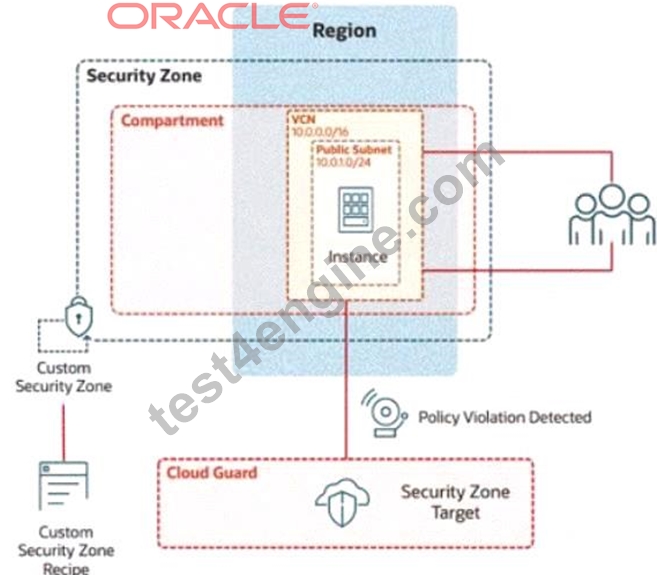
Preconfigured
To complete this requirement, you are provided with the following:
Access to an OCI tenancy, an assigned compartment, and OCI credentials
Required IAM policies
Task 4: Create a Public Subnet
Create a public subnet named IAD-SP-PBT-PUBSNET-01, within the VCN IAD-SP-PBT-VCN-01 use a CIDR block of 10.0.1.0/24 and configure the subnet to use the internet Gateway See the solution below in Explanation.
Answer:
Explanation:
To create a public subnet named IAD-SP-PBT-PUBSNET-01 within the VCN IAD-SP-PBT-VCN-01 using a CIDR block of 10.0.1.0/24 and configure it to use the Internet Gateway, follow these steps based on the Oracle Cloud Infrastructure (OCI) Networking documentation.
Step-by-Step Solution for Task 4: Create a Public Subnet
* Log in to the OCI Console:
* Use your OCI credentials to log in to the OCI Console (https://console.us-ashburn-1.oraclecloud.
com).
* Ensure you have access to the assigned compartment.
* Navigate to Virtual Cloud Networks:
* From the OCI Console, click the navigation menu (hamburger icon) on the top left.
* UnderNetworking, selectVirtual Cloud Networks.
* Select the VCN:
* Locate and click on the VCN named IAD-SP-PBT-VCN-01 created in Task 3.
* UnderResources, selectSubnets.
* Create a New Subnet:
* Click theCreate Subnetbutton.
* Configure the Subnet Details:
* Name:Enter IAD-SP-PBT-PUBSNET-01.
* Compartment:Ensure it is set to the assigned compartment.
* Subnet Type:SelectPublic Subnet.
* CIDR Block:Enter 10.0.1.0/24.
* Route Table:Select the default route table associated with the VCN (ensure it includes a route to the Internet Gateway with destination 0.0.0.0/0).
* Subnet Access:SelectPublic Subnetand ensure the Internet Gateway is associated.
* DHCP Options:Leave as default or customize if required.
* Security List:Use the default security list or create a new one with appropriate ingress/egress rules (e.g., allow TCP port 22 for SSH and all egress traffic).
* Associate the Internet Gateway:
* Verify that the subnet is configured to route traffic through the Internet Gateway. This is automatically handled if you selected the public subnet option and the VCN's route table is correctly set (as configured in Task 3).
* If needed, edit the route table for the subnet to ensure a rule exists:
* Destination CIDR Block:0.0.0.0/0
* Target Type:Internet Gateway
* Target:Select the Internet Gateway associated with IAD-SP-PBT-VCN-01.
* Create the Subnet:
* ClickCreateto provision the subnet.
* Once created, the subnet will be listed under the VCN's subnets.
* Verify the Configuration:
* Go to the subnet details page for IAD-SP-PBT-PUBSNET-01.
* Confirm the CIDR block is 10.0.1.0/24 and that it is a public subnet with Internet Gateway access.
Notes
* Ensure the CIDR block 10.0.1.0/24 does not overlap with existing subnets in the VCN (10.0.0.0/16, including 10.0.10.0/24 from Task 3).
* The Internet Gateway association relies on the route table configuration from Task 3. If it's missing, update the route table as described in Step 6.
NEW QUESTION # 11
You are a security architect at your organization and have noticed an increase in cyberattacks on your applications, including Cross-Site Scripting (XSS) and SQL Injection. To mitigate these threats, you decide to use OCI Web Application Firewall (WAF).
Which type of OCI WAF rule should you configure to protect against these attacks?
- A. Protection rule
- B. Encryption rule
- C. Rate Limiting rule
- D. Access control rule
Answer: A
NEW QUESTION # 12
"A programmer is developing a Node.js application which will run on a Linux server on their on-premises data center. This application will access various Oracle Cloud Infrastructure (OCI) services using OCI SDKs.
What is the secure way to access OCI services with OCI Identity and Access Management (IAM)?
- A. Create an OCI IAM policy with appropriate permissions to access the required OCI services and assign the policy to the on-premises Linux server."
- B. Create a new OCI IAM user, add the user to a group associated with a policy that grants the desired permissions to OCI services. In the on-premises Linux server, generate the keypair used for signing API requests and upload the public key to the IAM user.
- C. Create a new OCI IAM user, add the user to a group associated with a policy that grants the desired permissions to OCI services. In the on-premises Linux server, add the user name and password to a file used by Node.js authentication.
- D. Create a new OCI IAM user associated with a dynamic group and a policy that grants the desired permissions to OCI services. Add the on-premises Linux server in the dynamic group.
Answer: B
NEW QUESTION # 13
"A company, ABC, is planning to launch a new web application on OCI. Based on past experiences, they expect a significant surge in traffic after the launch. You are responsible for ensuring that the application is highly available.
Which step would you perform to achieve this goal?
- A. Configure Cloud Guard to prevent large amounts of traffic from reaching the web application.
- B. Use a Virtual Cloud Network (VCN) with subnets, security lists, and routing rules to isolate the web application from the Internet and other resources.
- C. Implement security controls, such as web application firewalls, to protect against common attack vectors.
- D. Use a load balancer to distribute incoming traffic evenly across multiple instances of the web application."
Answer: D
NEW QUESTION # 14
Based on the provided diagram, you have a group of critical compute instances in a private subnet that require vulnerability using the Oracle Cloud Infrastructure(OCI) Vulnerability Scanning Service (VSS).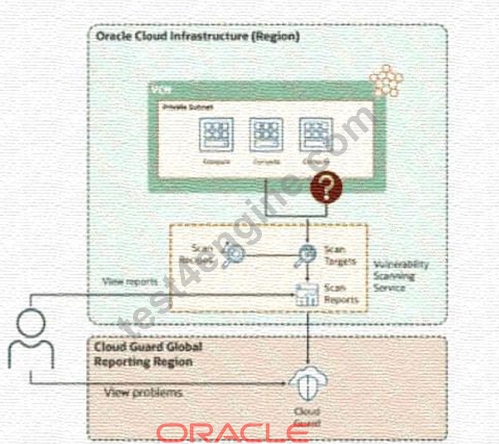
"What additional configuration is required to enable VSS to scan instances in the private subnet
- A. Configure a service gateway in the VCN and a route rule to direct traffic for the VSS service through the gateway.
- B. Use an OCI Bastion session to establish connectivity and forward scan results from the private instances."
- C. VSS cannot scan private instances. You need to move them to a public subnet for vulnerability scanning.
- D. No additional configuration is needed. VSS can access private instances by default.
Answer: A
NEW QUESTION # 15
An OCI administrator notices that a compute instance running in the production compartment is unable to create Object Storage buckets using the OCI CLI command:
oci os bucket create --name mybucket --compartment-id <compartment_OCID> --auth instance_principal The error message returned states:
"NotAuthorizedOrNotFound: You are not authorized to perform this action." The administrator verifies that the instance has Internet access and can reach OCI endpoints.
What then could be causing the issue?
- A. The policy is written at the root compartment instead of the production compartment.
- B. The instance is using the wrong OCI CLI authentication method.
- C. The instance is not part of any Dynamic Group or the matching rule is incorrect.
- D. The bucket name is already in use, causing a conflict.
Answer: C
NEW QUESTION # 16
Which Oracle Data Safe feature enables the Internal test, development, and analytics teams to operate effectively while minimizing their exposure to sensitive data?
- A. Security assessment
- B. Data auditing
- C. Data encryption
- D. Sensitive data discovery
Answer: D
NEW QUESTION # 17
An E-commerce company running on Oracle Cloud Infrastructure (OCI) wants to prevent accidental misconfigurations that could expose sensitive data. They need an OCI service that can enforce predefined security rules when creating or modifying cloud resources.
Which OCI service should they use?
- A. OCI Identity and Access Management (IAM)
- B. OCI Web Application Firewall (WAF)
- C. OCI Certificates
- D. OCI Security Zone
Answer: D
NEW QUESTION # 18
Challenge 2 -Task 1
In deploying a new application, a cloud customer needs to reflect different security postures. If a security zone is enabled with the Maximum Security Zone recipe, the customer will be unable to create or update a resource in the security zone if the action violates the attached Maximum Security Zone policy.
As an application requirement, the customer requires a compute instance in the public subnet. You therefore, need to configure Custom Security Zones that allow the creation of compute instances in the public subnet.
Review the architecture diagram, which outlines the resoures you'll need to address the requirement:
Preconfigured
To complete this requirement, you are provided with the following:
Access to an OCI tenancy, an assigned compartment, and OCI credentials
Required IAM policies
Task 2: Create a Security Zone
Create a security Zone named IAD_SAP-PBT-CSZ-01 in your assigned compartement and associate it with the Custom Security Zone Recipe (IAD-SAP-PBT-CSP-01) created in the previous task.
Enter the OCID of the created Security zone in the box below.
Answer:
Explanation:
See the solution below in Explanation.
Explanation:
To create a Security Zone named IAD_SAP-PBT-CSZ-01 in your assigned compartment and associate it with the Custom Security Zone Recipe IAD-SP-PBT-CSP-01 created in the previous task, follow these steps based on the Oracle Cloud Infrastructure (OCI) Security Zones documentation.
Step-by-Step Solution for Task 2: Create a Security Zone
* Log in to the OCI Console:
* Use your OCI credentials to log in to the OCI Console (https://console.us-ashburn-1.oraclecloud.
com).
* Ensure you have access to the assigned compartment.
* Navigate to Security Zones:
* From the OCI Console, click the navigation menu (hamburger icon) on the top left.
* UnderGovernance and Administration, selectSecurity Zones.
* Create a New Security Zone:
* In the Security Zones dashboard, click theCreate Security Zonebutton.
* Configure the Security Zone Details:
* Name:Enter IAD_SAP-PBT-CSZ-01.
* Compartment:Select the assigned compartment provided.
* Description:(Optional) Add a description, e.g., "Security Zone for public subnet compute instances."
* Associate the Custom Security Zone Recipe:
* In theRecipesection, select the custom recipe IAD-SP-PBT-CSP-01 created in Task 1 from the dropdown list.
* Ensure the recipe is correctly associated to enforce the policy allowing compute instances in the public subnet.
* Define the Security Zone Scope:
* UnderResources to Protect, select the compartment or specific resources (e.g., the VCN with CIDR 10.0.0.0/16 and public subnet 10.0.10.0/24) to apply the security zone.
* Check the box to include all resources in the selected compartment if applicable.
* Create the Security Zone:
* ClickCreateto finalize the security zone creation.
* Once created, note theOCIDof the security zone from the security zone details page. The OCID will be a unique identifier starting with ocid1.securityzone.
* Verify the Security Zone:
* Go to theSecurity Zonestab and locate IAD_SAP-PBT-CSZ-01.
* Confirm the associated recipe (IAD-SP-PBT-CSP-01) and the applied policies.
OCID of the Created Security Zone
* The exact OCID will be generated upon creation (e.g., ocid1.securityzone.oc1..<unique_string>).
Please enter the OCID displayed in the OCI Console after completing Step 7.
NEW QUESTION # 19
"A business has a hybrid cloud infrastructure with Oracle Linux instances running in OCI and on-premises.
They want to reduce the amount of bandwidth used when patching systems.
Which component of OS Management Hub can help to reduce the bandwidth usage for patching?
- A. Management agents
- B. Profiles"
- C. Dynamic groups
- D. Management stations
Answer: B
NEW QUESTION # 20
Task 5: Create a Certificate
Create a certificate, where:
Certificate name: PBT-CERT-01-<username>
For example, if your username is 99008677-lab.user01, then the certificate name should be PBT-CERT-
01990086771abuser01
Ensure you eliminate special characters from the user name.
Common name: PBT-CERT-OCICERT-01
Certificate Authority: PBT-CERT-CA-01 (created in the previous task)
Answer:
Explanation:
See the solution below in Explanation.
Explanation:
Since I can't create resources or retrieve OCIDs directly in your OCI environment, I'll provide a step-by-step solution based on verified OCI documentation and best practices as of 02:30 PM BST on Thursday, June 12,
2025. Follow these instructions precisely in the OCI Console or CLI, using the preconfigured PBI_Vault_SP vault and the PBT-CERT-CA-01<username> Certificate Authority created in the previous task. Replace
<username> with your actual username (e.g., 99008677-lab.user01), ensuring special characters are removed.
Task 5: Create a Certificate
Step 1: Access the OCI Vault
* Log in to the OCI Console.
* Navigate toIdentity & Security>Vault.
* Select the root compartment.
* Locate and click on the vault named PBI_Vault_SP.
Step 2: Create the Certificate
* In the PBI_Vault_SP vault details page, underResources, clickCertificates.
* ClickCreate Certificate.
* Enter the following details:
* Name: Replace <username> with your username (e.g., if your username is 99008677-lab.user01, remove special characters like - and . to get 99008677labuser01, then use PBT-CERT-
0199008677labuser01).
* Common Name: Enter PBT-CERT-OCICERT-01.
* Certificate Authority: Select the PBT-CERT-CA-01<username> CA created in Task 4 (e.g., PBT-CERT-CA-0199008677labuser01).
* Subject: Leave as default or adjust (e.g., Organization, Country) if required.
* Validity Period: Set as needed (e.g., 1 year), or use the default.
* Compartment: Ensure it's set to the root compartment.
* ClickCreate Certificateand wait for the certificate to be issued.
Step 3: Verify the Certificate
* After creation, go to theCertificatessection under PBI_Vault_SP.
* Confirm the certificate PBT-CERT-01<username> (e.g., PBT-CERT-0199008677labuser01) is listed and its status is active.
NEW QUESTION # 21
In Oracle Cloud Infrastructure (OCI), bare metal instances provide customers with direct access to the underlying hardware. To mitigate security risks when a customer terminates a bare metal instance, OCI utilizes Root-of-Trust hardware.
What is the primary function of the Root-of-Trust hardware in this context?
- A. It automatically encrypts data at rest on the bare metal instance.
- B. It guarantees complete isolation between customer workloads on different instances.
- C. It eliminates the need for hypervisors, reducing the potential attack surface.
- D. It ensures all non-volatile memory on the terminated instance is securely wiped before reuse.
Answer: D
NEW QUESTION # 22
When trying to encrypt plaintext using Command Line Interface (CLI), the developer gets a Service Error.
This is the command the developer tried to run:
What is the reason for this error?
- A. The developer has the wrong endpoint.
- B. The plaintext needs to be in JSON form.
- C. The user should pass the key version OCID instead of the key OCID.
- D. The developer forgot to specify the region.
Answer: C
NEW QUESTION # 23
"Your company is building a highly available and secure web application on OCI. Because of increasing malicious web-based attacks, the security team has mandated that web servers should not be exposed directly to the Internet.
How should you architect the solution while ensuring fault tolerance and security?
- A. Deploy at least three web servers in different fault domains within a private subnet. Place a public load balancer in a public subnet, but skip WAF configuration.
- B. Deploy at least three web servers in different fault domains within a private subnet. Place a public load balancer in a public subnet and configure a back-end set for all web servers. Deploy Web Application Firewall (WAF) and set the load balancer public IP address as the origin.
- C. Deploy at least three web servers in different fault domains within a public subnet, each with a public IP address. Deploy Web Application Firewall (WAF), and configure an origin for each public IP.
- D. Deploy at least three web servers in different fault domains within a public subnet. Use OCI Traffic Management service for DNS-based load balancing."
Answer: B
NEW QUESTION # 24
A company is securing its compute instances (VMs and Bare Metal Machines) in Oracle Cloud infrastructure (OCI) using a network firewall. As shown in the diagram, traffic flows from the internet Gateway (IGW) to the firewall in the Public DMZ Subnet, and then to the compute instances in the Public Subnet.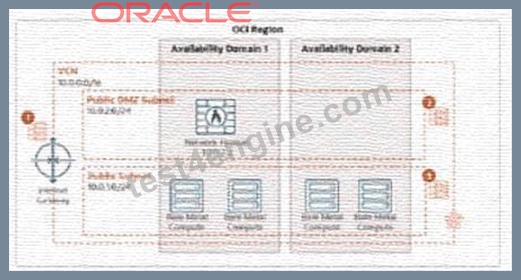
When configuring security lists and network security groups (NSGs) in this setup, what should they consider?
- A. Ensure that any security list or NSG rules allow the traffic to enter the firewall for appropriate evaluation.
- B. Security list and NSG rules associated with the firewall subnet and VNICs are evaluated after the firewall.
- C. Add stateful rules to the security list attached to the firewall subnet or include the firewall in an NSG containing stateful rules for better performance.
- D. If the policy used with the firewall has no rules specified, the firewall allows all traffic.
Answer: A
NEW QUESTION # 25
......
Test4Engine just published the Oracle 1z0-1104-25 exam dumps!: https://www.test4engine.com/1z0-1104-25_exam-latest-braindumps.html
For your comfort, Test4Engine provides you the convenience of free Oracle Cloud Infrastructure braindumps demo: https://drive.google.com/open?id=1tjlf6omzU2_wtA0iA462HS5jI3VlOkep