


CIS-DF Dumps Free Test Engine Player Verified Updated [Sep 09, 2026]
Q&As with Explanations Verified & Correct Answers
NEW QUESTION # 20
A CMDB Administrator has imported data into the ServiceNow CMDB from a third-party source by using a Service Graph Connector. The Administrator wants to review specific field-to-field mappings for the import.
Which feature shows this information?
- A. IntegrationHub ETL
- B. CMDB Integrations Dashboard
- C. Integration Hub
Answer: B
Explanation:
The CMDB Integrations Dashboard provides visibility into integrations that populate the CMDB, including Service Graph Connector activity and mapping information. It enables administrators to inspect how source data is mapped to ServiceNow target classes and fields, review connector execution information, and investigate ingestion or mapping problems.
Service Graph Connectors are prebuilt, governed integrations that import third-party data into the CMDB through standardized class mappings and IRE processing. They are intended to minimize custom transformations and preserve source and reconciliation information. The guide describes Service Graph Connectors as upgrade-safe integrations that ingest external data while applying Identification and Reconciliation Engine controls.
Integration Hub is the broader integration and automation framework, not the specific dashboard for reviewing Service Graph Connector field mappings. IntegrationHub ETL is a separate tool for building and managing ETL transformations. It does not serve as the inspection dashboard for mappings belonging to an installed Service Graph Connector.
Therefore, B is correct.
NEW QUESTION # 21
An organization needs to ensure that when a parent CI's Life Cycle Stage changes, the Life Cycle Stage of its child CIs is updated automatically.
What action should the organization take?
- A. Use a Transform Map to update Life Cycle Stage statuses.
- B. Create a new CI class for Life Cycle Stage management.
- C. Use CMDB Data Manager to configure Life Cycle Stage automation.
Answer: C
Explanation:
CMDB Data Manager provides policy-driven lifecycle governance for configuration items. The organization should configure Life Cycle Stage automation in Data Manager so that a qualifying lifecycle change on a parent CI is propagated consistently to the relevant child CIs.
This approach creates a controlled and auditable lifecycle process. It avoids relying on custom scripts or disconnected import logic and ensures that lifecycle transitions are applied according to defined conditions and CI relationships.
A Transform Map is intended to transform and import source data. It is not the appropriate mechanism for continuously cascading lifecycle changes between related CIs. Creating a new CI class would also be incorrect because lifecycle management is a behaviour applied to existing CI classes rather than a separate CI type.
CMDB Data Manager is specifically designed to automate CI lifecycle activities such as retirement, archival, deletion, certification, and attestation. Therefore, Data Manager lifecycle automation is the governed solution.
NEW QUESTION # 22
When integrating data into the CMDB using Import Sets and Transform Maps, which type of script is added to ensure the data is processed through the Identification and Reconciliation Engine (IRE)?
- A. onStart
- B. onBefore
- C. onAfter
- D. onComplete
Answer: C
Explanation:
When using Import Sets and Transform Maps to ingest data into the CMDB, it is critical that records are processed through the Identification and Reconciliation Engine (IRE) to prevent duplicates and enforce source precedence. In ServiceNow, this is achieved by invoking the IRE after the transform logic has completed.
The onAfter transform script is the correct place to call the IRE API. At this stage, the transformed data has already been mapped and prepared, allowing the IRE to correctly identify whether a CI already exists and reconcile updates according to defined rules.
The onBefore and onStart scripts execute too early--before data mapping is complete--making them unsuitable for IRE processing. The onComplete script runs after the entire import job finishes and is not intended for per-record CI identification and reconciliation.
Because Import Sets can bypass IRE if not configured correctly, using an onAfter script is a critical Data Foundations safeguard when this ingestion method is chosen.
NEW QUESTION # 23
The CMDB Administrator has set up two Dynamic Reconciliation Rules within the ServiceNow Production Instance. The ' Server ' class has a Dynamic Reconciliation Rule of largest value for the RAM field. The ' Windows Server ' class has a Dynamic Reconciliation Rule of most reported for the RAM field.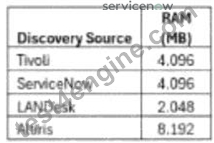
Given the above data in Multisource CMDB, which value is added to the CMDB for RAM for a Server CI?
- A. 4,096 MB
- B. 8,192 MB
- C. 2,048 MB
Answer: B
Explanation:
This question hinges on understanding class-specific Dynamic Reconciliation Rules in CMDB 360 / Multisource CMDB within ServiceNow.
Although two different dynamic rules are configured, the rule applied depends on the CI class being evaluated:
For the Server class, the configured rule is Largest value for the RAM attribute.
For the Windows Server class, the rule Most reported would apply-but only if the CI were evaluated as a Windows Server.
The question explicitly asks for the resulting RAM value for a Server CI, not a Windows Server CI.
Therefore, the Largest value rule governs the outcome.
Looking at the multisource values:
2,048 MB (LANDesk)
4,096 MB (Tivoli)
4,096 MB (ServiceNow)
8,192 MB (Altiris)
Under the Largest value dynamic reconciliation rule, the IRE selects the maximum numeric value, regardless of how frequently it is reported or which source provided it.
The Most reported logic (which would result in 4,096 MB) does not apply here because that rule is configured for a different class (Windows Server).
This scenario illustrates an important CMDB 360 principle: Dynamic reconciliation is evaluated per class, and child-class rules do not override parent-class rules unless the CI is actually classified under that child class.
NEW QUESTION # 24
The CMDB Configuration Management team has successfully developed a healthy and trusted CMDB. They have integrated discovered infrastructure data, accurately referenced non-discoverable data (such as change and support group information), and made the CMDB service-aware using Service Mapping.
Which field on anIncident formis automatically populated after a CI is selected that references an appropriate support group?
- A. Support Group
- B. Change Group
- C. Approval Group
- D. Managed by Group
- E. Assignment Group
Answer: E
Explanation:
In a mature CMDB implementation withinServiceNow, CI operational attributes are leveraged toautomate ITSM workflows. One of the most important outcomes of accurate Configuration Management isautomatic incident routing.
When a CI is selected on an Incident record, ServiceNow evaluates the CI'sSupport Groupattribute. If populated correctly, the platform automatically copies this value into theAssignment Groupfield on the Incident. This ensures incidents are routed to the correct resolver group without manual triage, reducing mean time to resolution (MTTR).
TheSupport Groupis a CI attribute, not an incident field that drives workflow directly. TheAssignment Groupis the operational field used by Incident Management to assign ownership. Managed by Group, Approval Group, and Change Group are used in other governance and lifecycle contexts and are not auto- populated during incident creation.
This behavior is a direct result of Data Foundations best practices: maintaining accurate CI-to-support-group relationships to enableautomation and consistencyacross ITSM processes.
Therefore, the correct answer isC - Assignment Group.
NEW QUESTION # 25
Which roles must be assigned to a user who will either configure CMDB Data Manager or work on tasks generated by CMDB Data Manager?
(Choose two options.)
- A. data_manager_user
- B. data_manager_admin
- C. cmdb_dm_user
- D. cmdb_dm_admin
Answer: C,D
Explanation:
The two applicable roles are cmdb_dm_admin and cmdb_dm_user . The administrative role provides permission to configure, publish, and manage CMDB Data Manager policies. These policies govern activities such as attestation, certification, retirement, archival, and deletion of CI records.
The user role provides access to the operational work generated by those policies. Assigned users can review and complete applicable Data Manager tasks through the My Work tab in CMDB Workspace.
The alternative role names data_manager_user and data_manager_admin do not represent the CMDB Data Manager roles tested in this question. The distinction is important: policy administrators configure governance controls in the Management area, while task users act on the resulting assignments. CMDB Data Manager therefore separates policy administration from task execution through these two roles.
=========
NEW QUESTION # 26
Drag and Drop Question
ACMDB Administrator seeks to understand the available tools for preventing addressing, and remediating duplicate CIs Drag and drop each feature with the corresponding outcome Some options may not apply.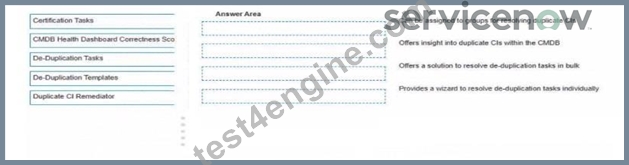
Answer:
Explanation: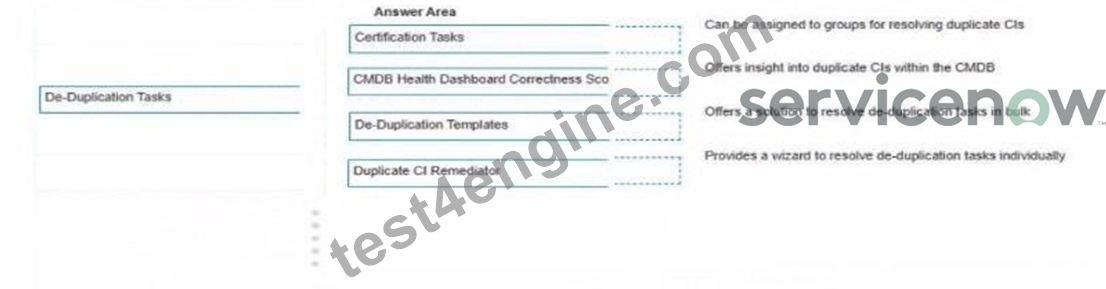
Explanation:
In ServiceNow, duplicate CI management spans detection, insight, and remediation:
The CMDB Health Dashboard Correctness surfaces where duplicates exist and their impact, providing visibility and prioritization.
Certification Tasks support governed resolution, allowing assignment to individuals or groups to validate and correct data.
De-duplication Templates enable bulk remediation, ideal when standardized merge rules can be applied across many duplicates.
The Duplicate CI Remediator offers a guided, record-by-record wizard, preserving relationships and history for safer individual resolutions.
De-duplication Tasks are the work items generated by these processes, but they do not themselves represent an outcome--hence not applicable.
This mapping aligns with CMDB Data Foundations best practices, ensuring duplicates are identified, prioritized, and remediated efficiently and safely.
NEW QUESTION # 27
A customer wants their Business Services tied directly to infrastructure CIs without Application Services. This violates which CSDM principle?
- A. All services must be technical
- B. Foundation data should not reference CIs
- C. Business Services must not depend directly on infrastructure
- D. Avoid CI relationships
Answer: C
Explanation:
In CSDM, Business Services should depend on Application Services, not directly on infrastructure. This ensures proper service abstraction and layered modeling.
NEW QUESTION # 28
A Configuration Manager wants to use the Unified Map.
Where would it be accessed?
- A. CI Class Manager
- B. CMDB Data Manager
- C. CMDB Workspace
Answer: C
Explanation:
In Data Foundations, "insight" focuses on turning trusted configuration data into clear visual understanding--so teams can assess relationships, troubleshoot impact, and validate service context. Unified Map supports this by providing a graphical view of CIs and their relationships, combining strengths of traditional dependency views and service-mapping-style visualization into a single, consistent map experience.
Unified Map is accessed from CMDB Workspace, typically via a Quick Links entry (and in some experiences, also from relevant CI/service contexts). This location makes sense in the Data Foundations model because CMDB Workspace is the central place where configuration and service data is explored, validated, and used for operational decision-making--exactly what mapping relationships is meant to enable.
NEW QUESTION # 29
Which ServiceNow solutions create automatic relationships? (Choose 2 options)
- A. IntegrationHub ETL
- B. Service Mapping
- C. Discovery
- D. Workflow Studio
Answer: B,C
Explanation:
Automatic relationship creation is fundamental to maintaining a service-aware and trustworthy CMDB. In ServiceNow, this capability is primarily delivered by Discovery and Service Mapping.
Discovery (Option C) automatically identifies infrastructure components--such as servers, network devices, and storage--and creates technical relationships between them (for example, "runs on,"
"connected to," or "depends on"). These relationships form the backbone of infrastructure dependency mapping.
Service Mapping (Option B) builds on Discovery by creating application- and service-level relationships. It maps how application components interact across servers, databases, and middleware, resulting in accurate Application Service models aligned with CSDM. These relationships are created and maintained automatically as the environment changes.
NEW QUESTION # 30
(Choose 2 options)
A Change Manager wants to gain value fromCSDM.
How will theChange Managementprocess benefit from CSDM?
- A. Route the change dynamically
- B. Understand the impact of the change on services
- C. Identify blackout windows
- D. Determine the root cause of the change issue
Answer: B,C
Explanation:
CSDM significantly enhancesChange Managementby providingservice-aware context, enabling better planning, risk assessment, and stakeholder communication.
One key benefit is the ability toidentify blackout windows(Option A). Through CSDM-alignedBusiness Services, Service Offerings, and service calendars, Change Managers can clearly see when services are unavailable for change due to business constraints, regulatory requirements, or peak usage periods. This helps prevent changes from being scheduled during high-risk windows.
Another critical benefit is the ability tounderstand the impact of the change on services(Option D). CSDM establishes clear relationships between infrastructure CIs, Application Services, and Business Services. When a change is proposed, these relationships enable accurateimpact analysis, allowing Change Managers to assess risk based on business criticality rather than just technical scope.
Option B (root cause determination) is primarily aProblem Managementfunction. Option C (dynamic routing of changes) is driven by workflow and approval logic, not directly by CSDM.
Therefore, the correct answers areA - Identify blackout windowsandD - Understand the impact of the change on services.
NEW QUESTION # 31
A CMDB Administrator is comparing the Unified Map to the Service Mapping map.
What are additional capabilities of the Unified Map? (Choose Two)
- A. Number of levels displayed on a map can be modified
- B. Map can be zoomed in and out
- C. Map nodes can be filtered based on user preferences
- D. Visibility to an application and the host it is installed on
Answer: B,C
NEW QUESTION # 32
A healthcare provider faces a critical incident affecting itspatient management system. The provider needs to identify theusers impactedto mitigate disruption effectively.
WhichCSDM-related datashould they leverage?
- A. Service Offerings by Department or Location
- B. Affected CI [task_ci] related list
- C. Incident history of similar CIs
- D. Service environment attribute
Answer: A
Explanation:
In a healthcare environment, identifyingwho is impactedduring a critical incident is essential to patient safety and continuity of care. Within theCommon Service Data Model (CSDM), the most effective way to determine impacted users is throughService Offerings, particularly when they are definedby department or location.
Service Offeringsrepresent how a service is consumed by specific user groups. In this case, a patient management system may have different offerings for departments such as Emergency, Inpatient Care, or Outpatient Services, or be scoped by hospital location. These offerings explicitly defineconsumer context, allowing incident responders to immediately identify which clinicians, staff, or facilities are affected.
Option D (Affected CI related list) identifies technical impact but does not translate that impact intouser or consumer context. Option A provides historical insight but does not identify current impacted users. Option C (service environment) helps differentiate production vs non-production but does not identifywhois impacted.
By leveragingService Offerings by Department or Location, the provider can quickly notify the right users, prioritize response based on clinical impact, and coordinate mitigation effectively-aligning with CSDM and ITIL best practices.
Therefore, the correct answer isB - Service Offerings by Department or Location.
NEW QUESTION # 33
A Configuration Manager needs to leverage a policy type toautomate the creation and assignment of tasks to validate the existence of CIs.
Which policy type should be used to accomplish this goal?
- A. Certification
- B. Delete
- C. Retire
- D. Attestation
Answer: D
Explanation:
InServiceNow, validating whether Configuration Items (CIs) still exist is a coreCMDB governanceactivity.
Over time, environments change rapidly-servers are decommissioned, cloud resources are torn down, and applications are replaced. If existence validation is not enforced, the CMDB quickly fills with obsolete or
"ghost" CIs.
Attestation policiesare specifically designed to address this need. An attestation policy automatically generates and assigns tasks to responsible users or groups, asking them toconfirm that a CI still exists and is still relevant. This process focuses on acknowledgment rather than deep data validation, making it lightweight and scalable across large CMDBs.
Certification policies (Option A) are used whenspecific attributes must be validated, such as lifecycle status, support group, or environment. While important for data correctness, certification is not intended solely to confirm CI existence. Delete (Option B) and Retire (Option C) policies are lifecycle actions that remove or transition records, but they do not validate existence before taking action.
Attestation integrates cleanly with CMDB Workspace, assigns tasks automatically, and supports auditability- ensuring accountability for CI ownership. This makes it the correct and Data Foundations-aligned policy type for validating CI existence.
Therefore,Option D - Attestationis the correct answer.
NEW QUESTION # 34
A CMDB Administrator, viewing the CMDB Data Foundations Dashboard, notices the Unique Locations Result percentage is low.
What is the recommended process from the associated playbook to correct this issue?
- A. Review both locations, update CIs with the correct location, and delete the duplicate location
- B. Keep both locations as either can be used as a valid alternate location
- C. Retain the location that matches the organization's standard naming convention, and delete the duplicate without further validation
- D. Use the Duplicate CI Remediator to merge the duplicate location records
Answer: A
Explanation:
In Data Foundations, a low "Unique Locations" result indicates the CMDB contains duplicate Location records (or inconsistent location usage) that reduce data reliability for operational reporting and service analytics. This sits under "Insight" because the dashboard is highlighting a measurable quality issue, and the playbook provides a structured remediation path to restore confidence.
The recommended playbook-aligned process is to review the duplicate locations, determine which one is correct per the organization's naming and data standards, then re-point dependent records (CIs) to the correct Location before removing the duplicate. That sequence is essential: if you delete a duplicate location without first updating related CIs, you risk leaving CIs with missing/invalid location references, creating new completeness and correctness issues.
Option C matches best practice: validate which location record should remain, update all affected CIs (and any other dependent records) to use the correct location, and then delete (or retire/merge, depending on process controls) the duplicate record. Option B is risky because it skips validation and dependency updates.
Option D defeats the purpose of "Unique Locations" by allowing ongoing inconsistency. Option A is not the best fit because "Duplicate CI Remediator" is oriented toward CI duplicates; Location is typically a reference
/organization data domain and is handled through the specific remediation steps for that data set. Therefore, C is the recommended process.
NEW QUESTION # 35
A customer's CMDB is aligned to the CSDM Walk stage.
What benefit is provided by the CMDB?
- A. Allows for additional stratification of technical teams' support structure along the lines of OLAs and commitments
- B. Improves the implementation velocity of APM Foundation for future business application rationalization
- C. Enables impact assessments for incident, problem, and change on Business Services
Answer: C
NEW QUESTION # 36
A Configuration Manager needs to ensure that each device in the CMDB has a unique serial number to reduce the risk of creating duplicate CIs.
Which management tool is used to identify CIs that do not have serial numbers?
- A. CMDB Data Foundations Dashboard
- B. CI Class Manager
- C. CSDM Data Foundations Dashboard
- D. CMDB Data Manager
Answer: A
Explanation:
The CMDB Data Foundations Dashboard identifies foundational CMDB data-quality deficiencies, including hardware CIs that lack important identification attributes such as serial numbers. A missing serial number is particularly serious because serial number is commonly included in Hardware identification rules.
Without it, Discovery and external integrations may fail to match an incoming device to its existing record, resulting in duplicate CIs.
The dashboard exposes the affected population and provides remediation playbooks that help administrators analyse the responsible data sources, correct existing records, and establish controls to ensure that serial numbers continue to be populated.
CI Class Manager is used to configure class structures and identification rules, but it is not the dashboard used to locate the full population of affected CIs. CMDB Data Manager governs lifecycle policies, while the CSDM dashboard focuses on service-model alignment.
=========
NEW QUESTION # 37
What is the relationship between an Application and a Server?
- A. Application > Runs::Runs On > Server
- B. Application > Used by::Uses > Server
- C. Application > Runs on::Runs > Server
- D. Application > Uses::Used by > Server
Answer: C
Explanation:
In Data Foundations (CMDB and CSDM), relationship modeling must reflect real operational dependency so that incident triage, change impact analysis, and service visibility remain accurate. When an Application is hosted on a Server, the standard hosting-style relationship used in CMDB relationship governance is expressed as "Runs on::Runs". This pairing represents the two directional descriptors of the same relationship type: from the application perspective it runs on the server, and from the server perspective it runs the application.
This matters because CMDB relationships are used by downstream capabilities (for example, dependency views, impact calculations, and governance rules). Using the correct out-of-box relationship descriptor pair ensures consistent reporting and prevents confusion when teams traverse relationships "upstream" and
"downstream." In addition, relationship governance rules and inheritance are commonly built around standard relationship types; using the correct "Runs on::Runs" semantics supports validation across subclasses (for example, specific application and server subclasses) without requiring custom relationship definitions.
The other options are either reversed ("Runs::Runs On"), represent different semantics ("Uses::Used by"), or do not align with the typical hosting relationship naming used for application-to-server hosting dependencies.
Therefore, the correct relationship expression between an Application and a Server is Application > Runs on::
Runs > Server.
NEW QUESTION # 38
......
Verified CIS-DF dumps Q&As Latest CIS-DF Download: https://www.test4engine.com/CIS-DF_exam-latest-braindumps.html