


[Apr-2024] PDII Exam Dumps, PDII Practice Test Questions
Attested PDII Dumps PDF Resource [2024]
The PDII certification is highly valued in the Salesforce ecosystem as it demonstrates a high level of technical expertise and experience in developing complex applications on the Salesforce platform. It is also a prerequisite for some of the more advanced Salesforce certifications, such as the Salesforce Technical Architect certification.
NEW QUESTION # 45
A developer needs to store variables to control the style and behavior of a Lightning Web Component.
Which feature can be used to ensure that the variables are testable in both Production and all Sandboxes?
- A. Custom metadata
- B. Custom setting
- C. Custom variable
- D. Custom object
Answer: A
NEW QUESTION # 46
A developer has created a Team Member sObject that has a Master-Detail relationship to a Project sObject and a Lookup relationship to the User sObject. The developer must ensure that a User listed on a Team Member record has Read-Write access to the parent Project record.
How can the developer accomplish this if the Project sObject has a Private sharing model and thousands of Project records?
- A. Create a Criteria-Based Sharing Rule on the Project sObject
- B. Create a Team Member Trigger that inserts Project_Share records
- C. Create a Controller that uses the Without Sharing keyword
- D. Create a Project Sharing Rule that shares to the Team Member Group
Answer: B
NEW QUESTION # 47
A company has reference data stored in multiple custom metadata records that represent default information and delete behavior for certain geographic regions.
When a contact is inserted, the default information should be set on the contact from the custom metadata records based on the contact's address information.
Additionally, if a user attempts to delete a contact that belongs to a flagged region, the user must get an error message.
Depending on company personnel resources, what are two ways to automate this?
Choose 2 answers
- A. Apex trigger
- B. Flow Builder
- C. Remote action
- D. Apex invocable method
Answer: A,B
Explanation:
To automate the process based on the contact's address information and prevent deletion from flagged regions:
Flow Builder: Can be used to set default information on records when they are created.
Apex Trigger: Allows for complex logic to be executed before or after data manipulation operations, including insert and delete. It can be used to enforce rules such as preventing deletion.
References:
Flow Builder: Salesforce Help Article
Apex Triggers: Apex Developer Guide
NEW QUESTION # 48
A Lightning Component functions in preview mode and needs to be used inside a Lightning App Builder page, but it is not available.
What change should be applied to the component?
- A. Expose it in the markup using the implements and access attributes.
- B. Look for errors in the logic in the JavaScript controller.
- C. Refresh the sandbox and upgrade it to the latest API version.
- D. Delete the component, metadata, and Apex controller and recreate them.
Answer: A
NEW QUESTION # 49
A developer created 2 class that implements the Queueable Interface, as follows:
As part of the deployment process, the developer is asked to create a corresponding test class.
Which two actions should the developer take to successfully execute the test class?
Choose 2 answers
- A. Enclose System.enqueueJob(new OrderQueueableJob ()] within Tess. and Test .stopTest (1.
- B. Implement seeAllData=True to ensure the Queueable job is able to run in bulk mode.
- C. Implement Test. isRunningTest() to prevent chaining jobs during test execution.
- D. Ensure the running user of the test class has, at I the View All permission on the Order object.
Answer: A,C
Explanation:
When writing a test class for a Queueable class in Salesforce, the goal is to ensure that the asynchronous code is executed within the test context and that it does not affect the state of the production org or depend on its data.
Option C is correct because using Test.startTest() and Test.stopTest() ensures that the asynchronous code is executed immediately within the test's context. This is essential for testing Queueable classes because it allows the test to wait for the asynchronous process to complete before assertions are made.
Without this, the asynchronous job would not necessarily run during the test execution.
Option D is correct because Test.isRunningTest() can be used within the Queueable class to prevent the chaining of jobs during test execution. Chaining queueable jobs can lead to governor limits being hit and is generally not allowed in test methods. This conditional check allows the developer to bypass sections of the code not suitable for a testing context.
Option A is incorrect because the seeAllData=True annotation is not required for testing Queueable classes, and it is not a best practice to depend on live data for tests. It's preferable to create test data within the test class itself.
Option B is incorrect because having the 'View All' permission on the Order object is not related to the successful execution of the Queueable class in tests. Permissions are typically not enforced in test contexts unless using System.runAs() to test with a specific user context.
References:
Salesforce Documentation on Queueable Apex: Queueable Apex
Salesforce Documentation on Testing Asynchronous Apex: Testing Asynchronous Apex
NEW QUESTION # 50
Consider the following code snippet: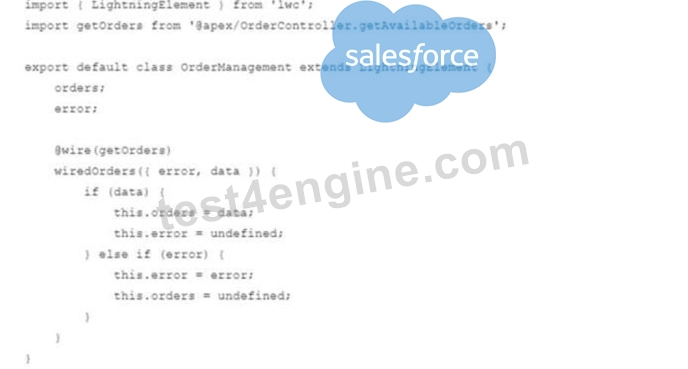
Choose 2 answers
- A. import { LightningElement, wire ) from 'lwc';
- B. import getOrders from ,@salesforce/apex/OrderController.getAvailableOrders';
- C. import getOrders from @salesforc/apex/c.OrderController.getAvailablOrders';
- D. import ( LightningElement-apt ) from 'lwc*.-
Answer: A,B
NEW QUESTION # 51
Universal Containers uses a custom Lightning page to provide a mechanism to perform a step-by-step wizard search for Accounts. One of the steps in the wizard is to allow the user to input text into a text field, ERP_Number__c, that is then used in a query to find matching Accounts.
A developer receives the exception 'SOQL query not selective enough.
Which step should be taken to resolve the issue?
- A. Mark the ERP_Number__c field as required.
- B. Move the SOQL query to within an asyncronous process.
- C. Mark the lRP_Number__c field as an external ID.
- D. Perform the SOQL query as part of a for loop.
Answer: C
NEW QUESTION # 52
A developer needs to send Account records to an external system for backup purposes. The process must take a snapshot of Accounts as they are saved and then make a callout to a RESTful web service. The web service can only receive, at most, one record per call. Which feature should be used to implement these requirements?
- A. Process Builder
- B. @future
- C. workflow
- D. Queueable
Answer: A
NEW QUESTION # 53
A business requires that every parent record must have a child record. A developer writes an Apex method with two DML statements to insert a parent record and a child record.
A validation rule blocks child records from being created. The method uses a try/catch block to handle the DML exception.
What should the developer do to ensure the parent always has a child record?
- A. Delete the parent record in the catch statement when an error occurs on the child record DML operation.
- B. Use addExror() on the parent record if an error occurs on the child record.
- C. Set a database savepoint to rollback if there are errors.
- D. Use Catabase.inserc() and set the all = parameter to true,
Answer: D
NEW QUESTION # 54
If a developer wanted to display error messages with the standard Salesforce UI styling, what would they use?
- A. <apex:outputText>
- B. <apex:error>
- C. <apex:message>
- D. <apex:pageMessages>
Answer: D
NEW QUESTION # 55
A developer wants to write a generic Apex method that will compare the Salesforce Name field between any two object records. For example, to compare the Name field of an Account and an Opportunity; or the Name of an Account and a Contact.
Assuming the Name field exists, how should the developer do this?
- A. Cast each object into an sObject and use sObject.get to compare the Name fields,
- B. Use a string. Replace () method to parse the contents of each Name field and then compare the results.
- C. describe) function to compare the values of each Name field.
- D. Use the Salesforce Metadata API to extract the value of each object and compare the Name fields.
Answer: A
Explanation:
The best way to write a generic Apex method that will compare the Salesforce Name field between any two object records is to cast each object into an sObject and use sObject.get to compare the Name fields. An sObject is a generic abstract type that can represent any object record, and it has methods to access and manipulate the fields of the record. The developer can use the sObject.get method to get the value of a field by passing the field name as a string parameter. The developer can then compare the values of the Name fields of the two sObject records using the == operator. Using the describe function to compare the values of each Name field will not work, as the describe function is used to get the metadata information about an object or a field, such as the label, the data type, or the picklist values, but it does not get the actual value of the field. Using the Salesforce Metadata API to extract the value of each object and compare the Name fields will not work, as the Salesforce Metadata API is used to retrieve and deploy the configuration and customization metadata of the org, such as the objects, fields, layouts, or workflows, but it does not retrieve or deploy the data records of the objects. Using a string.replace method to parse the contents of each Name field and then compare the results will not work, as the string.replace method is used to replace a substring within a string with another substring, but it does not extract the value of the field from the object record. Reference: [sObject Class], [Apex Developer Guide]
NEW QUESTION # 56
Where in a query can you use Geolocation and Distance? (Choose two.)
- A. Order By clause
- B. Filter clause
- C. Group By clause
- D. Select clause
Answer: A,B
NEW QUESTION # 57
A managed package uses a list of country ISO codes and country names as reference data in many different places from within the managed package Apex code.
What is the optimal way to store and retrieve the list?
- A. Store the information in Custom Metadata and query it with SOQL
- B. Store the information in a List Custom Setting and access it with the getAll() method
- C. Store the information in a List Custom Setting and query it with SOQL
- D. Store the information in Custom Metadata and access it with the getAll() method
Answer: B
Explanation:
Explanation/Reference: https://developer.salesforce.com/docs/atlas.en-us.apexcode.meta/apexcode/ apex_customsettings.htm
NEW QUESTION # 58
A developer is using a third-party JavaScript library to create a custom user interface in Visualforce. The developer needs to use JavaScript to get data from a controller method in response to a user action.
How can the developer accomplish this?
- A. Use <apex:actionFunction> to create a JavaScript wrapper for the controller method
- B. Use <apex:actionSupport> to enable JavaScript support for the controller method
- C. Use the $Controller global variable to access the controller method via JavaScript
- D. Use the @RemoteAction annotation on the method definition with JavaScript Remoting
Answer: D
NEW QUESTION # 59
A developer wishes to improve runtime performance of Apex calls by caching results on the client.
What is the best way to implement this?
- A. Decorate the server-side method with @AuraEnabled(storable=true).
- B. Set a cookie in the browser for use upon return to the page.
- C. Decorate the server-side method with @AuraEnabled(cacheable=true).
- D. Call the setStorable() method on the action in the JavaScript client-side code.
Answer: D
NEW QUESTION # 60
A developer gets an error saying 'Maximum Trigger Depth Exceeded.'
What is a possible reason to get this error message?
- A. A flow trigger was included too many times.
- B. There are numerous DML operations in the trigger logic.
- C. The SOQL governor limits are being hit.
- D. A trigger is recursively invoked more than 16 times.
Answer: D
NEW QUESTION # 61
A developer writes the following code:
While testing the code, the developer receives the following error message: System.CalloutException : You have uncommitted work pending What should the developer do? (Choose two.)
- A. Move the web service callout into an Cfuture method
- B. Use the asyncSend() method of the HTTP class to send the request in async context
- C. Ensure all callouts are completed prior to executing DML statements
- D. Use Database.insert (order, true) to immediately commit any database changes
Answer: A,C
NEW QUESTION # 62
Given the following code sample, what is a potential issue regarding bulk processing of records? trigger accountTestTrggr on Account (before insert, before update) Account acct = Trigger.new[0]; List <Contact> contacts = new List <Contact> ([select id, salutation, firstname, lastname,email from Contact where accountId
= :acct.Id]); for (Contact con: contacts) con.Title = 'Not Selected'; update contacts;
- A. The code will not execute because the list can be null and cause an exception.
- B. The code will have to be invoked multiple times to process all the records.
- C. The code will not execute because the record in the list can be null and cause an exception.
- D. The code will process one record that is called explicitly per execution.
Answer: B,D
NEW QUESTION # 63
Which statement is considered a best practice for writing bulk safe Apex triggers?
- A. Add LIMIT 50000 to every SOQL statement.
- B. Perform all DML operations from within a future method.
- C. Add records to collections and perform DML operations against these collections.
- D. Use the Database methods with allorNone set to £21s= instead of DML statements.
Answer: C
Explanation:
Bulk-safe triggers use collections to aggregate DML operations. This practice minimizes the number of DML statements, which is essential for bulk processing.References: Apex Developer Guide - Bulk Trigger Best Practices
NEW QUESTION # 64
The Bulk API...
- A. Is used to to create, retrieve, update or delete records, such as accounts, leads, and custom objects, and allows you to allows you to maintain passwords, perform searches, and much more
- B. Provides a powerful, convenient, and simple REST-based web services interface for interacting with Salesforce. Its advantages include ease of integration and development, and it's an excellent choice of technology for use with mobile applications and web projects
- C. Is used to to retrieve, deploy, create, update, or delete customizations for your org. The most common use is to migrate changes from a sandbox or testing org to your production environment
- D. Is based on REST principles and is optimized for loading or deleting large sets of data. You can use it to query, queryAll, insert, update, upsert, or delete many records asynchronously by submitting batches
Answer: D
NEW QUESTION # 65
......
To prepare for the exam, candidates should have a solid understanding of the Salesforce platform and its features, as well as experience in developing and deploying applications using Apex and Visualforce. Salesforce offers various study materials and resources, including online courses, study guides, and practice exams, to help candidates prepare for the PDII certification exam.
Latest PDII Actual Free Exam Questions Updated 198 Questions: https://www.test4engine.com/PDII_exam-latest-braindumps.html
Free PDII Exam Braindumps certification guide Q&A: https://drive.google.com/open?id=1-X5YFv86q-HTOdypD0kC_OWcuoHB8dwf