


AZ-305 Free Study Guide! with New Update 305 Exam Questions
Get up-to-date Real Exam Questions for AZ-305 UPDATED [2025]
Microsoft AZ-305 certification exam is a part of the Microsoft Certified: Azure Solutions Architect Expert certification path. The Solutions Architect Expert certification path is designed for professionals who want to demonstrate their expertise in designing and implementing solutions that run on Azure. Designing Microsoft Azure Infrastructure Solutions certification path includes two exams: AZ-303: Microsoft Azure Architect Technologies and AZ-304: Microsoft Azure Architect Design.
Microsoft AZ-305 certification exam is an important credential for professionals who work with Azure services and want to demonstrate their expertise in designing solutions that meet customer requirements. With the right preparation and training, candidates can successfully pass the exam and advance their career in cloud computing.
NEW QUESTION # 133
You have an Azure subscription.
You need to deploy an Azure Kubernetes Service (AKS) solution that will use Windows Server 2019 nodes.
The solution must meet the following requirements:
Minimize the time it takes to provision compute resources during scale-out operations.
Support autoscaling of Windows Server containers.
Which scaling option should you recommend?
- A. cluster autoscaler
- B. horizontal pod autoscaler
- C. Virtual nodes with Virtual Kubelet ACI
- D. Kubernetes version 1.20.2 or newer
Answer: C
Explanation:
Azure Container Instances (ACI) lets you quickly deploy container instances without additional infrastructure overhead. When you connect with AKS, ACI becomes a secured, logical extension of your AKS cluster. The virtual nodes component, which is based on Virtual Kubelet, is installed in your AKS cluster that presents ACI as a virtual Kubernetes node. Kubernetes can then schedule pods that run as ACI instances through virtual nodes, not as pods on VM nodes directly in your AKS cluster.
Your application requires no modification to use virtual nodes. Deployments can scale across AKS and ACI and with no delay as cluster autoscaler deploys new nodes in your AKS cluster.
Note: AKS clusters can scale in one of two ways:
The cluster autoscaler watches for pods that can't be scheduled on nodes because of resource constraints. The cluster then automatically increases the number of nodes.
The horizontal pod autoscaler uses the Metrics Server in a Kubernetes cluster to monitor the resource demand of pods. If an application needs more resources, the number of pods is automatically increased to meet the demand.
Reference:
https://docs.microsoft.com/en-us/azure/aks/concepts-scale5
NEW QUESTION # 134
You have an Azure subscription that contains the resources shown in the following table.
You create an Azure SQL database named DB1 that is hosted in the East US region.
To DB1, you add a diagnostic setting named Settings1. Settings1 archives SQLInsights to storage1 and sends SQLInsights to Workspace1.
For each of the following statements, select Yes if the statement is true. Otherwise, select No.
NOTE:Each correct selections is worth one point.
Answer:
Explanation:
Explanation
Box 1: Yes
Box 2: Yes
Box 3: Yes
For more information on Azure SQL diagnostics , you can visit the below linkhttps://docs.microsoft.com/en-us/azure/azure-sql/database/metrics-diagnostic-telemetry-logging-streaming-ex
NEW QUESTION # 135
You plan to migrate App1 to Azure.
You need to recommend a storage solution for App1 that meets the security and compliance requirements.
Which type of storage should you recommend, and how should you recommend configuring the storage? To answer, select the appropriate options in the answer area.
NOTE: Each correct selection is worth one point.
Answer:
Explanation:
Reference:
https://docs.microsoft.com/en-us/azure/storage/blobs/data-protection-overview
NEW QUESTION # 136
Your company identifies the following business continuity and disaster recovery objectives for virtual machines that host sales, finance, and reporting application in the company's on-premises data center.
*The finance application requires that data be retained for seven years. In the event of a disaster, the application must be able to run from Azure. The recovery in objective (RTO) is 10 minutes,
* The reporting application must be able to recover point in-time data al a daily granularity. The RTO is eight hours.
*The sales application must be able to fail over to second on-premises data center.
You need to recommend which Azure services meet the business community and disaster recovery objectives.
The solution must minimize costs.
What should you recommend for each application? To answer, drag the appropriate services to the correct application. Each service may be used owe. More than once not at an You may need to drag the spin bar between panes or scroll 10 view content.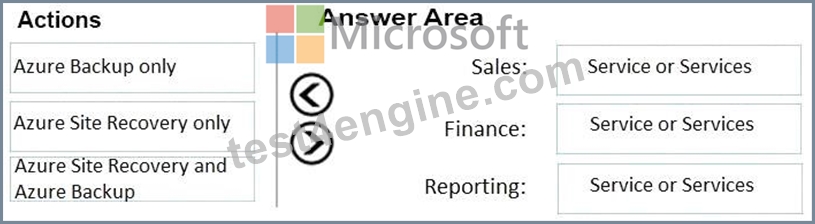
Answer:
Explanation:
Explanation
1) Sales: Azure Site Recovery only
2) Finance: Azure Site Recovery and Azure Backup
3) Reporting: Azure Backup only
NEW QUESTION # 137
You have an on-premises Microsoft SQL Server database named SQL1.
You plan to migrate SQL 1 to Azure.
You need to recommend a hosting solution for SQL1. The solution must meet the following requirements:
* Support the deployment of multiple secondary, read-only replicas.
* Support automatic replication between primary and secondary replicas.
* Support failover between primary and secondary replicas within a 15-minute recovery time objective (RTO).
Answer:
Explanation: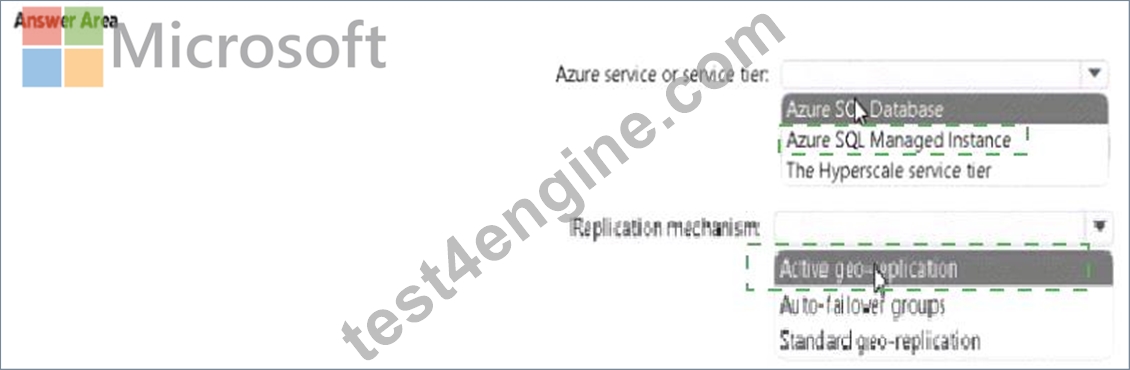
Explanation:
NEW QUESTION # 138
You have an Azure Active Directory (Azure AD) tenant that syncs with an on-premises Active Directory domain.
You have an internal web app named WebApp1 that is hosted on-premises. WebApp1 uses Integrated Windows authentication.
Some users work remotely and do NOT have VPN access to the on-premises network.
You need to provide the remote users with single sign-on (SSO) access to WebApp1.
Which two features should you include in the solution? Each correct answer presents part of the solution.
NOTE: Each correct selection is worth one point.
- A. Conditional Access policies
- B. Azure Application Gateway
- C. Azure AD Privileged Identity Management (PIM)
- D. Azure AD Application Proxy
- E. Azure AD enterprise applications
- F. Azure Arc
Answer: A,D
Explanation:
Explanation
A: Application Proxy is a feature of Azure AD that enables users to access on-premises web applications from a remote client. Application Proxy includes both the Application Proxy service which runs in the cloud, and the Application Proxy connector which runs on an on-premises server.
You can configure single sign-on to an Application Proxy application.
C: Microsoft recommends using Application Proxy with pre-authentication and Conditional Access policies for remote access from the internet. An approach to provide Conditional Access for intranet use is to modernize applications so they can directly authenticate with AAD.
Reference:
https://docs.microsoft.com/en-us/azure/active-directory/app-proxy/application-proxy-config-sso-how-to
https://docs.microsoft.com/en-us/azure/active-directory/app-proxy/application-proxy-deployment-plan
NEW QUESTION # 139
You have an on-premises network that uses on IP address space of 172.16.0.0/16 You plan to deploy 25 virtual machines to a new azure subscription.
You identity the following technical requirements.
All Azure virtual machines must be placed on the same subnet subnet1.
All the Azure virtual machines must be able to communicate with all on premises severs.
The servers must be able to communicate between the on-premises network and Azure by using a site to site VPN.
You need to recommend a subnet design that meets the technical requirements.
What should you include in the recommendation? To answer, drag the appropriate network addresses to the correct subnet. Each network address may be used once, more than once or not at all. You may need to drag the split bar between panes or scroll to view content.
NOTE: Each correct selection is worth one point.
Answer:
Explanation:
NEW QUESTION # 140
You are evaluating the components of the migration to Azure that require you to provision an Azure Storage account.
For each of the following statements, select Yes if the statement is true. Otherwise, select No.
NOTE: Each correct selection is worth one point.
Answer:
Explanation: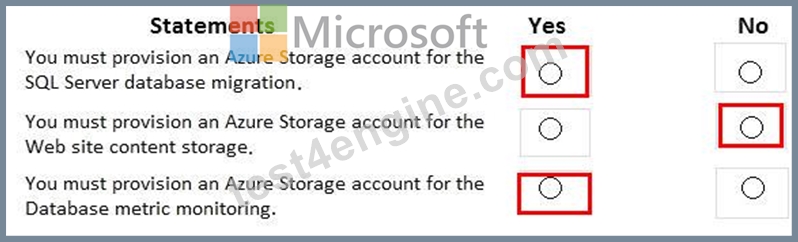
NEW QUESTION # 141
You have an Azure subscription that contains 1,000 resources.
You need to generate compliance reports for the subscription. The solution must ensure that the resources can be grouped by department.
What should you use to organize the resources?
- A. administrative units and Azure Lighthouse
- B. Azure Policy and tags
- C. application groups and quotas
- D. resource groups and role assignments
Answer: B
NEW QUESTION # 142
You have an on-premises database that you plan to migrate to Azure.
You need to design the database architecture to meet the following requirements:
Support scaling up and down.
Support geo-redundant backups.
Support a database of up to 75 TB.
Be optimized for online transaction processing (OLTP).
What should you include in the design? To answer, select the appropriate options in the answer area.
NOTE: Each correct selection is worth one point.
Answer:
Explanation: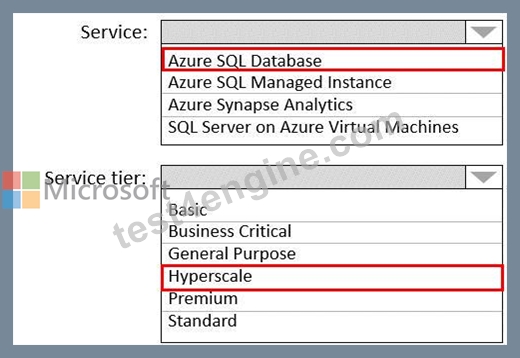
Reference:
https://docs.microsoft.com/en-us/azure/azure-sql/database/active-geo-replication-overview
https://medium.com/awesome-azure/azure-difference-between-azure-sql-database-and-sql-server-on-vm-comparison-azure-sql-vs-sql-server-vm-cf02578a1188
NEW QUESTION # 143
You need to deploy an instance of SQL Server on Azure Virtual Machines. The solution must meet the following requirements:
* Support 15.000 disk IOPS.
* Support SR-IOV.
* Minimize costs.
What should you include in the solution? To answer, select the appropriate options in the answer area. NOTE:
Each correct selection is worth one point.
Answer:
Explanation:
Explanation:
NEW QUESTION # 144
Your company has 20 web APIs that were developed in-house.
The company is developing 10 web apps that will use the web APIs. The web apps and the APIs are registered in the company s Azure AD tenant. The web APIs are published by using Azure API Management.
You need to recommend a solution to block unauthorized requests originating from the web apps from reaching the web APIs. The solution must meet the following requirements:
* Use Azure AD-generated claims.
* Minimize configuration and management effort
What should you include in the recommendation? To answer, select the appropriate options in the answer are a. NOTE: Each correct selection is worth one point.
NOTE: Each correct selection is worth one point.
Answer:
Explanation:
NEW QUESTION # 145
You are designing a data storage solution to support reporting.
The solution will ingest high volumes of data in the JSON format by using Azure Event Hubs. As the data arrives, Event Hubs will write the data to storage. The solution must meet the following requirements:
* Organize data in directories by date and time.
* Allow stored data to be queried directly, transformed into summarized tables, and then stored in a data warehouse.
* Ensure that the data warehouse can store 50 TB of relational data and support between 200 and 300 concurrent read operations.
Which service should you recommend for each type of data store? To answer, select the appropriate options in the answer area.
NOTE: Each correct selection is worth one point.
Answer:
Explanation:
Explanation:
NEW QUESTION # 146
You are planning an Azure Storage solution for sensitive data. The data will be accessed daily. The data set is less than 10 GB.
You need to recommend a storage solution that meets the following requirements:
* All the data written to storage must be retained for five years.
* Once the data is written, the data can only be read. Modifications and deletion must be prevented.
* After five years, the data can be deleted, but never modified.
* Data access charges must be minimized
What should you recommend? To answer, select the appropriate options in the answer area.
NOTE: Each correct selection is worth one point.
Answer:
Explanation:
Explanation
Graphical user interface, text, application Description automatically generated
Box 1: General purpose v2 with Archive acce3ss tier for blobs
Archive - Optimized for storing data that is rarely accessed and stored for at least 180 days with flexible latency requirements, on the order of hours.
Cool - Optimized for storing data that is infrequently accessed and stored for at least 30 days.
Hot - Optimized for storing data that is accessed frequently.
Box 2: Storage account resource lock
As an administrator, you can lock a subscription, resource group, or resource to prevent other users in your organization from accidentally deleting or modifying critical resources. The lock overrides any permissions the user might have.
Note: You can set the lock level to CanNotDelete or ReadOnly. In the portal, the locks are called Delete and Read-only respectively.
* CanNotDelete means authorized users can still read and modify a resource, but they can't delete the resource.
* ReadOnly means authorized users can read a resource, but they can't delete or update the resource.
Applying this lock is similar to restricting all authorized users to the permissions granted by the Reader role.
Reference:
https://docs.microsoft.com/en-us/azure/storage/blobs/storage-blob-storage-tiers
NEW QUESTION # 147
You plan to deploy the backup policy shown in the following exhibit.
Use the drop-down menus to select the answer choice that completes each statement based on the information presented in the graphic.
NOTE: Each correct selection is worth one point.
Answer:
Explanation:
Explanation
https://docs.microsoft.com/en-us/azure/backup/backup-azure-vm-backup-faq#what-s-the-minimum-rpo-and-rto-f
NEW QUESTION # 148
You design a solution for the web tier of WebApp1 as shown in the exhibit.
For each of the following statements, select Yes if the statement is true. Otherwise, select No.
Answer:
Explanation:
Explanation
Box 1: Yes
Any new deployments to Azure must be redundant in case an Azure region fails.
Traffic Manager uses DNS to direct client requests to the most appropriate service endpoint based on a traffic-routing method and the health of the endpoints. An endpoint is any Internet-facing service hosted inside or outside of Azure. Traffic Manager provides a range of traffic-routing methods and endpoint monitoring options to suit different application needs and automatic failover models. Traffic Manager is resilient to failure, including the failure of an entire Azure region.
Box 2: Yes
Recent changes in Azure brought some significant changes in autoscaling options for Azure Web Apps (i.e.
Azure App Service to be precise as scaling happens on App Service plan level and has effect on all Web Apps running in that App Service plan).
Box 3: No
Traffic Manager provides a range of traffic-routing methods and endpoint monitoring options to suit different application needs and automatic failover models. Traffic Manager is resilient to failure, including the failure of an entire Azure region.
Reference:
https://docs.microsoft.com/en-us/azure/traffic-manager/traffic-manager-overview
https://blogs.msdn.microsoft.com/hsirtl/2017/07/03/autoscaling-azure-web-apps/
NEW QUESTION # 149
You have two on-premises Microsoft SQL Server 2017 instances that host an Always On availability group named AG1. AG1 contains a single database named DB1.
You have an Azure subscription that contains a virtual machine named VM1VM1 runs Linux and contains a SQL Server 2019 instance.
You need to migrate DB1 to VMI. The solution must minimize downtime on DBI. What should you do? To answer, select the appropriate options in the answer area.
NOTE: Each correct selection is worth one point.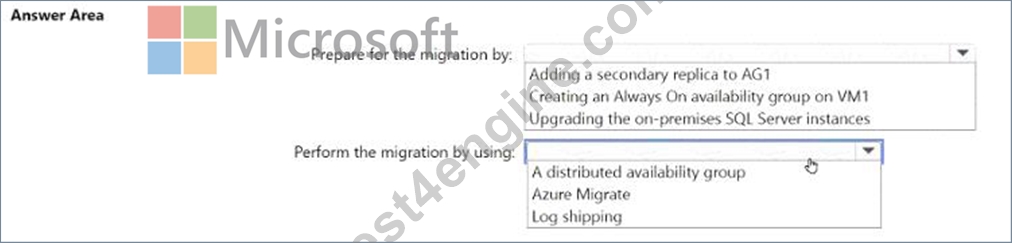
Answer:
Explanation:
Explanation:
NEW QUESTION # 150
......
Pass Microsoft AZ-305 Exam in First Attempt Guaranteed: https://www.test4engine.com/AZ-305_exam-latest-braindumps.html
Pass AZ-305 Exam Latest Practice Questions: https://drive.google.com/open?id=1rN_ZxiJBU17xYjCUPx_6N4wnn5Jlwzxd