


Free 365 Days Exam Updates 350-401 dumps with test Engine Practice
Updated Verified 350-401 dumps Q&As - 100% Pass Guaranteed
NEW QUESTION # 362
Refer to the exhibit.
A port channel is configured between SW2 and SW3. SW2 is not running a Cisco operating system. When all physical connections are mode, the port channel does not establish. Based on the configuration excerpt of SW3, what is the cause of the problem?
- A. The port-channel should be set to auto.
- B. The port-channel trunk is not allowing the native VLAN.
- C. The port-channel interface lead balance should be set to src-mac
- D. The port channel on SW2 is using an incompatible protocol.
Answer: D
Explanation:
Explanation
The Cisco switch was configured with PAgP, which is a Cisco proprietary protocol so non-Cisco switch could not communicate.
NEW QUESTION # 363
Drag and drop the characteristics from the left onto the correct infrastructure deployment types on the right.
Answer:
Explanation:
Explanation
On premise: customizable,specific requirements,resources
Cloud: scale, built-in automated backup, strong stable internet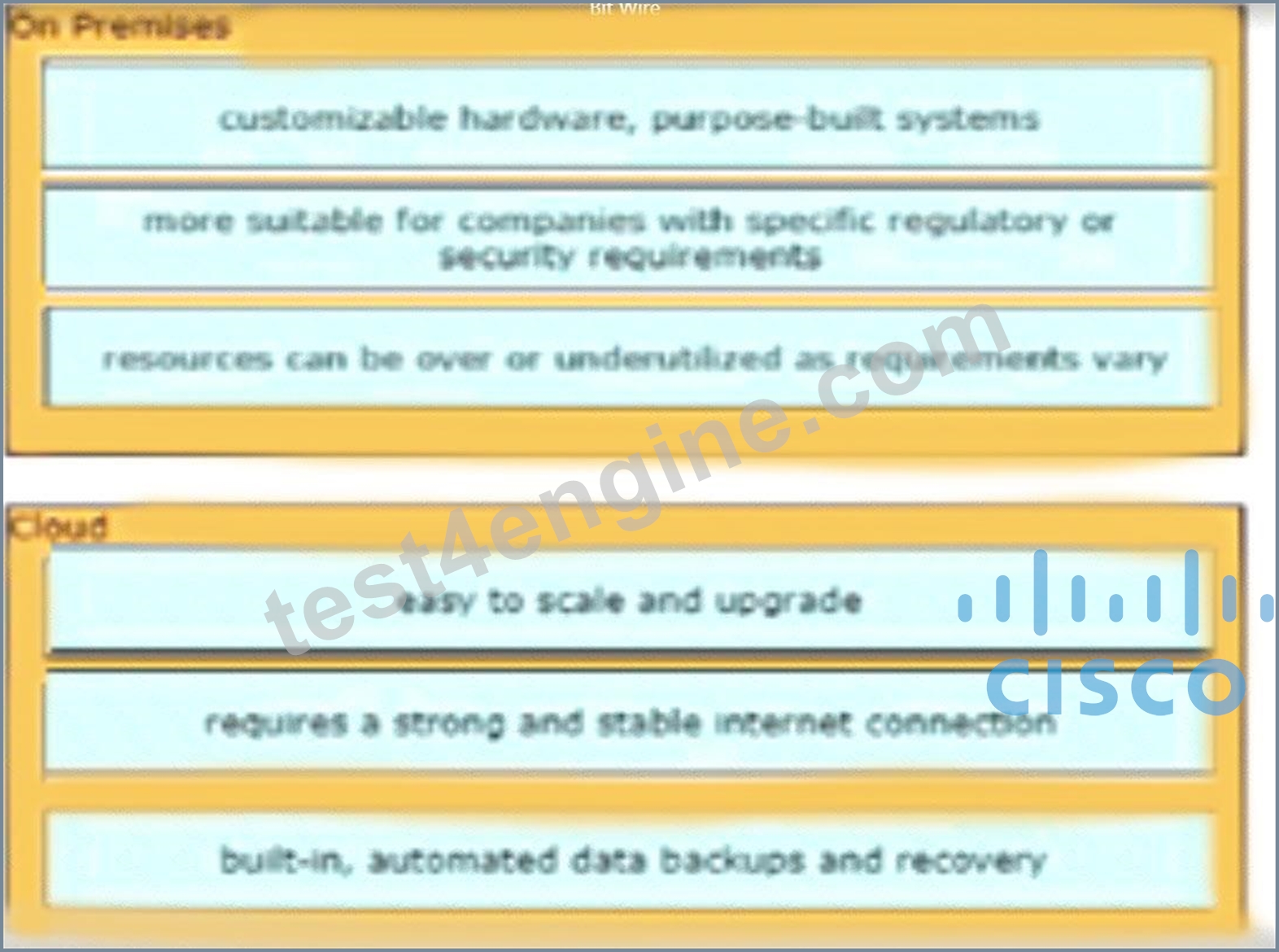
NEW QUESTION # 364
Refer to the exhibit.
What is required to configure a second export destination for IP address 192.168.10.1?
- A. Specify a different flow ID
- B. Configure a version 5 flow-export to the same destination.
- C. Specify a different UDP port.
- D. Specify a VRF.
- E. Specify a different TCP port.
Answer: C
Explanation:
Explanation
To configure multiple NetFlow export destinations to a router, use the following commands in global configuration mode:
Step 1: Router(config)# ip flow-export destination
Step 2: Router(config)# ip flow-export destination
The following example enables the exporting of information in NetFlow cache entries:
ip flow-export destination 10.42.42.1 9991 ip flow-export destination 10.0.101.254 1999 Reference: https://www.cisco.com/c/en/us/td/docs/ios/12_0s/feature/guide/12s_mdnf.html
NEW QUESTION # 365
What is a characteristic of a Type I hypervisor?
- A. It is installed on an operating system and supports other operating systems above it.
- B. Problems in the base operating system can affect the entire system.
- C. It is referred to as a hosted hypervisor.
- D. It is completely independent of the operating system.
Answer: D
Explanation:
A Type I hypervisor is a layer of software installed directly on top of a physical server and its underlying hardware. Since no other software runs between the hardware and the hypervisor, it is also called the bare-metal hypervisor. This type of hypervisor provides excellent performance and stability because it does not run inside another operating system but is a simple operating system designed to run virtual machines. The physical machine the hypervisor runs on serves virtualization purposes only, making it completely independent of any operating system. References := phoenixNAP, IBM, ITExamAnswers, Linux Handbook, GeeksforGeeks
NEW QUESTION # 366
Which function is handled by vManage in the Cisco SD-WAN fabric?
- A. Distributes policies that govern data forwarding
- B. Performs remote software upgrades for WAN Edge. vSmart and vBond
- C. Establishes BFD sessions to test liveliness of links and nodes
- D. Establishes IPsec tunnels with nodes.
Answer: B
Explanation:
We can remote upgrades WAN Edge, vSmart and vBond in vManage.
https://sdwan-
docs.cisco.com/Product_Documentation/vManage_Help/Release_18.4/Maintenance/Software_U pgrade
NEW QUESTION # 367
Which statement describes the IP and MAC allocation requirements for virtual machines on types
1 hypervisors?
- A. Each virtual machine requires a unique IP and MAC addresses to be able to reach to other nodes.
- B. Each virtual machines requires a unique IP address but shares the MAC address with the address of the physical server.
- C. Each virtual machine requires a unique MAC address but shares the IP address with the physical server.
- D. Each virtual machine requires a unique IP address but shares the MAC address with the physical server
Answer: A
Explanation:
A virtual machine (VM) is a software emulation of a physical server with an operating system.
From an application's point of view, the VM provides the look
and feel of a real physical server, including all its components, such as CPU, memory, and network interface cards (NICs).
The virtualization software that creates VMs and performs the hardware abstraction that allows multiple VMs to run concurrently is known as a hypervisor.
There are two types of hypervisors: type 1 and type 2 hypervisor.
In type 1 hypervisor (or native hypervisor), the hypervisor is installed directly on the physical server. Then instances of an operating system (OS) are installed on the hypervisor. Type 1 hypervisor has direct access to the hardware resources. Therefore they are more efficient than hosted architectures. Some examples of type 1 hypervisor are VMware vSphere/ESXi, Oracle VM Server, KVM and Microsoft Hyper-V.
In contrast to type 1 hypervisor, a type 2 hypervisor (or hosted hypervisor) runs on top of an operating system and not the physical hardware directly. A big advantage of Type 2 hypervisors is that management console software is not required.
NEW QUESTION # 368
How does NETCONF YANG represent data structures?
- A. as strict data structures denned by RFC 6020
- B. as modules within a tree
- C. in an XML tree format
- D. in an HTML format
Answer: A
NEW QUESTION # 369 
Reler to the exhibit The EtherChannel between SW1 and SW2 is not operational. Which a coon will resolve the issue?
- A. Configure twitchport trunk encapsulation dot1q on SW1 and SW2.
- B. Configure channel-group 1 mode active on GVO and G1 1 of SW2.
- C. Configure channel-group 1 mode active on Gl'O and GM of SW1 .
- D. Configure switchport mode dynamic desirable on SW1 and SW2
Answer: C
NEW QUESTION # 370 
Refer to the exhibit. R1 and R2 are directly connected, but the BGP session does not establish. Which action must be taken to build an eBGP session?
- A. Configure neighbor 192.168.12.1 activate under R2 BGP process.
- B. Configure ip route 1.1.1.1 0.0.0.0 192.168.12.1 on R2.
- C. Configure neighbor 2.2.2.2 remote-as 65002 under R1 BGP process.
- D. Configure no neighbor 192.168.12.1 shutdown under R2 BGP process.
Answer: D
NEW QUESTION # 371
Refer to the exhibit.
Security policy requires all idle-exec sessions to be terminated in 600 seconds. Which configuration achieves this goal?
- A. line vty 0 15 exec-timeout
- B. line vty 0 4 exec-timeout 600
- C. line vty 0 15 absolute-timeout 600
- D. line vty 0 15 exec-timeout 10 0
Answer: D
Explanation:
The "exec-timeout" command is used to configure the inactive session timeout on the console port or the virtual terminal. The syntax of this command is:
exec-timeout minutes [seconds]
Therefore we need to use the "exec-timeout 10 0" command to set the user inactivity timer to 600 seconds (10 minutes).
NEW QUESTION # 372
Refer to the exhibit.
An engineer must establish eBGP peering between router R3 and router R4. Both routers should use their loopback interfaces as the BGP router ID. Which configuration set accomplishes this task?
- A. Option C
- B. Option A
- C. Option D
- D. Option B
Answer: B
NEW QUESTION # 373
Refer to the exhibit. How should the script be completed so that each device configuration is saved into a JSON-formatted file under the device name?
- A.

- B.

- C.
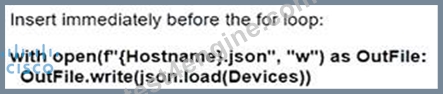
- D.

Answer: D
NEW QUESTION # 374
Refer to the exhibit.
An engineer is reaching network 172.16.10.0/24 via the R1-R2-R4 path. Which configuration forces the traffic to fake a path of R1-R3-R4?
A)
B)
C)
D)
- A. Option C
- B. Option D
- C. Option A
- D. Option B
Answer: B
NEW QUESTION # 375
What is an OVF?
- A. a package that is similar to an IMG and that contains an OVA file used to build a virtual machine
- B. the third step in a P2V migration
- C. an alternative form of an ISO that Is used to install the base operating system of a virtual machine
- D. a package of files that is used to describe a virtual machine or virtual appliance
Answer: A
Explanation:
An OVF, or Open Virtualization Format, is a package format that allows for the distribution of virtual appliances or virtual machines. It is platform-independent and can include one or more virtual disks and a VM configuration file (typically an .ovf or .ova file). The OVF package can be used to easily deploy complex multi-tier applications across different virtualization platforms.
References: Implementing and Operating Cisco Service Provider Network Core Technologies (SPCOR) course materials
NEW QUESTION # 376
Drag and drop the characteristics from the left onto the architectures on the right.
Answer:
Explanation:
Explanation:
NEW QUESTION # 377
Refer to the exhibit.
An engineer must configure and validate a CoPP policy that allows the network management server to monitor router R1 via SNMP while protecting the control plane. Which two commands or command sets must be used?
(Choose two.)

- A. Option C
- B. Option E
- C. Option F
- D. Option D
- E. Option B
- F. Option A
Answer: B,E
Explanation:
In the context of Cisco Service Provider Network Core Technologies, Control Plane Policing (CoPP) is used to protect the control plane of routers and switches from excessive or malicious traffic, which can affect network stability and performance. To allow SNMP monitoring while protecting the control plane, one would need to implement a CoPP policy that permits SNMP traffic from the network management server but restricts other types of traffic that could be harmful.
Option B includes a class map called "class-map match-all CoPP-management" which matches on access-list
150; this access list permits UDP traffic for SNMP from host 10.0.1.2 to host 10.0.1.4, which is likely our network management server.
Option E applies the CoPP policy to the control plane with "service-policy input CoPP-policy". This command activates the defined CoPP policy on incoming traffic directed at the control plane.
NEW QUESTION # 378
Drag and drop the REST API authentication method from the left to the description on the right.
Answer:
Explanation:

NEW QUESTION # 379
Which network devices secure API platform?
- A. content switches
- B. next-generation intrusion detection systems
- C. web application firewalls
- D. Layer 3 transit network devices
Answer: A
Explanation:
Reference: https://www.cisco.com/c/en/us/products/collateral/security/advanced-waf-bot-aag.pdf > Cisco Secure Web Application Firewall (WAF) and bot protection defends your > online presence and ensures that website, mobile applications, and APIs > are secure, protected, and "always on."
> Cisco Secure Web Application Firewall (WAF) and bot protection defends your
> online presence and ensures that website, mobile applications, and APIs
Reference: https://www.cisco.com/c/en/us/products/collateral/security/advanced-waf-bot-aag.pdf > Cisco Secure Web Application Firewall (WAF) and bot protection defends your > online presence and ensures that website, mobile applications, and APIs > are secure, protected, and "always on."
NEW QUESTION # 380
Drag and drop the characteristics from the left onto the infrastructure types on the right.
Answer:
Explanation: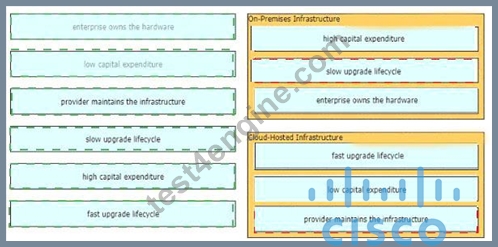
Explanation
NEW QUESTION # 381
An engineer must create an EEM applet that sends a syslog message in the event a change happens in the network due to trouble with an OSPF process. Which action should the engineer use?
- A. action 1 syslog send "OSPF ROUTING ERROR"
- B. action 1syslog write "OSPF ROUTING ERROR"
- C. action 1 syslog msg "OSPF ROUTING ERROR"
- D. action 1 syslog pattern "OSPF ROUTING ERROR"
Answer: C
Explanation:
In Cisco IOS, the Embedded Event Manager (EEM) applet can be used to monitor events and take action when a specified event occurs. To send a syslog message, the correct command within an EEM applet is action
<sequence-number> syslog msg "<message-text>". This command will trigger a syslog message with the specified text when the applet conditions are met. References: Implementing and Operating Cisco Service Provider Network Core Technologies (SPCOR) v1.0 - EEM documentation.
NEW QUESTION # 382
Which statement about TLS is accurate when using RESTCONF to write configurations on network devices?
- A. It is provided using NGINX acting as a proxy web server
- B. It requires certificates for authentication
- C. It is not supported on Cisco devices
- D. It is used for HTTP and HTTPS requests
Answer: D
NEW QUESTION # 383
Refer to the exhibit.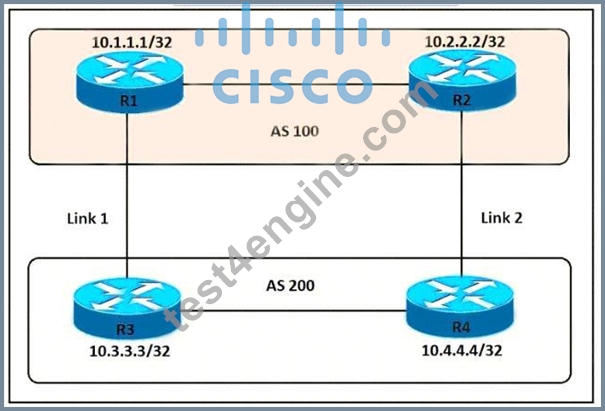
An engineer must ensure that all traffic leaving AS 200 will choose Link 2 as an entry point. Assuming that all BGP neighbor relationships have been formed and that the attributes have not been changed on any of the routers, which configuration accomplish task?
- A. Option C
- B. Option A
- C. Option D
- D. Option B
Answer: B
Explanation:
Explanation
R3 advertises BGP updates to R1 with multiple AS 100 so R3 believes the path to reach AS 200 via R3 is farther than R2 so R3 will choose R2 to forward traffic to AS 200.
NEW QUESTION # 384
Drag and drop the wireless elements on the left to their definitions on the right.
Answer:
Explanation:
NEW QUESTION # 385
......
Provide Valid Dumps To Help You Prepare For Implementing Cisco Enterprise Network Core Technologies (350-401 ENCOR) Exam: https://www.test4engine.com/350-401_exam-latest-braindumps.html
350-401 Dumps Questions [2024] Pass for Exam: https://drive.google.com/open?id=1OEmi_ZkT96M_cGy1Gc1WtluYNwv_JK-v