


JN0-363 Dumps 2026 - New Juniper JN0-363 Exam Questions
Free JN0-363 Braindumps Download Updated on Mar 13, 2026 with 88 Questions
The JN0-363 certification exam is ideal for network engineers, network administrators, and network operations center (NOC) technicians who work in service provider environments. Candidates who pass JN0-363 exam will have a solid understanding of the underlying technologies that power service provider networks and will be able to configure, maintain, and troubleshoot these networks. Service Provider Routing and Switching, Specialist (JNCIS-SP) certification is widely recognized in the industry and is highly valued by employers. It is also a prerequisite for the higher-level Juniper certifications such as the Juniper Networks Certified Internet Expert (JNCIE) certification.
The JN0-363 exam is designed to measure a candidate's understanding of service provider network architecture, protocols, and services. JN0-363 exam covers a wide range of topics, including routing protocols, MPLS, BGP, multicast, and Layer 2 VPNs. Candidates will be tested on their ability to configure and troubleshoot these protocols on Juniper Networks service provider routers and switches.
NEW QUESTION # 40
Which three statements are true about GRES? (Choose three.)
- A. GRES requires redundant REs.
- B. GRES requires only one RE.
- C. Control plane information is preserved.
- D. Kernel information is preserved.
- E. Interface information is preserved.
Answer: A,D,E
NEW QUESTION # 41
You have a stub OSPF area running in your network. Your supervisor has asked you to build a virtual link across this area to connect new equipment acquired in a recent ISP acquisition.Which statement is correct about this scenario?
- A. Type 5 LSAs would be blocked in a stub area.
- B. Type 5 LSAs would be seen only in the newly attached area.
- C. Type 5 LSAs would be converted to type 7 LSAs.
- D. Type 5 LSAs would carry external information across your transit area to the backbone.
Answer: A
NEW QUESTION # 42
You are deploying link aggregation groups.
- A. By default, what are two considerations in this scenario? (Choose two.)
- B. Member links can reside on different members within an MC-LAG.
- C. There should only be four member links per LAG.
- D. All the ports must have the same speed.
- E. Member links are required to be contiguous ports.
Answer: C,E
NEW QUESTION # 43
You have created a routing instance named vr3 that will provide access to Server 2 (10.0.0.2) (or the hosts on the 10.10.10.0/24 network. Which command would you use to test connectivity between vr3 and Server 2?
- A. user@router1> ping 10.0.0.2 routing-instance vr3 count 5
- B. user@vr3> ping 10.0.0.2 count 5
- C. user9router1> ping 10.0.0.2 count 5
- D. user@vr3> ping 10.0.0.2 count 5 source 10.10.10.1
Answer: A
Explanation:
To test connectivity to a server from within a specific routing instance, you use the ping command along with the routing-instance option to specify the routing instance from which you are pinging. This is necessary because the routing table associated with vr3 is separate from the main routing table, and you must explicitly tell the device to use the vr3 routing table to reach the server.
Reference:
Juniper Networks documentation on Routing Instances: Routing Instances Overview
NEW QUESTION # 44
Which configuration selling prohibits a static route from being redistributed by a dynamic routing protocol?
- A. no-readvertise
- B. passive
- C. route-filter
- D. qualified-next-hop
Answer: A
NEW QUESTION # 45
You are asked to create connections between routing instances on the same Junos device and route between the connected Instances. What are two ways to accomplish this task? (Choose two.)
- A. Use an IRB interface.
- B. Use physical interfaces.
- C. Use logical tunnel interfaces.
- D. Use loopback interfaces.
Answer: C,D
Explanation:
To create connections between routing instances on the same Junos device and route between them, you can use logical tunnel interfaces, which are virtual interfaces that can be used to route traffic between instances without the need for physical connectivity. Additionally, loopback interfaces, which represent the device itself, can be used to route traffic between routing instances as they are always up and can be reached within the device.
Reference:
Juniper Networks Technical Documentation on Routing Instances
Juniper Networks Technical Documentation on Logical Tunnel Interfaces
NEW QUESTION # 46
Click the Exhibit button.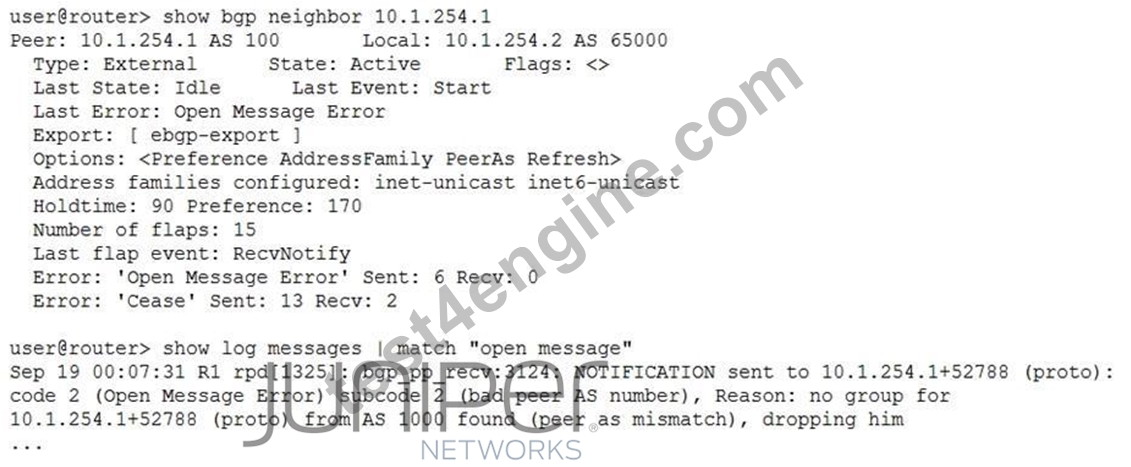
You are troubleshooting a new BGP peering session which is not establishing.
Referring to the exhibit, which statement is true?
- A. The update messages contain an unsupported option
- B. The neighbor does not support IPv6
- C. The peer's AS number is misconfigured
- D. The TCP session is not establishing
Answer: C
NEW QUESTION # 47
Click the Exhibit button.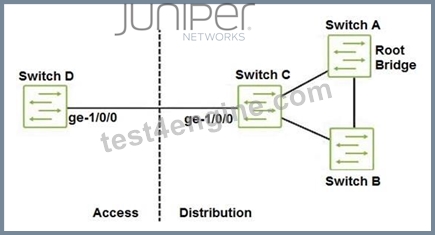
In the network shown in the exhibit, all switches are configured with the default STP root bridge priority, and Switch A has been selected as root. You recently added the older Switch D into the network as an access switch, and notice it has taken over as root.
Which configuration would solve this problem?
- A.
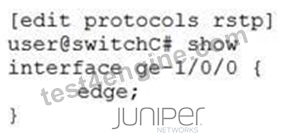
- B.
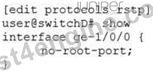
- C.
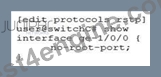
- D.
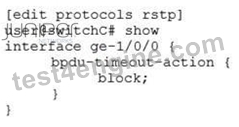
Answer: C
Explanation:
https://www.juniper.net/documentation/en_US/junos/topics/reference/configuration-statement/no-root-port-edit-protocols-stp.html
NEW QUESTION # 48
Exhibit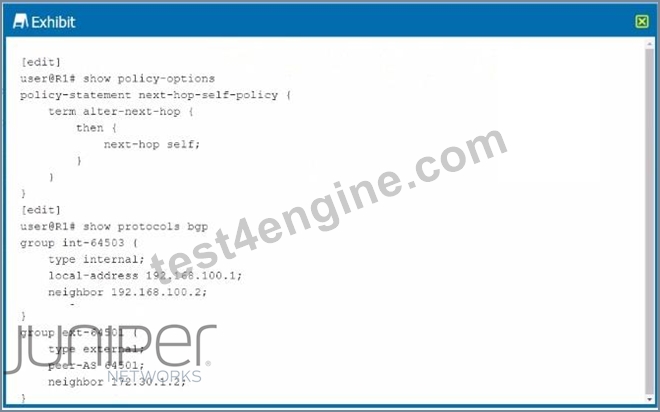
Referring to the exhibit, where should next-hop-self-policy be applied to alter the next-hop value?
- A. The policy is applied as an export policy for the group int-64503.
- B. The policy is applied as an export policy for the group ext-64501.
- C. The policy is applied as an import policy for the group int- 64 503.
- D. The policy is applied as an Import policy for the group ext-64501.
Answer: B
Explanation:
The next-hop-self-policy policy is used to alter the next-hop attribute of BGP routes. When you apply it as an export policy to an external BGP (eBGP) group, it changes the next-hop attribute of the routes being advertised to eBGP neighbors so that the next-hop IP address is the IP address of the router itself. This ensures that the eBGP neighbors use the local router as the next hop to reach these routes.
Reference:
Juniper Networks Technical Documentation on BGP Policies
NEW QUESTION # 49
Click the Exhibit button.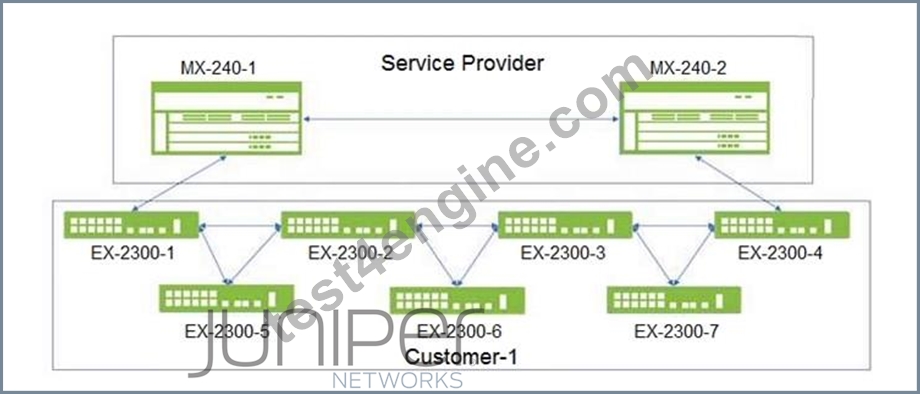
Customer-1 wants the Service Provider to allow STP to operate normally on all ports but only allow the MX Series devices to manage the Layer 2 topology.
Referring to the exhibit, which feature needs to be implemented on all devices to accomplish this task?
- A. MAC movement protection
- B. root protection
- C. loop protection
- D. BPDU protection
Answer: C
NEW QUESTION # 50
You have recently configured MSTP on two switches in your network to participate in the same MSTP region. You issue the show spanning-tree mstp configuration command on both switches and notice that the configuration digests do not match.
What does this mismatch indicate?
- A. Everything is functioning as expected because the configuration digests should not match.
- B. You should ensure that the bridge IDs and priority values are unique on both switches.
- C. You should ensure that the max-age and hello timers are equal on both switches.
- D. You should ensure that the MSTIs and their VLAN IDs are equal on both switches.
Answer: D
NEW QUESTION # 51
Which two statements describe advantages of using BGP for VPLS signaling instead of LDP signaling? (Choose two.)
- A. There is auto discovery.
- B. There is a well-defined scaling hierarchy.
- C. There is a separation of signaling from other services.
- D. There is no need for MPLS signaling protocol.
Answer: A,B
NEW QUESTION # 52
Click the Exhibit.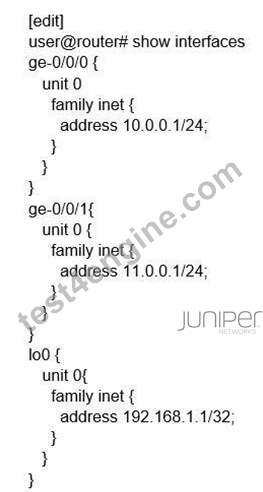
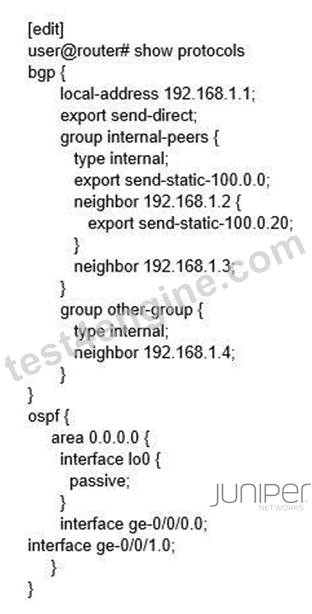
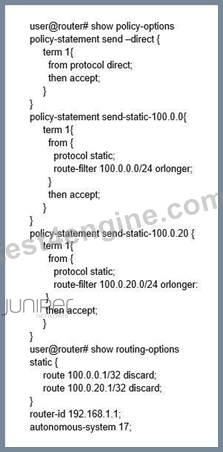
Referring to the exhibit, which route(s) will be exported to neighbor 192.168.1.2?
- A. 10.0.0.0/24, 11.0.0.0/24,100.0.0.1/32, 100.0.20.1/32, and 192.168.1.1/32
- B. 100.0.1/32 and 100.0.20.1/32
- C. 100.0.20.1/32
- D. 100.0.20.1/32, 192.168.1.1/32, and 100.0.0.1/32
Answer: A
NEW QUESTION # 53
Referring to the exhibit, which statement is correct?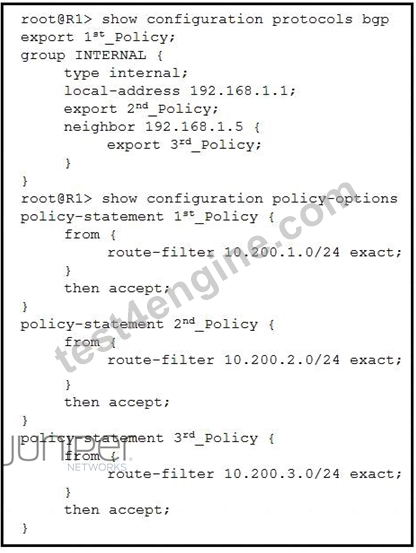
- A. R1 will advertise only the 10.200.2.0/24 prefix to the 192.168.1.5 neighbor.
- B. R1 will advertise only the 10.200.1.0/24 prefix to the 192.168.1.5 neighbor.
- C. R1 will advertise the 10.200.1.0/24, 10.200.2.0/24, and 10.200.3.0/24 prefixes to the 192.168.1.5 neighbor.
- D. R1 will advertise only the 10.200.3.0/24 prefix to the 192.168.1.5 neighbor.
Answer: D
Explanation:
Referring to the configuration in the exhibit, R1 is set to export the 3rd_Policy to the neighbor at 192.168.1.5.
Since 3rd_Policy permits the 10.200.3.0/24 prefix, only that prefix will be advertised to the neighbor.
References:
BGP Policies, Juniper Networks Documentation
Policy Framework, Juniper Networks Documentation
only 10.200.3.0/24 will be advertised. The neighbor export overrides anything at the group level and protocol level. Policies aren't additive, you can't apply all three at the same time. What if one of them rejected a prefix while the other accepted the same one? You need one to override the other
NEW QUESTION # 54
Click the Exhibit button.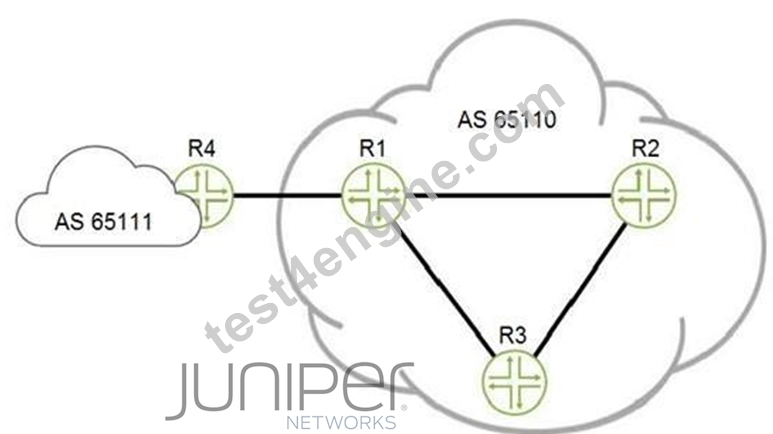
Referring to the exhibit, which two statements are true? (Choose two.)
- A. The BGP peering between R1 and R4 should use loopback interface addresses
- B. The BGP peerings between R1, R2, and R3 should use physical interface addresses
- C. The BGP peerings between R1, R2, and R3 should use loopback interface addresses
- D. The BGP peering between R1 and R4 should use physical interface addresses
Answer: C,D
NEW QUESTION # 55
......
Juniper JN0-363 exam is an excellent certification for individuals who are looking to validate their knowledge and skills in service provider routing and switching technologies. Service Provider Routing and Switching, Specialist (JNCIS-SP) certification demonstrates the candidate's ability to configure and troubleshoot Juniper Networks service provider routing and switching platforms, which is a valuable asset for service providers and network engineers.
Juniper JN0-363 Exam Practice Test Questions: https://www.test4engine.com/JN0-363_exam-latest-braindumps.html
Updated Certification Exam JN0-363 Dumps - Practice Test Questions: https://drive.google.com/open?id=1SO0i-6iis02QotpYJrnQz50WaGcR7oD3