


Pass Your JNCIP-DC JN0-683 Exam on Feb 05, 2026 with 68 Questions
JN0-683 Free Exam Study Guide! (Updated 68 Questions)
NEW QUESTION # 34
Which three statements are correct about VXLAN control planes? (Choose three.)
- A. Multicast is not agile and requires manual VNI mapping.
- B. EVPN enables fast convergence and updates.
- C. Multicast does not require as many resources.
- D. Both multicast and EVPN can facilitate MAC learning.
- E. EVPN is inefficient and does not scale well.
Answer: B,C,D
Explanation:
* VXLAN Control Planes:
* VXLAN (Virtual Extensible LAN) uses different control planes to handle MAC learning and traffic forwarding. The control planes include multicast and EVPN (Ethernet VPN).
* Multicast and EVPN Comparison:
* Option B:Both multicast and EVPN can be used for MAC learning in a VXLAN environment.
Multicast is a more traditional approach, while EVPN is more advanced and supports distributed MAC learning.
* Option D:EVPN offers benefits such as fast convergence and rapid updates, making it more efficient and scalable for modern data center environments.
* Option E:Multicast does not require as many resources because it relies on traditional Layer 3 multicast mechanisms to distribute broadcast, unknown unicast, and multicast (BUM) traffic.
However, it can be less flexible and less scalable compared to EVPN.
Conclusion:
* Option B:Correct-Both control planes facilitate MAC learning.
* Option D:Correct-EVPN provides fast convergence and updates.
* Option E:Correct-Multicast is resource-efficient but less flexible.
NEW QUESTION # 35
Exhibit.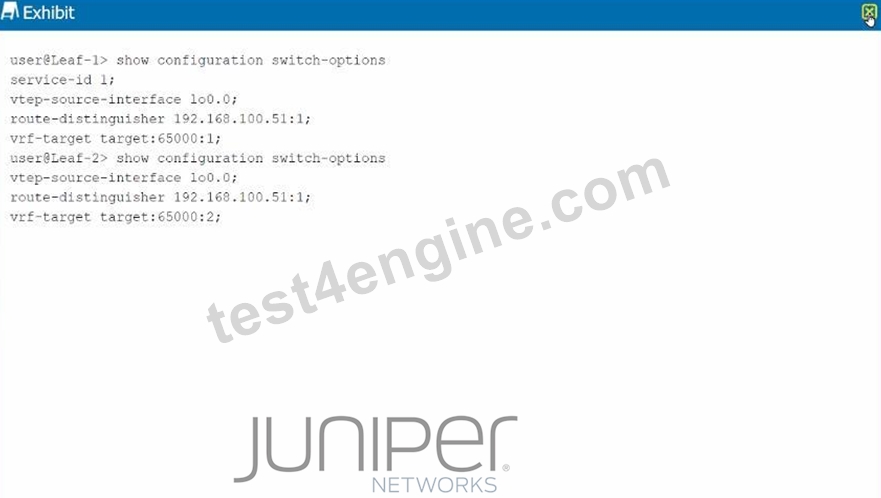
Connections between hosts connected to Leaf-1 and Leaf-2 are not working correctly.
- A. Configure the set switch-options route-distinguisher i92.168.100.50:1parameter on Leaf-1.
- B. Configure the set switch-options vtep-source-interface irb.0 parameter on Leaf-1.
- C. Configure the set switch-options vrf-target target:65000:1parameteron Leaf-2.
- D. Referring to the exhibit, which two configuration changes are required to solve the problem? (Choose two.)
- E. Configure the set switch-options service-id 1 parameter on Leaf-2.
Answer: A,C
NEW QUESTION # 36
Exhibit.
Host A is connected to vlan 100 on lead. Host B is connected to vlan 200 on leaf1. Host A and Host B ate unable to communicate. You have reviewed the touting and your hosts have the correct default route (.1) Referring to the exhibit, which two commands will solve the problem? (Choose two.)
- A. set vlans vn10013-interface irb.100
- B. delete vlans vn200 13-interface irb.200
- C. set interfaces irb unit 100 family inet address 192-168.100.1
- D. set routing-options static route 0.0.0.0/0 next-hop 192.168.200.10
Answer: A,D
Explanation:
In the provided network configuration, Host A is in VLAN 100 and Host B is in VLAN 200. The issue arises because these two hosts are unable to communicate, which indicates that either the interfaces are not properly linked to their respective VLANs, or there is a missing static route required for inter-VLAN routing.
Step-by-Step Analysis:
* VLAN Assignment:
* The exhibit shows that irb.200 is correctly associated with VLAN 200 in the configuration.
However, there is no corresponding irb.100 for VLAN 100. Without irb.100, the network lacks the logical interface to handle routing for VLAN 100. Thus, adding irb.100 to VLAN 100 is necessary.
Command to solve this:
set vlans vn100 13-interface irb.100
* Static Route Configuration:
* For inter-VLAN routing to occur, a static route needs to be configured that allows traffic to pass between different subnets (in this case, between VLAN 100 and VLAN 200). The command set routing-options static route 0.0.0.0/0 next-hop 192.168.200.10 would add a static route that directs all traffic from VLAN 100 to the correct gateway (192.168.200.10), which is necessary to route traffic between the two VLANs.
Command to solve this:
set routing-options static route 0.0.0.0/0 next-hop 192.168.200.10
Explanation of Incorrect Options:
* Option A (delete vlans vn200 13-interface irb.200): This would remove the logical interface associated with VLAN 200, which is not desired because we need VLAN 200 to remain active and properly routed.
* Option B (set interfaces irb unit 100 family inet address 192-168.100.1): This command would incorrectly assign an IP address that does not correspond with the subnet of VLAN 100 (192.168.200.1
/24). This could create a misconfiguration, leading to routing issues.
Data Center References:
For a Data Center, proper VLAN management and static routing are crucial for ensuring that different network segments can communicate effectively, especially when dealing with separated subnets or zones like in different VLANs. This aligns with best practices in DCIM (Data Center InfrastructureManagement) which stress the importance of proper network configuration to avoid downtime and ensure seamless communication between all critical IT infrastructure components.
Ensuring that the correct interfaces are associated with the correct VLANs and having the proper static routes in place are both essential steps in maintaining a robust and reliable data center network.
This detailed analysis reflects best practices as noted in standard data center design and network configuration guides.
NEW QUESTION # 37
You want to ensure thatVXLAN traffic from the xe-0/0/12 interlace is being encapsulatedby logical vlep.
32770 and sent to a remote leaf device in this scenario, which command would you use to verify that traffic is flowing?
- A. monitor traffic interface xe-0/0/12
- B. show interfaces terse vtep.32770 statistics
- C. show interface terse vtep.32770
- D. show interfaces vtep.32770 detail
Answer: B
Explanation:
* VXLAN Traffic Verification:
* To ensure VXLAN traffic from the xe-0/0/12 interface is correctly encapsulated by the logical vtep.32770 and sent to a remote leaf device, it is essential to monitor the relevant interface statistics.
* The command show interfaces terse vtep.32770 statistics provides a concise overview of the traffic statistics for the specific VTEP interface, which can help verify whether traffic is being correctly encapsulated and transmitted.
* Explanation:
* This command is particularly useful for quickly checking the traffic counters and identifying any potential issues with VXLAN encapsulation or transmission.
* It allows you to confirm that traffic is flowing as expected, by checking the transmitted and received packet counters.
Data Center References:
* Monitoring interface statistics is a crucial step in troubleshooting and validating network traffic, particularly in complex overlay environments like EVPN-VXLAN.
NEW QUESTION # 38
You are designing an IP fabric tor a large data center, and you are concerned about growth and scalability.
Which two actions would you take to address these concerns? (Choose two.)
- A. Use EX4300 Series devices as the spine devices.
- B. Use OFX5700 Series devices as the super spines.
- C. Design a five-stage Clos IP fabric.
- D. Design a three-stage Clos IP fabric.
Answer: B,D
Explanation:
* Clos IP Fabric Design:
* A Clos fabric is a network topology designed for scalable, high-performance data centers. It is typically arranged in multiple stages, providing redundancy, high bandwidth, and low latency.
* Three-Stage Clos Fabric:
* Option B:A three-stage Clos fabric, consisting of leaf, spine, and super spine layers, is widely used in data centers. This design scales well and allows for easy expansion by adding more leaf and spine devices as needed.
* Super Spines for Scalability:
* Option D:Using high-capacity devices like the QFX5700 Series as super spines can handle the increased traffic demands in large data centers and support future growth. These devices provide the necessary bandwidth and scalability for large-scale deployments.
Conclusion:
* Option B:Correct-A three-stage Clos fabric is a proven design that addresses growth and scalability concerns in large data centers.
* Option D:Correct-QFX5700 Series devices are suitable for use as super spines in large-scale environments due to their high performance.
NEW QUESTION # 39
You are asked to configure telemetry on the OFX Series devices in your data center fabric. You want to use sensors that have a vendor-neutral data model Which type of sensor should you use in this scenario?
- A. Python sensors
- B. analog sensors
- C. JTI native sensors
- D. JTI OpenConfig sensors
Answer: D
Explanation:
* Telemetry in Data Centers:
* Telemetry allows for real-time monitoring of network devices by collecting and exporting data such as interface statistics, routing table updates, and other key metrics.
* Vendor-Neutral Data Models:
* Option A:JTI (Junos Telemetry Interface) OpenConfig sensors use a vendor-neutral data model, which is important for ensuring compatibility across different network devices and systems.
OpenConfig is an industry-standard model, which facilitates integration with various telemetry collection systems.
Conclusion:
* Option A:Correct-OpenConfig sensors provide a vendor-neutral solution for telemetry, ensuring broad compatibility and flexibility in data center environments.
NEW QUESTION # 40
You are asked to deploy 100 QFX Series devices using ZTP Each OFX5120 requires a different configuration. In this scenario, what are two components that you would configure on the DHCP server?
(Choose two.)
- A. the MAC address for each OFX5120
- B. the IP address of the FTP server
- C. the management IP address for each OFX5120
- D. the MAC address of the FTP server
Answer: A,C
Explanation:
* Zero Touch Provisioning (ZTP):
* ZTP allows for the automated configuration of network devices, like QFX Series switches, without manual intervention. During ZTP, a switch will obtain its configuration from a DHCP server and then download the required software and configuration files from a specified server (e.
g., FTP, HTTP).
* DHCP Server Configuration:
* Option B:The DHCP server needs to know theMAC address for each QFX5120to provide a specific configuration based on the device identity. By mapping the MAC address to a particular configuration, the DHCP server can ensure that each switch gets the correct configuration.
* Option D:Themanagement IP address for each QFX5120must also be assigned by the DHCP server. This IP address allows the device to communicate on the network and access the configuration files and other required resources during the ZTP process.
Conclusion:
* Option B:Correct-MAC addresses allow the DHCP server to identify each QFX5120 and assign the appropriate configuration.
* Option D:Correct-Management IP addresses are essential for network communication during ZTP.
NEW QUESTION # 41
Why is a designated forwarder required in a multihomed CE-to-PE VXLAN environmentusing EVPN signalling?
- A. The designated forwarder is required to prevent flooding of MAC addresses to multihomed hosts.
- B. The designated forwarder is required to prevent a traffic storm from being received on multihomed hosts.
- C. The designated forwarder is required to prevent packets from looping between the PEs.
- D. The designated forwarder is required to prevent duplicate packets from being received on multihomed hosts.
Answer: D
Explanation:
* Understanding Multihomed CE-to-PE VXLAN Environment:
* In a VXLAN environment using EVPN signaling, multiple PEs (Provider Edge devices) can be connected to the same CE (Customer Edge device). This setup is referred to as multihoming, where a CE device has multiple connections to the network to ensure redundancy and load balancing.
* Role of the Designated Forwarder:
* The designated forwarder (DF) is a mechanism used in EVPN to manage the forwarding of broadcast, unknown unicast, and multicast (BUM) traffic in a multihomed environment. The DF is selected to ensure that only one of the PEs forwards this type of traffic to the CE, preventing loops and unnecessary duplicate packets.
* Avoiding Duplicate Packets:
* Without a designated forwarder, all PEs connected to a multihomed CE could potentially forward the same packet to the CE, resulting in duplicate packets. This duplication can cause issues with packet processing on the CE, leading to inefficiencies and potential network problems.
Conclusion:
* Option D:Correct-The designated forwarder is essential to prevent duplicate packets from being received on multihomed hosts, ensuring that only one PE forwards BUM traffic to the CE.
NEW QUESTION # 42
Which three statements are correct about symmetric IRB routing with EVPN Type 2 routes? (Choose three.)
- A. An L3 interface (IRB) is required for each local VLAN.
- B. Symmetric routing supports the EVPN service VLAN bundle.
- C. Symmetric routing requires MAC-VRF.
- D. Symmetric routing requires an extra transit VNI for each VRF.
- E. Symmetric routing is less efficient than asymmetric routing.
Answer: A,C,D
Explanation:
* Symmetric IRB Routing with EVPN Type 2 Routes:
* Symmetric Routing: In symmetric IRB (Integrated Routing and Bridging), routing occurs in both directions at the ingress and egress leaf nodes using the same routing logic. This is contrasted with asymmetric routing, where different routing logic is used depending on the direction of the traffic.
* Required Components:
* Option A:An L3 IRB interface is necessary for each VLAN that participates in routing, as it handles the Layer 3 processing for the VLAN.
* Option B:MAC-VRF is required for symmetric routing to maintain a mapping of MAC addresses to the appropriate VRF, ensuring correct forwarding within the EVPN.
* Option D:A transit VNI (Virtual Network Identifier) is required for each VRF to encapsulate the Layer 3 traffic as it traverses the network, allowing the IP traffic to be appropriately forwarded.
Conclusion:
* Option A:Correct-Each local VLAN needs an IRB interface for L3 processing.
* Option B:Correct-MAC-VRF is necessary for handling MAC address resolution in symmetric routing.
* Option D:Correct-Transit VNIs are required for routing VRF-specific traffic across the network.
OptionsCandEare incorrect because:
* C:Symmetric routing can work with various VLAN models, including single or multiple VLANs within an EVPN instance.
* E:Symmetric routing is generally more efficient than asymmetric routing as it uses consistent routing logic in both directions.
NEW QUESTION # 43
You are asked to implement VXLAN group-based policies (GBPs) in your data center. Which two statements are correct in (his scenario? (Choose two.)
- A. VXLAN GBP ensures consistent application of security group policies throughout the network.
- B. VXLAN GBP uses scalable group tags that may be configured on a RADIUS server and pushed to the switch through 802.1X.
- C. VXLAN GBP ensures consistent application of BGP groups throughout the network.
- D. VXLAN GBP uses scalable group tags thatmust be configured statically on each switch and activated through 802.1X.
Answer: A,B
Explanation:
* VXLAN Group-Based Policies (GBP):
* VXLAN Group-Based Policies are used to apply security policies consistently across the network. These policies are often tied to user or device identities rather than static IP addresses, which allows for more dynamic and scalable security management.
* Scalable Group Tags via RADIUS and 802.1X:
* Option B:VXLAN GBP can use scalable group tags configured on a RADIUS server, which are then pushed to network devices through 802.1X. This allows for centralized and automated policy application based on user or device identity.
* Consistent Security Policy Application:
* Option C:GBP ensures that security policies are consistently applied across the network, regardless of where a user or device connects. This consistency is crucial in environments where security policies must follow the user or device.
Conclusion:
* Option B:Correct-Group tags can be configured on a RADIUS server and pushed via 802.1X, enabling centralized policy management.
* Option C:Correct-GBP ensures consistent application of security policies, which is essential for maintaining security across a dynamic network environment.
NEW QUESTION # 44
A local VTEP has two ECMP paths to a remote VTEP
Which two statements are correctwhen load balancing is enabled in this scenario? (Choose two.)
- A. The inner packet fields are used in the hash for load balancing.
- B. The destination port in the UDP header is used to load balance VXLAN traffic.
- C. The source port in the UDP header is used to load balance VXLAN traffic.
- D. The inner packet fields are not used in the hash for load balancing.
Answer: A,C
Explanation:
* Load Balancing in VXLAN:
* VXLAN uses UDP encapsulation to transport Layer 2 frames over an IP network. For load balancing across Equal-Cost Multi-Path (ECMP) links, various fields in the packet can be used to ensure even distribution of traffic.
* Key Load Balancing Fields:
* C. The source port in the UDP header is used to load balance VXLAN traffic:This is correct.
The source UDP port in the VXLAN packet is typically calculated based on a hash of the inner packet's fields. This makes the source port vary between packets, enabling effective load balancing across multiple paths.
* D. The inner packet fields are used in the hash for load balancing:This is also correct. Fields such as the source and destination IP addresses, source and destination MACaddresses, and possibly even higher-layer protocol information from the inner packet can be used to generate the hash that determines the ECMP path.
* Incorrect Statements:
* A. The inner packet fields are not used in the hash for load balancing:This is incorrect as the inner packet fields are indeed critical for generating the hash used in load balancing.
* B. The destination port in the UDP header is used to load balance VXLAN traffic:This is incorrect because the destination UDP port in VXLAN packets is typically fixed (e.g., port 4789 for VXLAN), and therefore cannot be used for effective load balancing.
Data Center References:
* Effective load balancing in VXLAN is crucial for ensuring high throughput and avoiding congestion on specific links. By using a combination of the source UDP port and inner packet fields, the network can distribute traffic evenly across available paths.
NEW QUESTION # 45
Exhibit.
You have a sample configuration for connecting two sites through EVPN-VXLAN by exchanging IP prefix routes.
Referring to the exhibit, which two statements regarding the configuration are true? {Choose two.)
- A. The VNI must match on all devices for the same customer.
- B. The advertise direct-nexthop option enables the receiver to resolve the next-hop route using only information carried in the Type 2 route.
- C. The VNI should be unique on all devices for each customer site.
- D. The advertise direct-nexthop option enables the receiver to resolve the next-hop route using only information carried in the Type 5 route.
Answer: A,D
Explanation:
EVPN-VXLAN Configuration:
* The configuration provided in the exhibit shows an EVPN-VXLAN setup where IP prefix routes are exchanged between two sites. The advertise direct-nexthop option and the VNI (Virtual Network Identifier) settings are crucial in this context.
Advertise Direct-Nexthop:
* Option A:The advertise direct-nexthop option ensures that the next-hop route is resolved using only the information carried in the EVPN Type 5 route. Type 5 routes are used for IP prefix advertisement in EVPN, which is key to enabling Layer 3 interconnectivity between different VXLAN segments.
VNI Consistency:
* Option C:For the same customer across different devices, the VNI must be consistent. This consistency ensures that all devices can correctly map traffic to the appropriate VXLAN segment, maintaining seamless Layer 2 and Layer 3 connectivity.
NEW QUESTION # 46
You are deploying multiple Juniper switches al the same location. Your switches are currently using the factory-default configuration.
In this scenario, which two statements are correct? (Choose two.)
- A. The DHCP server configuration can provide Junos version requirements to DHCP clients.
- B. The switch will try to request an IP address from a DHCP server using only the management interface.
- C. The DHCP server configuration cannot provide Junos version requirements to DHCP clients.
- D. The switch will try to request an IP address from a DHCP server using all interfaces that are connected and are operational.
Answer: A,D
Explanation:
* DHCP Behavior in Factory-Default Configuration:
* Option B:In the factory-default configuration, Juniper switches are designed to send DHCP requests on all operational interfaces. This behavior ensures that the switch can obtain an IP address for management and further configuration from any available DHCP server.
* Option D:The DHCP server can provide additional configuration parameters, including the required Junos version. This allows for automated provisioning and ensures that the switch is running the correct software version.
Conclusion:
* Option B:Correct-The switch will use any operational interface to request an IP address via DHCP.
* Option D:Correct-The DHCP server can specify Junos version requirements, enabling automated software management.
NEW QUESTION # 47
Exhibit.
You are troubleshooting a DCI connection to another data center The BGP session to the provider is established, but the session to Border-Leaf-2 is not established. Referring to the exhibit, which configuration change should be made to solve the problem?
- A. set protocols bgp group PROVIDER export LOOPBACKS
- B. set protocols bgp group overlay export loopbacks
- C. delete protocols bgp group OVERLAY accept-remote-nexthop
- D. delete protocols bgp group UNDERLAY advertise-external
Answer: C
Explanation:
* Understanding the Configuration:
* The exhibit shows a BGP configuration on a Border-Leaf device. The BGP group UNDERLAY is used for the underlay network, OVERLAY for EVPN signaling, and PROVIDER for connecting to the provider network.
* The OVERLAY group has the accept-remote-nexthop statement, which is designed to accept the next-hop address learned from the remote peer as is, without modifying it.
* Problem Identification:
* The BGP session to Border-Leaf-2 is not established. A common issue in EVPN-VXLAN environments is related to next-hop reachability, especially when accept-remote-nexthop is configured.
* In typical EVPN-VXLAN setups, the next-hop address should be reachable within the overlay network. However, the accept-remote-nexthop can cause issues if the next-hop IP address is not directly reachable or conflicts with the expected behavior in the overlay.
* Corrective Action:
* D. delete protocols bgp group OVERLAY accept-remote-nexthop:Removing this command will ensure that the device uses its own IP address as the next-hop in BGP advertisements, which is standard practice in many EVPN-VXLAN setups. This change should help establish the BGP session with Border-Leaf-2.
Data Center References:
* Proper handling of BGP next-hop attributes is critical in establishing and maintaining stable BGP sessions, especially in complex multi-fabric environments like EVPN-VXLAN. Removing accept- remote-nexthop aligns with best practices in many scenarios.
NEW QUESTION # 48
Exhibit.
Given the configuration shown in the exhibit, why has the next hop remained the same for the EVPN routes advertised to the peer 203.0.113.2?
- A. The export policy is incorrectly configured.
- B. EVPN routes cannot have the next hop changed.
- C. The vrf-export parameter must be applied.
- D. The vpn-apply-export parameter must be applied to this peer.
Answer: D
Explanation:
* Understanding the Configuration:
* The configuration shown in the exhibit involves an EVPN (Ethernet VPN) setup using BGP as the routing protocol. The export policy named CHANGE_NH is applied to the BGP group evpn- peer, which includes a rule to change the next hop for routes that match the policy.
* Issue with Next Hop Not Changing:
* The policy CHANGE_NH is correctly configured to change the next hop to 203.0.113.10 for the matching routes. However, the next hop remains unchanged when advertising EVPN routes to the peer 203.0.113.2.
* Reason for the Issue:
* In Junos OS, when exporting routes for VPNs (including EVPN), the next-hop change defined in a policy will not take effect unless the vpn-apply-export parameter is used inthe BGP configuration. This parameter ensures that the export policy is applied specifically to VPN routes.
* The vpn-apply-export parameter must be included to apply the next-hop change to EVPN routes.
* Correct Answer Explanation:
* D. The vpn-apply-export parameter must be applied to this peer:This is the correct solution because the next hop in EVPN routes won't be altered without this parameter in the BGP configuration. It instructs the BGP process to apply the export policy to the EVPN routes.
Data Center References:
* This behavior is standard in EVPN deployments with Juniper Networks devices, where the export policies applied to VPN routes require explicit invocation using vpn-apply-export to take effect.
NEW QUESTION # 49
Which two statements are true about IP fabrics using unnumbered BGP? (Choose two.)
- A. Unnumbered BGP peering automatically provisions IPv4 peering.
- B. Unnumbered BGP peering automatically provisions IPv6 peering.
- C. Unnumbered BGP requires that family inet is configured on each interface.
- D. Unnumbered BGP requires that family inet6is configured on each interface.
Answer: A,C
Explanation:
* Understanding Unnumbered BGP:
* Unnumbered BGP (Border Gateway Protocol) allows BGP peering between routers without assigning specific IP addresses to the interfaces. Instead, it uses the loopback address or another router identifier for the BGP session, making IP address management more straightforward in large-scale networks.
* Family inet Configuration:
* Option C:The family inet configuration is required on each interface involved in unnumbered BGP peering to support IPv4 address families. This ensures that IPv4 peering sessions can be established between devices.
* Automatic IPv4 Peering:
* Option D:Unnumbered BGP peering automatically provisions IPv4 peering sessions. This simplifies the configuration by eliminating the need to manually assign and manage IP addresses for BGP peering.
Conclusion:
* Option C:Correct-Unnumbered BGP requires the family inet configuration for IPv4.
* Option D:Correct-Unnumbered BGP automatically provisions IPv4 peering, simplifying setup.
NEW QUESTION # 50
You are preparing an sFlow monitoring system configuration.
In this scenario, what Information will be included in the datagram sent to the sFlow collector? (Choose two.)
- A. the interlace through which the packets entered the agent
- B. the CRC from the sampled packet
- C. the source and destination VLAN for sampled packets
- D. the sending device's serial number
Answer: A,C
Explanation:
* Understanding sFlow Monitoring:
* sFlow is a packet sampling technology used to monitor traffic in a network. It sends sampled packet data and interface counters to an sFlow collector, which analyzes the traffic patterns.
* Information Included in sFlow Datagram:
* Option A:The datagram sent to the sFlow collector includes information about the interface through which the packets entered the agent (the switch or router). This is crucial for understanding where in the network the traffic was captured.
* Option D:sFlow datagrams also include the source and destination VLAN for the sampled packets. This allows for detailed analysis of the traffic flow within different VLANs.
Conclusion:
* Option A:Correct-The ingress interface is included in the sFlow datagram.
* Option D:Correct-The source and destination VLANs are also included, providing context for the sampled traffic.
NEW QUESTION # 51
You are implementing VXLAN broadcast domains in your data center environment. Which two statements are correct in this scenario? (Choose two.)
- A. The VNI must match the VLAN tag to ensure that the remote VTEP can decapsulate VXLAN packets.
- B. A VXLAN packet does not contain a VLAN ID.
- C. The VNI is a 16-bit value and can range from 0 through 16.777.215.
- D. Layer 2 frames are encapsulated by the source VTEP.
Answer: B,D
Explanation:
* VXLAN Overview:
* VXLAN (Virtual Extensible LAN) is a network virtualization technology that encapsulates Layer
2 Ethernet frames into Layer 3 UDP packets for transmission over an IP network. It allows the creation of Layer 2 overlay networks across a Layer 3 infrastructure.
* Understanding VXLAN Components:
* VTEP (VXLAN Tunnel Endpoint):A VTEP is responsible for encapsulating and decapsulating Ethernet frames into and from VXLAN packets.
* VNI (VXLAN Network Identifier):A 24-bit identifier used to distinguish different VXLAN segments, allowing for up to 16 million unique segments.
* Correct Statements:
* C. Layer 2 frames are encapsulated by the source VTEP:This is correct. In a VXLAN deployment, the source VTEP encapsulates the original Layer 2 Ethernet frame into a VXLAN packet before transmitting it over the IP network to the destination VTEP, which then decapsulates it.
* A. A VXLAN packet does not contain a VLAN ID:This is correct. The VXLAN header does not carry the original VLAN ID; instead, it uses the VNI to identify the network segment. The VLAN ID is local to the switch and does not traverse the VXLAN tunnel.
* Incorrect Statements:
* B. The VNI must match the VLAN tag to ensure that the remote VTEP can decapsulate VXLAN packets:This is incorrect. The VNI is independent of the VLAN tag, and the VLAN ID does not need to match the VNI. The VNI is what the remote VTEP uses to identify the correct VXLAN segment.
* D. The VNI is a 16-bit value and can range from 0 through 16,777,215:This is incorrect because the VNI is a 24-bit value, allowing for a range of 0 to 16,777,215.
Data Center References:
* VXLAN technology is critical for modern data centers as it enables scalability and efficient segmentation without the constraints of traditional VLAN limits.
NEW QUESTION # 52
You are asked to deploy 100 QFX Series devices using ZTP Each OFX5120 requires a different configuration. In this scenario, what are two components that you would configure on the DHCP server?
(Choose two.)
- A. the MAC address for each OFX5120
- B. the IP address of the FTP server
- C. the management IP address for each OFX5120
- D. the MAC address of the FTP server
Answer: A,C
NEW QUESTION # 53
Exhibit.
You want to enable the border leaf device to send Type 5 routes of local networks to the border leaf device in another data center. What must be changed to the configuration shown in the exhibit to satisfy this requirement?
- A. Add a VLAN configuration with an 13-interface to the tenant1 routing instance.
- B. Add encapsulation vxlan to the evpn hierarchy.
- C. Move vrf-target target: 65000:1 to the evpn hierarchy.
- D. Change: 5001 in the route-distinguisher to : 10010.
Answer: C
Explanation:
In this scenario, you want the border leaf device to advertise Type 5 EVPN routes to another border leaf in a different data center. Type 5 routes in EVPN are used to advertise IP prefixes, which means that for proper route advertisement, you need to configure the correct settings within the evpn hierarchy.
Step-by-Step Analysis:
* Understanding EVPN Type 5 Routes:
* EVPN Type 5 routes are used to advertise IP prefixes across EVPN instances, which allow different data centers or networks to exchange routing information effectively.
* VRF Target Setting:
* The vrf-target configuration is crucial because it defines the export and import policies for the VRF within the EVPN instance. For EVPN Type 5 routes to be advertised to other border leaf devices, the vrf-target needs to be correctly configured under the evpn hierarchy, not just within the routing instance.
Command to solve this:
move vrf-target target:65000:1 to evpn
* Other Options:
* Option B:Adding a VLAN configuration would not address the requirement to advertise Type 5 routes.
* Option C:Adding VXLAN encapsulation may be necessary for other scenarios but does not directly address the Type 5 route advertisement.
* Option D:Changing the route-distinguisher will differentiate routes but does not impact the advertisement of Type 5 routes to other data centers.
By moving the vrf-target to the evpn hierarchy, you enable the proper route advertisement, ensuring that the Type 5 routes for local networks are shared with other data center border leaf devices. This is aligned with best practices for multi-data center EVPN implementations, which emphasize the correct placement of routing policies within the EVPN configuration.
NEW QUESTION # 54
Exhibit.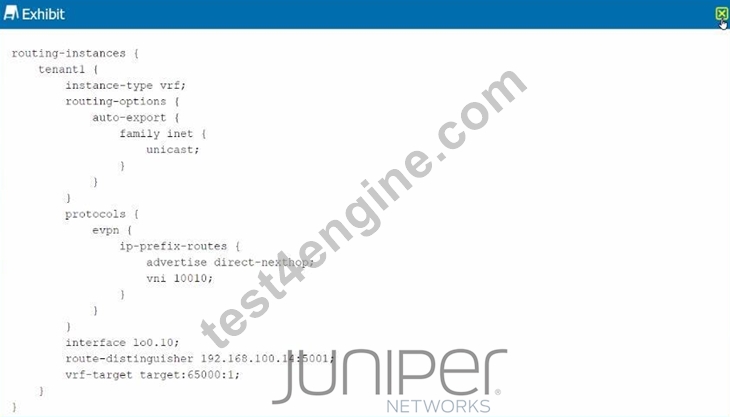
You want to enable the border leaf device to send Type 5 routes of local networks to the border leaf device in another data center. What must be changed to the configuration shown in the exhibit to satisfy this requirement?
- A. Add a VLAN configuration with an 13-interface to the tenant1 routing instance.
- B. Add encapsulation vxlan to the evpn hierarchy.
- C. Move vrf-target target: 65000:1 to the evpn hierarchy.
- D. Change: 5001 in the route-distinguisher to : 10010.
Answer: C
Explanation:
In this scenario, you want the border leaf device to advertise Type 5 EVPN routes to another border leaf in a different data center. Type 5 routes in EVPN are used to advertise IP prefixes, which means that for proper route advertisement, you need to configure the correct settings within the evpn hierarchy.
Step-by-Step Analysis:
* Understanding EVPN Type 5 Routes:
* EVPN Type 5 routes are used to advertise IP prefixes across EVPN instances, which allow different data centers or networks to exchange routing information effectively.
* VRF Target Setting:
* The vrf-target configuration is crucial because it defines the export and import policies for the VRF within the EVPN instance. For EVPN Type 5 routes to be advertised to other border leaf devices, the vrf-target needs to be correctly configured under the evpn hierarchy, not just within the routing instance.
Command to solve this:
move vrf-target target:65000:1 to evpn
* Other Options:
* Option B:Adding a VLAN configuration would not address the requirement to advertise Type 5 routes.
* Option C:Adding VXLAN encapsulation may be necessary for other scenarios but does not directly address the Type 5 route advertisement.
* Option D:Changing the route-distinguisher will differentiate routes but does not impact the advertisement of Type 5 routes to other data centers.
By moving the vrf-target to the evpn hierarchy, you enable the proper route advertisement, ensuring that the Type 5 routes for local networks are shared with other data center border leaf devices. This is aligned with best practices for multi-data center EVPN implementations, which emphasize the correct placement of routing policies within the EVPN configuration.
NEW QUESTION # 55
......
Juniper JN0-683 Exam Syllabus Topics:
| Topic | Details |
|---|---|
| Topic 1 |
|
| Topic 2 |
|
| Topic 3 |
|
| Topic 4 |
|
JN0-683 Dumps for JNCIP-DC Certified Exam Questions and Answer: https://www.test4engine.com/JN0-683_exam-latest-braindumps.html
Realistic Verified JN0-683 exam dumps Q&As - JN0-683 Free Update: https://drive.google.com/open?id=1PePGUW1vUd_TX9MW6288YAe2jEb3AmfQ