


Updated Oct-2022 Test Engine to Practice Test for 200-301 Exam Questions and Answers!
Cisco Certified Network Associate Exam Certification Sample Questions and Practice Exam
NEW QUESTION 233
Which mode allows access points to be managed by Cisco Wireless LAN Controllers?
- A. autonomous
- B. mobility express
- C. lightweight
- D. bridge
Answer: C
Explanation:
A Lightweight Access Point (LAP) is an AP that is designed to be connected to a wireless LAN (WLAN) controller (WLC). APs are "lightweight," which means that they cannot act independently of a wireless LAN controller (WLC). The WLC manages the AP configurations and firmware. The APs are "zero touch" deployed, and individual configuration of APs is not necessary.
Reference: https://www.cisco.com/c/en/us/support/docs/wireless/aironet-1200-series/70278-lap- faq.html
NEW QUESTION 234
Refer to the exhibit.
What is the effect of this configuration?
- A. All ARP packets are dropped by the switch
- B. Egress traffic is passed only if the destination is a DHCP server.
- C. All ingress and egress traffic is dropped because the interface is untrusted
- D. The switch discard all ingress ARP traffic with invalid MAC-to-IP address bindings.
Answer: D
Explanation:
Explanation
Dynamic ARP inspection is an ingress security feature; it does not perform any egress checking.
NEW QUESTION 235
Which access layer threat mitigation technique security by acting as a filter between trusted and untrusted traffic sources?
- A. a nondefault native VLAN
- B. dynamic packet inspection
- C. DHCP snooping
- D. 802.1X
Answer: D
NEW QUESTION 236
Refer to the exhibit.
An engineer built a new L2 LACP EtherChannel between SW1 and SW2 and executed these show commands to verify the work. Which additional task allows the two switches to establish an LACP port channel?
- A. Change the channel-group mode on SW1 to active or passive.
- B. Change the channel-group mode on SW2 to auto
- C. Configure the interface port-channel 1 command on both switches.
- D. Change the channel-group mode on SW1 to desirable.
Answer: A
NEW QUESTION 237
A frame that enters a switch fails the Frame Check Sequence. Which two interface counters are incremented?
(Choose two)
- A. giants
- B. CRC
- C. frame
- D. input errors
- E. runts
Answer: B,D
NEW QUESTION 238
Drag and drop to the characteristics of networking from the left onto the correct networking types on the right.
Answer:
Explanation:
NEW QUESTION 239
Drag the descriptions of device management from the left onto the types of device management on the right.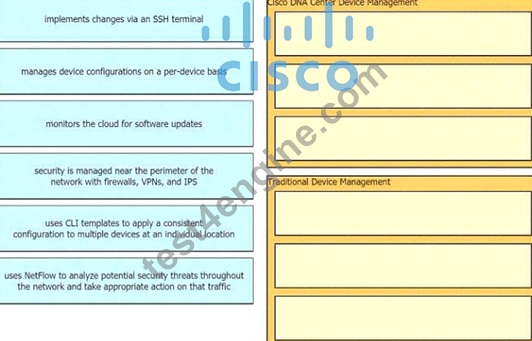
Answer:
Explanation:
Explanation

Cisco DNA Center Device Management
3. Monitor the cloud for software update
5. Uses CLI templates to apply a consistent configuration to multiple devices at an individual location
6. Uses NetFlow to analyse potential security threats throughout the network and take appropriate action on that traffic Traditional device management
2. Manages device configuration on a per-device basis
4. Security is managed near the perimeter of the network with firewalls, VPNs, and IPS
* Implements changes via an SSH terminal
NEW QUESTION 240
Refer to the exhibit. If OSPF is running on this network, how does Router2 handle traffic from Site B to 10.10.13.128/25 at Site A?
- A. It is unreachable and discards the traffic.
- B. It sends packets out of interface Fa0/1.
- C. It sends packets out of interface FaO/2.
- D. It load-balances traffic out of Fa0/1 and Fa0/2.
Answer: A
NEW QUESTION 241
Drag the descriptions of IP protocol transmissions from the left onto the IP traffic types on the right.
Answer:
Explanation:
Explanation

TCP
* Sends tranmissions in sequence
4. Transmits packets individually
6. Uses a lower transmission rate to ensure relability
UDP
5. Uses a higher transmission rate to support latency-sensitive application
2. Transmissions include an 8-byte header
3. Transmits packets as a stream
NEW QUESTION 242
Refer to the exhibit.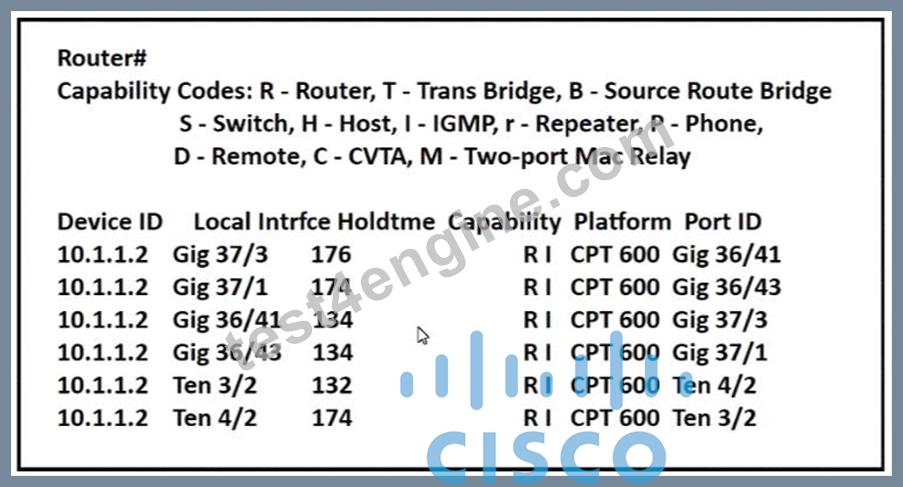
Which command provides this output?
- A. show ip route
- B. show ip interface
- C. show interface
- D. show cdp neighbor
Answer: D
NEW QUESTION 243
Which method does a connected trunk port use to tag VLAN traffic?
- A. IEEE 802 1Q
- B. IEEE 802 1D
- C. IEEE 802 1p
- D. IEEE 802 1w
Answer: A
NEW QUESTION 244
What is a function of Wireless LAN Controller?
- A. use SSIDs to distinguish between wireless clients.
- B. register with a single access point that controls traffic between wired and wireless endpoints.
- C. send LWAPP packets to access points.
- D. monitor activity on wireless and wired LANs
Answer: C
Explanation:
Explanation
Lightweight APs (LAPs) is devices require no initial configuration. LAPs use the Lightweight Access Point Protocol (LWAPP) to communicate with a WLAN controller (WLC), as shown in the below figure.
Controller-based APs are useful in situations where many APs are required in the network. As more APs are added, each AP is automatically configured and managed by the WLC.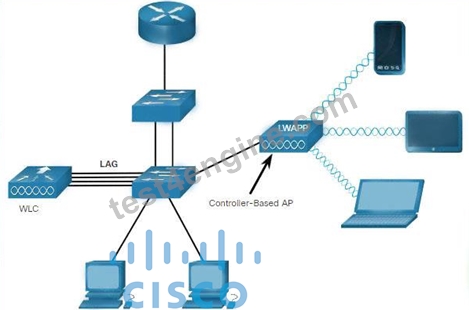
NEW QUESTION 245
Drag drop the descriptions from the left onto the correct configuration-management technologies on the right.
Answer:
Explanation:
NEW QUESTION 246
A user configured OSPF and advertised the Gigabit Ethernet interface in OSPF By default, which type of OSPF network does this interface belong to?
- A. point-to-multipoint
- B. broadcast
- C. nonbroadcast
- D. point-to-point
Answer: B
Explanation:
https://www.oreilly.com/library/view/cisco-ios-cookbook/0596527225/ch08s15.html The Broadcast network type is the default for an OSPF enabled ethernet interface (while Point-toPoint is the default OSPF network type for Serial interface with HDLC and PPP encapsulation).
NEW QUESTION 247
Which command enables a router to become a DHCP client?
- A. ip dhcp client
- B. ip dhcp pool
- C. ip helper-address
- D. ip address dhcp
Answer: D
NEW QUESTION 248
Refer to the exhibit.
Which two commands were used to create port channel 10? (Choose two )
- A. Option C
- B. Option A
- C. Option D
- D. Option E
- E. Option B
Answer: A,B
NEW QUESTION 249
What is the same for both copper and fiber interfaces when using SFP modules?
- A. They accommodate single-mode and multi-mode in a single module
- B. They support an inline optical attenuator to enhance signal strength
- C. They provide minimal interruption to services by being hot-swappable
- D. They offer reliable bandwidth up to 100 Mbps in half duplex mode
Answer: D
NEW QUESTION 250
After you deploy a new WLAN controller on your network, which two additional tasks should you consider? (choose two)
- A. deploy POE switches
- B. configure additional vlans
- C. configure multiple VRRP groups
- D. configure additional security policies
- E. deploy load balancers
Answer: D,E
NEW QUESTION 251
Which technology must be implemented to configure network device monitoring with the highest security?
- A. SNMPv3
- B. syslog
- C. IP SLA
- D. NetFlow
Answer: D
Explanation:
Section: Security Fundamentals
NEW QUESTION 252
How do TCP and UDP differ in the way they provide reliability for delivery of packets?
- A. TCP is a connectionless protocol that does not provide reliable delivery of data; UDP is a connection- oriented protocol that uses sequencing to provide reliable delivery.
- B. TCP does not guarantee delivery or error checking to ensure that there is no corruption of data, UDP provides message acknowledgement and retransmits data if lost.
- C. TCP uses windowing to deliver packets reliably; UDP provides reliable message transfer between hosts by establishing a three-way handshake.
- D. TCP provides flow control to avoid overwhelming a receiver by sending too many packets at once, UDP sends packets to the receiver in a continuous stream without checking.
Answer: D
Explanation:
Section: Network Fundamentals
NEW QUESTION 253
What are three parts of an IPv6 global unicast address? (Choose three.)
- A. a subnet ID that is used to identify networks inside of the local enterprise site
- B. an interface ID that is used to identify the local host on the network
- C. a global routing prefix that is used to identify the portion of the network address provided by a local administrator
- D. a global routing prefix that is used to identify the network portion of the address that has been provided by an ISP
- E. an interface ID that is used to identify the local network for a particular host.
Answer: A,B,D
NEW QUESTION 254
Drag the descriptions of IP protocol transmissions from the left onto the IP traffic types on the right.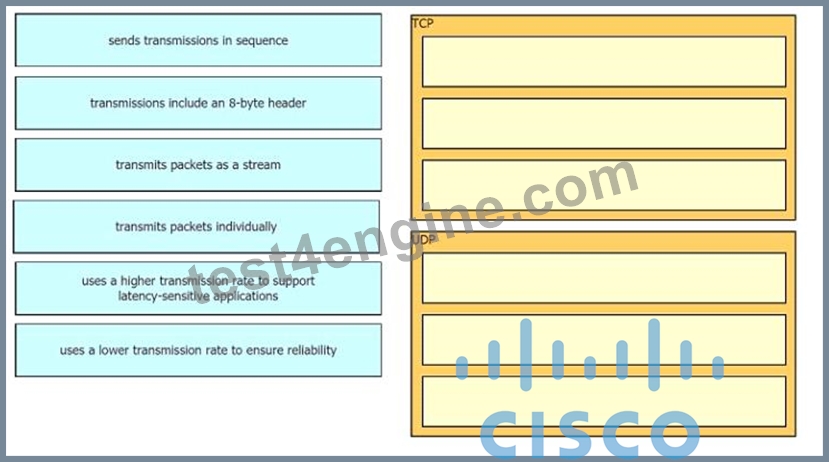
Answer:
Explanation:
NEW QUESTION 255
Refer to the exhibit.
After the election process what is the root bridge in the HQ LAN?
- A. Switch 4
- B. Switch 3
- C. Switch 2
- D. Switch 1
Answer: B
NEW QUESTION 256
Which three statements about IPv6 prefixes are true? (Choose three.)
- A. FC00::/7 is used in private networks.
- B. FE80::/8 is used for link-local unicast.
- C. FF00::/8 is used for IPv6 multicast.
- D. FEC0::/10 is used for IPv6 broadcast.
- E. 2001::1/127 is used for loopback addresses.
- F. FE80::/10 is used for link-local unicast.
Answer: A,C,F
NEW QUESTION 257
......
Certification dumps CCNA 200-301 guides - 100% valid: https://www.test4engine.com/200-301_exam-latest-braindumps.html
100% Pass Your 200-301 Cisco Certified Network Associate Exam at First Attempt with Test4Engine: https://drive.google.com/open?id=1eClBK2cLXryJ_0uz-jpGxxbMbXJlDIV4