


Ultimate Guide to the NSE7_SDW-7.2 - Latest Jun 18, 2025 Edition Available Now
2025 Updated Verified Pass NSE7_SDW-7.2 Exam - Real Questions and Answers
NEW QUESTION # 32
Which two statements are true about using SD-WAN to steer local-out traffic? (Choose two.)
- A. By default, local-out traffic does not use SD-WAN.
- B. FortiGate does not consider the source address of the packet when matching an SD-WAN rule for
local-out traffic. - C. By default, FortiGate does not check if the selected member has a valid route to the destination.
- D. You must configure each local-out feature individually, to use SD-WAN.
Answer: A,D
NEW QUESTION # 33
Refer to the exhibit.
The device exchanges routes using IBGP.
Which two statements are correct about the IBGP configuration and routing information on the device?
(Choose two.)
- A. You can run the get router info routing-table database command to display the additional paths.
- B. additional-path is enabled.
- C. Each BGP route is three hops away from the destination.
- D. ibgp-multipath is disabled.
Answer: A,B
NEW QUESTION # 34
Refer to the exhibits.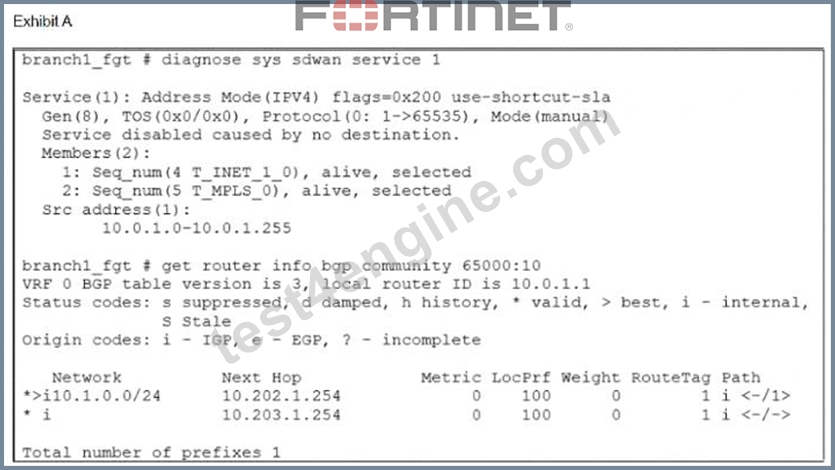
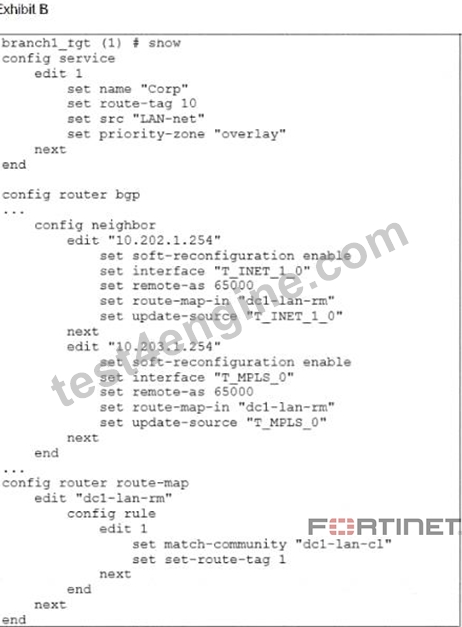
Exhibit A shows the SD-WAN rule status and the learned BGP routes with community 65000:10.
Exhibit B shows the SD-WAN rule configuration, the BGP neighbor configuration, and the route map
configuration.
The administrator wants to steer corporate traffic using routes tags in the SD-WAN rule ID 1.
However, the administrator observes that the corporate traffic does not match the SD-WAN rule ID 1.
Based on the exhibits, which configuration change is required to fix issue?
- A. In the BGP neighbor configuration, apply the route map dcl-lab-rm in the outbound direction.
- B. In the dcl-lab-rm route map configuration, set set-route-tag to 10.
- C. In the dcl-lab-rm route map configuration, unset match-community.
- D. In SD-WAN rule ID 1, change the destination to use ISDB entries.
Answer: A
NEW QUESTION # 35
What are two benefits of choosing packet duplication over FEC for data loss correction on noisy links?
(Choose two.)
- A. Packet duplication does not require a route to the destination.
- B. Packet duplication can leverage multiple IPsec overlays for sending additional data.
- C. Packet duplication uses smaller parity packets which results in less bandwidth consumption.
- D. Packet duplication supports hardware offloading.
Answer: B,D
NEW QUESTION # 36
Refer to the exhibit.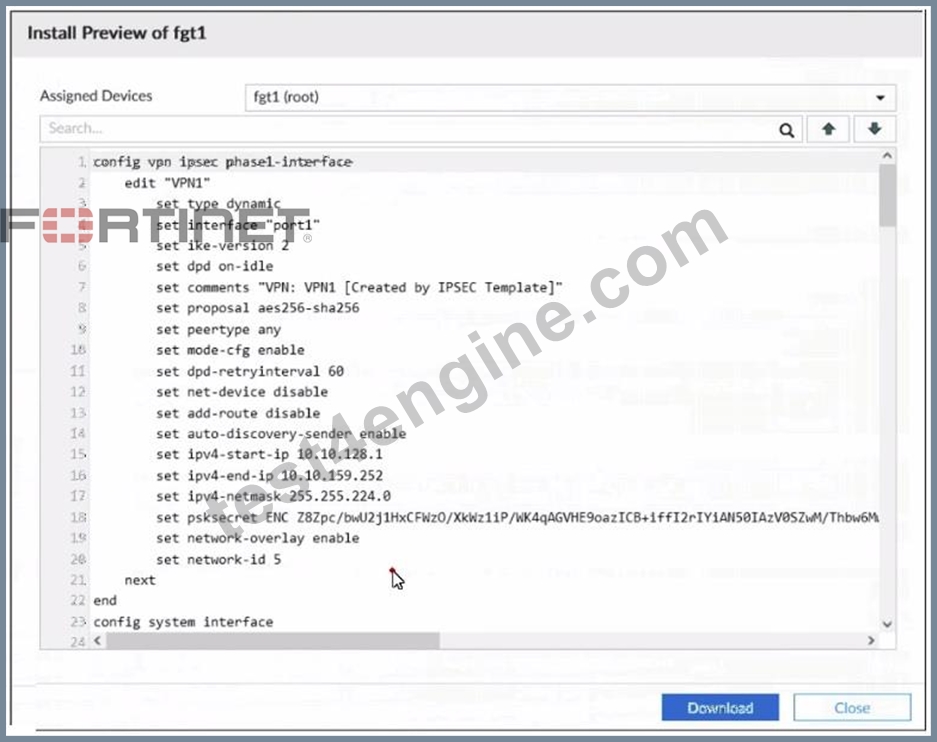
An administrator used the SD-WAN overlay template to prepare an IPsec configuration for a hub-and-spoke SD-WAN topology. The exhibit shows the installation preview for one FortiGate device. In the exhibit, which statement best describes the configuration applied to the FortiGate device?
- A. It is a spoke device that establishes dynamic IPsec tunnels to the hub. It can send ADVPN shortcut requests.
- B. It is a spoke device that establishes dynamic IPsec tunnels to the hub. The subnet range is 10.10.128.0/23.
- C. It is a hub device. It can send ADVPN shortcut offers.
- D. It is a hub device and will automatically discover the spoke devices that are in the SD-WAN topology.
Answer: A
Explanation:
According to the SD-WAN 7.2 Study Guide, the SD-WAN overlay template simplifies the configuration of IPsec tunnels in a hub-and-spoke topology. The template defines the following parameters:
type: dynamic for spokes, static for hubs
interface: the WAN interface to use for the IPsec tunnel
network-overlay: enable for spokes, disable for hubs
network-id: a unique identifier for each spoke
auto-discovery-sender: enable for hubs, disable for spokes
auto-discovery-receiver: enable for spokes, disable for hubs
Based on the exhibit, the FortiGate device has the following configuration:
type: dynamic
interface: port1
network-overlay: enable
network-id: 5
auto-discovery-sender: disable
auto-discovery-receiver: enable
Therefore, the FortiGate device is a spoke that establishes dynamic IPsec tunnels to the hub. It also has the network-overlay and auto-discovery-receiver options enabled, which means it can send ADVPN shortcut requests to other spokes when it receives a shortcut offer from the hub
NEW QUESTION # 37
Refer to the exhibits.
Exhibit A -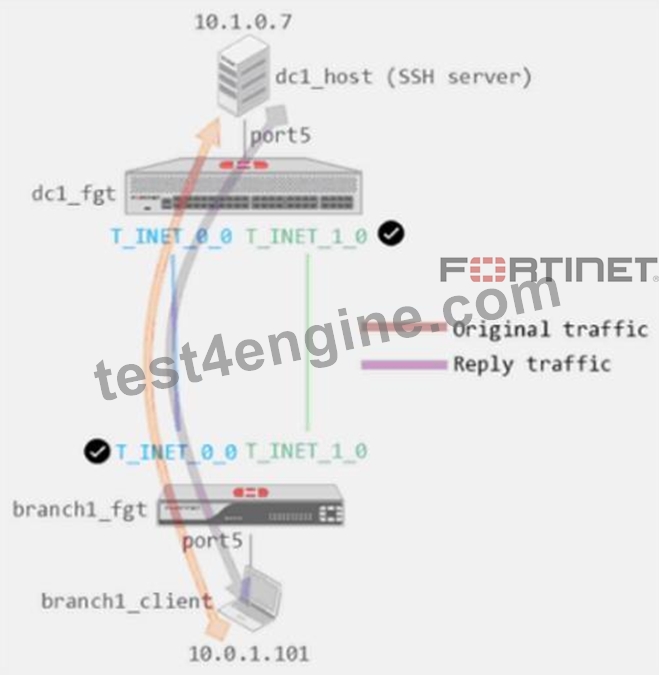
Exhibit B -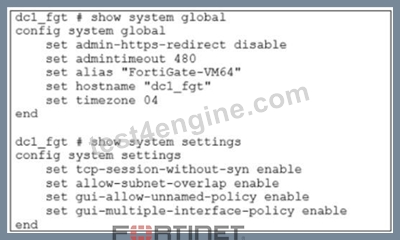
Exhibit A shows a site-to-site topology between two FortiGate devices: branch1_fgt and dc1_fgt. Exhibit B shows the system global and system settings configuration on dc1_fgt.
When branch1_client establishes a connection to dc1_host, the administrator observes that, on dc1_fgt, the reply traffic is routed over T_INET_0_0, even though T_INET_1_0 is the preferred member in the matching SD-WAN rule.
Based on the information shown in the exhibits, what configuration change must be made on dc1_fgt so dc1_fgt routes the reply traffic over T_INET_1_0?
- A. Enable auxiliary-session under config system settings.
- B. Disable allow-subnet-overlap under config system settings.
- C. Disable t#p-session-without-syn under config system settings.
- D. Enable snat-route-change under config system global.
Answer: A
NEW QUESTION # 38
Refer to the exhibit.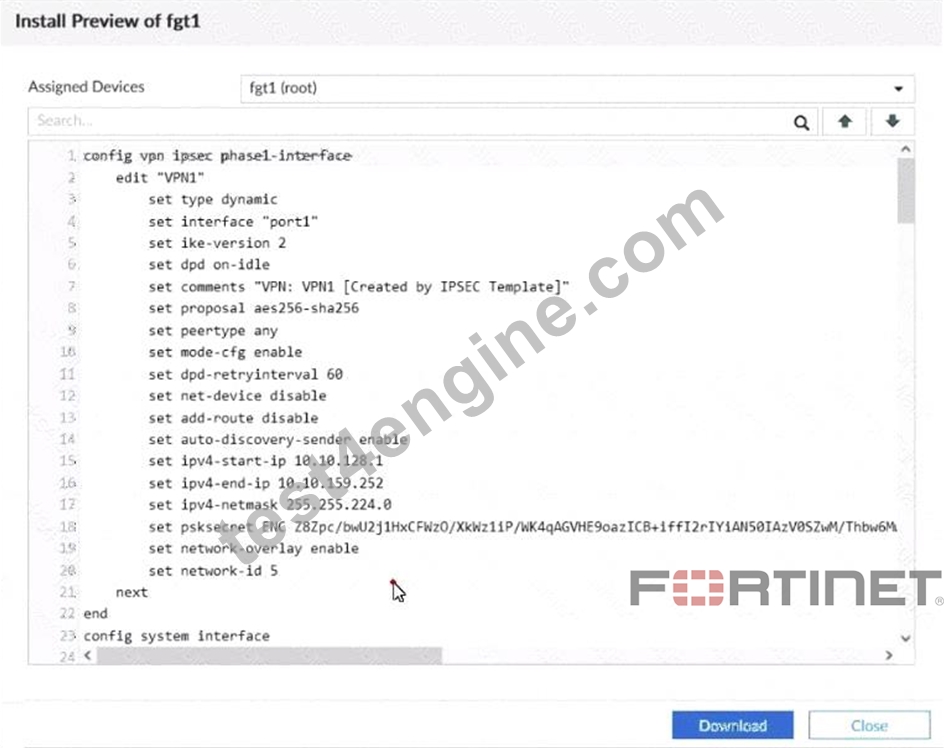
An administrator used the SD-WAN overlay template to prepare an IPsec configuration for a hub-and-spoke SD-WAN topology. The exhibit shows the installation preview for one FortiGate device. In the exhibit, which statement best describes the configuration applied to the FortiGate device?
- A. It is a spoke device that establishes dynamic IPsec tunnels to the hub. It can send ADVPN shortcut requests.
- B. It is a hub device. It can send ADVPN shortcut offers.
- C. It is a spoke device that establishes dynamic IPsec tunnels to the hub. The subnet range is
10.10.128.0/23. - D. It is a hub device and will automatically discover the spoke devices that are in the SD-WAN topology.
Answer: A
Explanation:
According to the SD-WAN 7.2 Study Guide, the SD-WAN overlay template simplifies the configuration of IPsec tunnels in a hub-and-spoke topology. The template defines the following parameters:
* type: dynamic for spokes, static for hubs
* interface: the WAN interface to use for the IPsec tunnel
* network-overlay: enable for spokes, disable for hubs
* network-id: a unique identifier for each spoke
* auto-discovery-sender: enable for hubs, disable for spokes
* auto-discovery-receiver: enable for spokes, disable for hubs
Based on the exhibit, the FortiGate device has the following configuration:
* type: dynamic
* interface: port1
* network-overlay: enable
* network-id: 5
* auto-discovery-sender: disable
* auto-discovery-receiver: enable
Therefore, the FortiGate device is a spoke that establishes dynamic IPsec tunnels to the hub. It also has the network-overlay and auto-discovery-receiver options enabled, which means it can send ADVPN shortcut requests to other spokes when it receives a shortcut offer from the hub
NEW QUESTION # 39
Which best describes the SD-WAN traffic shaping mode that bases itself on a percentage of available bandwidth?
- A. Reverse-policy shaping mode
- B. Interface-based shaping mode
- C. Per-IP shaping mode
- D. Shared-policy shaping mode
Answer: B
Explanation:
Interface-based shaping goes further, enabling traffic controls based on percentage of the interface bandwidth.
NEW QUESTION # 40
Refer to the exhibit.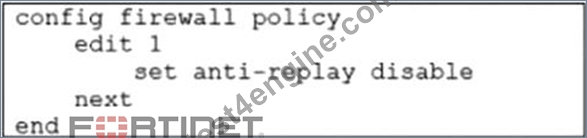
In a dual-hub hub-and-spoke SD-WAN deployment, which is a benefit of disabling theanti-replaysetting on
the hubs?
- A. It instructs the hub to not check the ESP sequence numbers on IPsec traffic, to improve performance.
- B. It instructs the hub to skip content inspection on TCP traffic, to improve performance.
- C. It instructs the hub to disable TCP sequence number check, which is required for TCP sessions
originated from spokes to fail over back and forth between the hubs. - D. It instructs the hub to disable the reordering of TCP packets on behalf of the receiver, to improve
performance.
Answer: C
NEW QUESTION # 41
Refer to the exhibit.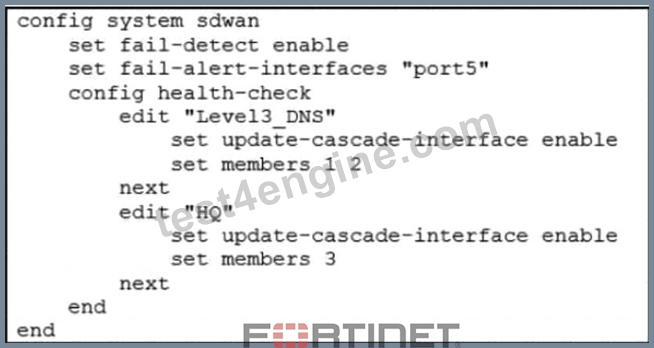
Based on the exhibit, which action does FortiGate take?
- A. FortiGate bounces port5 after it detects all SD-WAN members as dead.
- B. FortiGate brings up port5 after it detects all SD-WAN members as alive.
- C. FortiGate fails over to the secondary device after it detects all SD-WAN members as dead.
- D. FortiGate brings down port5 after it detects all SD-WAN members as dead.
Answer: A
NEW QUESTION # 42
Refer to the exhibit.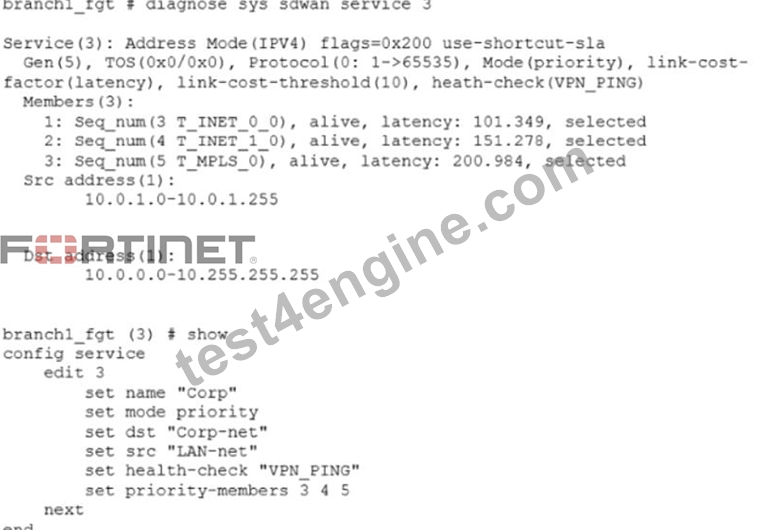
The exhibit shows the SD-WAN rule status and configuration.
Based on the exhibit, which change in the measured latency will make T_MPLS_0 the new preferred member?
- A. When T_INET_0_0 has a latency of 250 ms.
- B. When T_N1PLS_0 has a latency of 80 ms.
- C. When T_INET_0_0 and T_MPLS_0 have the same latency.
- D. When T_MPLS_0 has a latency of 100 ms.
Answer: B
NEW QUESTION # 43 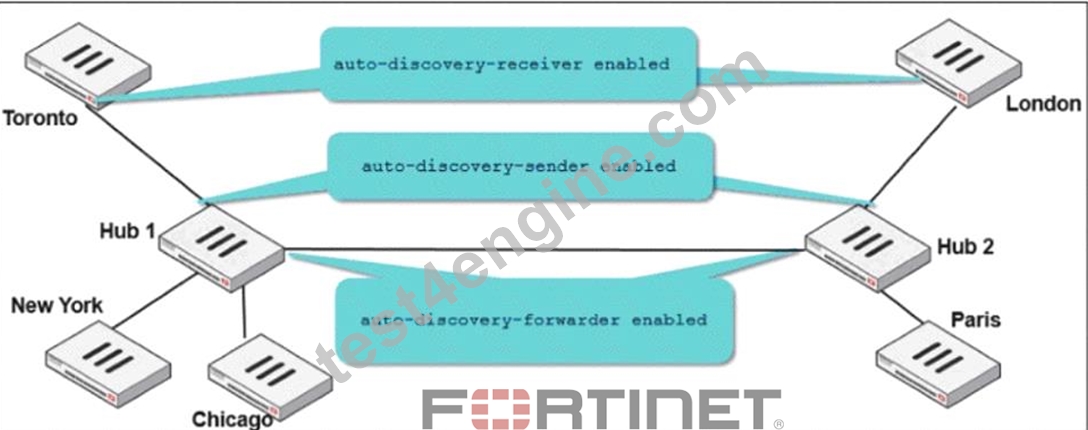
Two hub-and-spoke groups are connected through a site-to-site IPsec VPN between Hub 1 and Hub 2. The administrator configured ADVPN on both hub-and-spoke groups.
Which two outcomes are expected if a user in Toronto sends traffic to London? (Choose two.)
- A. Toronto needs to establish a site-to-site tunnel with Hub 2 to bypass Hub 1.
- B. Traffic from Toronto to London triggers the dynamic negotiation of a direct site-to-site VPN.
- C. London generates an IKE information message that contains the Toronto public IP address.
- D. The first packets from Toronto to London are routed through Hub 1 then to Hub 2.
Answer: B,D
NEW QUESTION # 44
Which two tasks are part of using central VPN management? (Choose two.)
- A. You configure VPN communities to define common IPsec settings shared by all VPN gateways.
- B. You can configure full mesh, star, and dial-up VPN topologies.
- C. FortiManager installs VPN settings on both managed and external gateways.
- D. You must enable VPN zones for SD-WAN deployments.
Answer: A,B
NEW QUESTION # 45
Which two statements are true about using SD-WAN to steer local-out traffic? (Choose two.)
- A. By default, local-out traffic does not use SD-WAN.
- B. By default, FortiGate does not check if the selected member has a valid route to the destination.
- C. You must configure each local-out feature individually, to use SD-WAN.
- D. FortiGate does not consider the source address of the packet when matching an SD-WAN rule for local-out traffic.
Answer: A,C
NEW QUESTION # 46
Refer to the exhibit, which shows an SD-WAN zone configuration on the FortiGate GUI.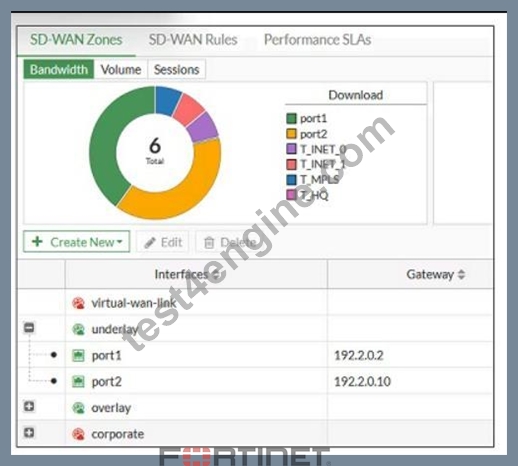
Based on the exhibit, which statement is true?
- A. You can move port1 from the underlay zone to the overlay zone.
- B. You can delete the virtual-wan-link zone because it contains no member.
- C. The corporate zone contains no member.
- D. The overlay zone contains four members.
Answer: C
Explanation:
Based on the exhibit, the "corporate" zone contains no member (B). In the FortiGate GUI, zones without members do not display any interfaces listed under them, which is the case for the corporate zone in the exhibit. References: This conclusion is based on standard Fortinet GUI interpretation and the operational logic of SD-WAN zones as per Fortinet's guidelines and user interface standards.
NEW QUESTION # 47
Which CLI command do you use to perform real-time troubleshooting for ADVPN negotiation?
- A. diagnose debug application ike
- B. diagnose vpn tunnel list
- C. get ipsec tunnel list
- D. get router info routing-table all
Answer: A
NEW QUESTION # 48
Refer to the exhibit.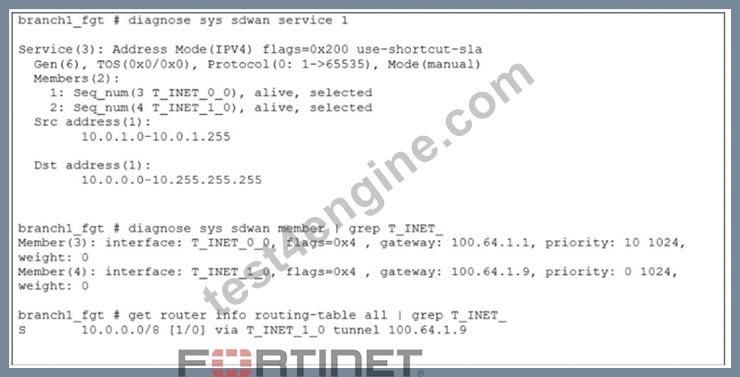
An administrator is troubleshooting SD-WAN on FortiGate. A device behind branch1_fgt generates traffic to the 10.0.0.0/8 network. The administrator expects the traffic to match SD-WAN rule ID 1 and be routed over T_INET_0_0. However, the traffic is routed over T_INET_1_0.
Based on the output shown in the exhibit, which two reasons can cause the observed behavior? (Choose two.)
- A. The traffic matches a regular policy route configured with T_INET_1_0 as the outgoing device.
- B. T_INET_1_0 has a higher member configuration priority than T_INET_0_0.
- C. T_INET_0_0 does not have a valid route to the destination.
- D. T_INET_1_0 has a lower route priority value (higher priority) than T_INET_0_0.
Answer: A,C
NEW QUESTION # 49
Refer to the exhibit.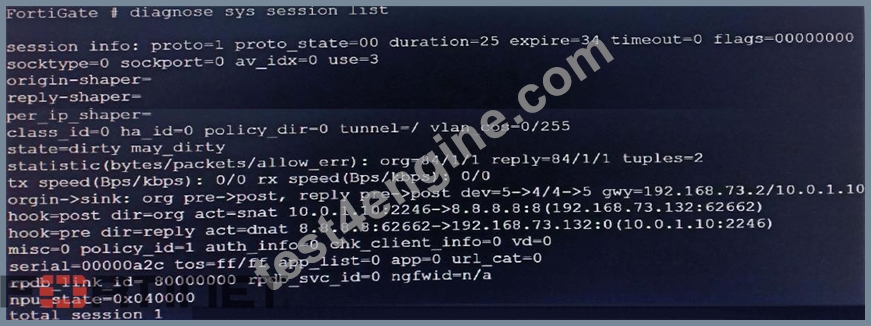
Based on the exhibit, which statement about FortiGate re-evaluating traffic is true?
- A. FortiGate has terminated the session after a change on policy ID 1.
- B. Changes have been made on firewall policy ID 1 on FortiGate.
- C. Firewall policy ID 1 has source NAT disabled.
- D. The type of traffic defined and allowed on firewall policy ID 1 is UDP.
Answer: B
NEW QUESTION # 50
Refer to the exhibit.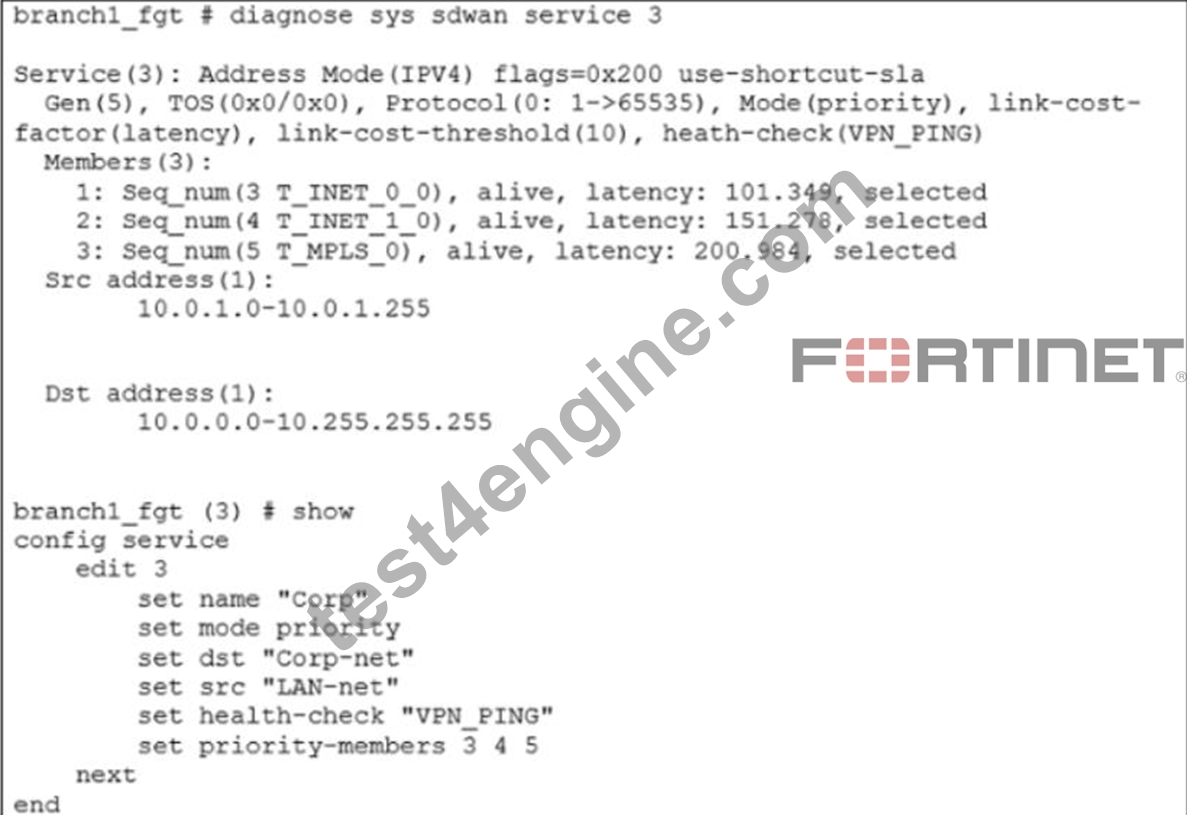
The exhibit shows the SD-WAN rule status and configuration.
Based on the exhibit, which change in the measured latency will make T_MPLS_0 the new preferred member?
- A. When T_INET_0_0 has a latency of 250 ms.
- B. When T_N1PLS_0 has a latency of 80 ms.
- C. When T_INET_0_0 and T_MPLS_0 have the same latency.
- D. When T_MPLS_0 has a latency of 100 ms.
Answer: B
NEW QUESTION # 51
Refer to the exhibit.
The device exchanges routes using IBGP.
Which two statements are correct about the IBGP configuration and routing information on the device? (Choose two.)
- A. You can run the get router info routing-table database command to display the additional paths.
- B. additional-path is enabled.
- C. Each BGP route is three hops away from the destination.
- D. ibgp-multipath is disabled.
Answer: A,B
NEW QUESTION # 52
Refer to the exhibits.
Exhibit A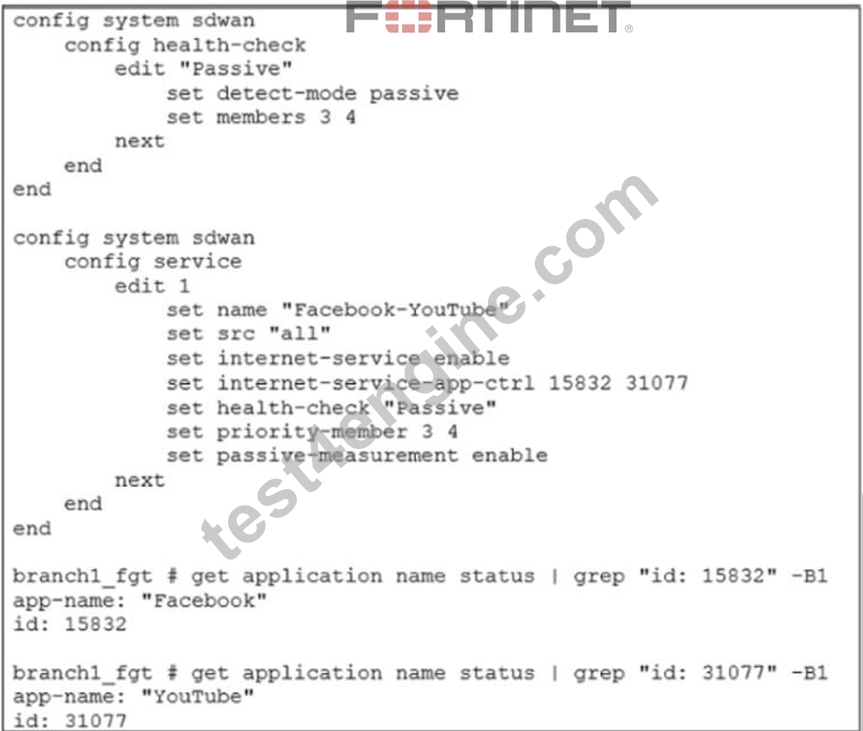
Exhibit B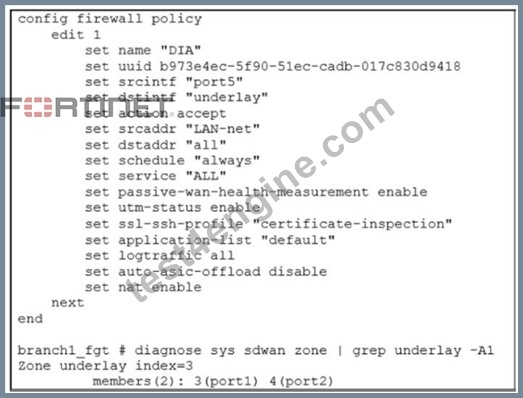
Exhibit A shows the SD-WAN performance SLA configuration, the SD-WAN rule configuration, and the application IDs of Facebook and YouTube. Exhibit B shows the firewall policy configuration and the underlay zone status.
Based on the exhibits, which two statements are correct about the health and performance of port1 and port2?
(Choose two.)
- A. FortiGate identifies the member as dead when there is no Facebook and YouTube traffic passing through the member.
- B. Non-TCP Facebook and YouTube traffic are not used for performance measurement.
- C. The performance is an average of the metrics measured for Facebook and YouTube traffic passing through the member.
- D. FortiGate is unable to measure jitter and packet loss on Facebook and YouTube traffic.
Answer: B,C
Explanation:
Study Guide 7.2, pages 103 - 104. Another comment said "because without using application Control on the firewall policy, SDWAN can't work" but there is a app control "default" defined on config.
NEW QUESTION # 53
Which CLI command do you use to perform real-time troubleshooting for ADVPN negotiation?
- A. diagnose debug application ike
- B. diagnose vpn tunnel list
- C. get ipsec tunnel list
- D. get router info routing-table all
Answer: A
Explanation:
IKE real-time debug - useful when debugging ADVPN shortcut messages and spoke-to-spoke negotiations.
* diagnose debug console timestamp enable
* diagnose vpn ike log filter clear
* diagnose vpn ike log filter mdst-addr4 <ip.of.hub> <ip.of.spoke>
* diagnose debug application ike -1
* diagnose debug enable
NEW QUESTION # 54
......
Dumps Moneyack Guarantee - NSE7_SDW-7.2 Dumps Approved Dumps: https://www.test4engine.com/NSE7_SDW-7.2_exam-latest-braindumps.html
Verified NSE7_SDW-7.2 Exam Dumps PDF [2025] Access using Test4Engine: https://drive.google.com/open?id=1BFhNnf9OhwCSROp3rOLjJMGhK8_dHcb7