


Updated Sep-2021 Test Engine to Practice Test for CBAP Exam Questions and Answers!
Cetified business analysis professional (CBAP) appliaction Certification Sample Questions and Practice Exam
NEW QUESTION 158
Company A is a nation-wide leader in commercial demolition. Having just celebrated its 100th year of operations, the company decided to begin doing work internationally. The current system used for reporting company finances is unable to keep pace with the potential demands of doing work in geographically dispersed locations. Therefore, the company decided to replace its client-based Profit & Loss (P&L) reporting system with a more robust, web-based system. This will ensure transparency across the organization and enable better decision making.
The business analyst (BA) at Company A has recently completed several rounds of elicitation to determine the requirements for the new, web-based system. Over 1250 requirements were elicited. An initial Requirements Traceability Matrix (RTM) has been drafted, and a subset of the RTM can be seen below: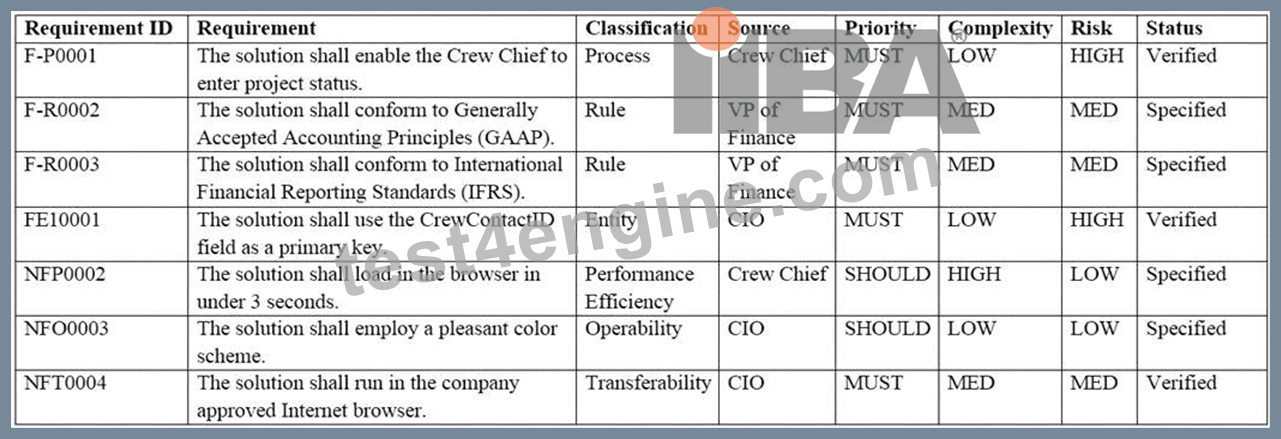
The risk associated with Requirement ID F-P0001 is HIGH. The BA has gone back to the Crew Chief to determine why this requirement's risk is HIGH. The Crew Chief stated that it was based on an assumption.
Which of the following assumptions would make this requirement's risk high?
- A. The system will be inaccessible in remote locations.
- B. The web-based interface will be complex.
- C. The users will require specialized training.
- D. The cost of the solution outweighs its benefit.
Answer: A
NEW QUESTION 159
You are the business analyst for your organization and are in the process of creating the solution approach for a technology problem.
Which one of the following definitions best describes the solution approach?
- A. It is an uncertain event or condition that may have a positive or negative impact on the abilities of the chartered project.
- B. It is the documentation and control of changes to the product scope as approved by the project stakeholders.
- C. Defines the general approach that will be taken to create or acquire new capabilities required to meet the business need.
- D. Decomposes the project scope into smaller deliverables; each deliverable is subdivided repeatedly until the deliverable cannot or should not be broken down any further.
Answer: C
NEW QUESTION 160
Which of the following is an estimate based on past projects to predict the current cost and/or duration of the current project?
- A. Past estimate
- B. Current estimate
- C. Top-down estimate
- D. Past project cost
Answer: C
Explanation:
Explanation/Reference:
Explanation:
NEW QUESTION 161
You are the business analyst for your organization and are working on prioritizing the project requirements. Management has asked you to prioritize the requirements based on the cost-benefit analysis for the requirements' value to the organization.
What basis for prioritization are you using in this instance?
- A. Business value
- B. Likelihood of success
- C. Urgency
- D. Stakeholder agreement
Answer: A
NEW QUESTION 162
Your organization is trying to determine which one of two opportunities they will pursue. The Project A is worth
$235,987 and Project B is worth $567,000 but carries significant risk. The organization elects to purse Project B and not Project A.
What is the opportunity cost in this scenario?
- A. $331013
- B. There is not enough information to know as the risk for Project B has not been quantified.
- C. $567,000
- D. $235,987
Answer: D
NEW QUESTION 163
Which of the following techniques is used to test customer acceptance of the solution and to measure marketplace demand?
- A. Technology Assessment
- B. Market Survey
- C. Interviews
- D. Prototyping
Answer: B
Explanation:
Explanation/Reference:
Explanation:
NEW QUESTION 164
Which of the following techniques involves attempting to make and numerically determine the probability of various adverse events and measuring the likely extent of the losses?
- A. Qualitative risk analysis
- B. Quantitative risk analysis
- C. Risk assessment
- D. Risk analysis
Answer: B
NEW QUESTION 165
Which of the following defines how the project will be estimated, budgeted, and how changes to cost will be managed?
- A. Cost variance reports
- B. Coercive power
- C. Cost management plan
- D. Control chart
Answer: C
NEW QUESTION 166
Zoe is the business analyst for her organization. She is currently prioritizing the requirements based on the implementation difficulty of the requirements to help with the solution planning.
Which of the following best describes the approach Zoe is taking with requirements prioritization?
- A. The requirements are ranked from easiest to hardest to implement.
- B. The requirements are categorized by the likelihood of management approving the requirem ents.
- C. The requirements are ranked most difficult to easiest to implement.
- D. The requirements are categorized by type of work, and then ranked within each category of ease of implementation to difficulty of implementation.
Answer: A
Explanation:
Section: Volume B
Explanation/Reference:
NEW QUESTION 167
Which of the following defines how the project scope should be created, executed, monitored and controlled, and then validated?
- A. Schedule management plan
- B. Scope variance plan
- C. Scope management plan
- D. Staffing management plan
Answer: C
Explanation:
Explanation/Reference:
Explanation:
NEW QUESTION 168
Henry is the business analyst for the UUH Organization. Currently Henry is working on several work products as part of the requirements development process. He may need to share these work products with the stakeholders.
Which of the following is not an example of a work product?
- A. Interview questions and notes
- B. Requirements documentation
- C. Meeting agendas and minutes
- D. Presentation slides
Answer: B
NEW QUESTION 169
An insurance company wants to increase sales by 15% and customer retention by 10% within 1 calendar year.
Various strategies to achieve this were considered and a restructure to the existing pricing model is selected to help achieve these goals.
A business analyst (BA) works with stakeholders such as actuaries, product specialists, sales staff, risk managers, and underwriters who agree to applying varying levels of discounts to customers based on:
*Total annual premium the customer has with the company (Financial worth)
*Time with the insurance company (Loyalty)
Various financial models are considered but the stakeholders agree that an initial applicable discount is determined based on the customer's overall premium: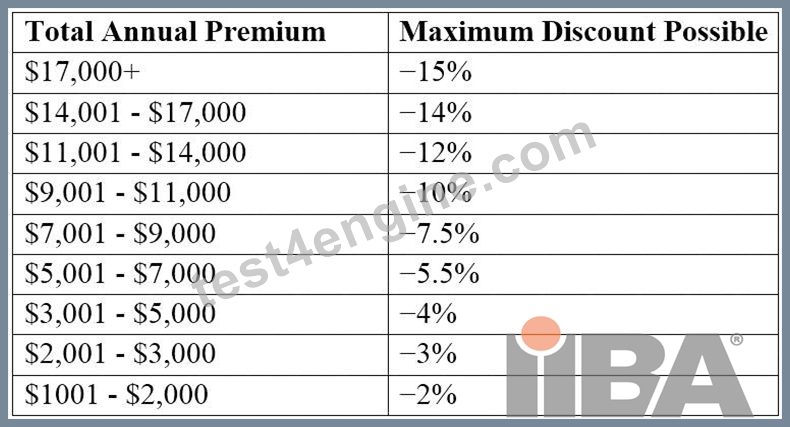
The percentage of the maximum possible discount available to the customer is adjusted based on time with the company:
If within the first six months, customer retention increased by 5 % and sales increased by 6%, then when will the desired sales and retention goals be achieved assuming the trend continues at the same pace?
- A. Sales - 2.5 years; Retention - 2 years
- B. Sales - 2 years; Retention - 18 months
- C. Sales - 18 months; Retention - 1 year
- D. Sales - 3 years; Retention - 1 year
Answer: C
NEW QUESTION 170
Which one of the following diagrams when properly laid out is always laid in a left to right display to properly reflect the chronology of all project work?
- A. Project schedule network diagram
- B. Time-scaled schedule network diagram
- C. Arrow diagramming method
- D. Influence diagram
Answer: A
Explanation:
Section: Volume C
Explanation/Reference:
NEW QUESTION 171
In a requirements elicitation effort, the business analyst (BA) needs to define boundaries for business domains, categorize and create a hierarchy of items, and show data sources and their relationships for specific audiences.
Which of the following modeling formats should the BA use?
- A. Matrices
- B. Prototype
- C. Graphics
- D. Diagrams
Answer: D
NEW QUESTION 172
Which of the following processes is used to make certain that the project team members are completing the project work according to the project plan?
- A. Quality management plan
- B. Quality control
- C. Project scope management
- D. Project time management
Answer: B
NEW QUESTION 173
Which of the following quantitative risk analysis techniques relies on experience and past data to compute the probability and impact of risks on project objectives?
- A. Sensitivity analysis
- B. Interviewing
- C. Probability distribution
- D. Modeling and simulation
Answer: B
NEW QUESTION 174
Which of the following roles approves the project scope statement, phase gate reviews, solution validations, scope changes, and project success criteria?
- A. Stakeholder
- B. Project manager
- C. Subject matter expert
- D. Solution owner
Answer: D
Explanation:
Section: Volume C
Explanation/Reference:
NEW QUESTION 175
You are creating a model that shows how data moves through a system. Each function that modifies the data in any manner is identified, decomposed to smaller levels, and the system is completely described from start to storage.
What type of a modeling technique are you using in this scenario?
- A. Functional decomposition
- B. Organization modeling
- C. Data flow diagramming
- D. Work decomposition
Answer: C
NEW QUESTION 176
As a program manager, you decided to overlap two phases of your program. Which of the following terms best describe your act?
- A. Fast tracking
- B. Rolling
- C. Lead time
- D. Crashing
Answer: A
Explanation:
Section: Volume C
Explanation/Reference:
NEW QUESTION 177
Martha is observing Sarah complete several complex steps as part of her business analysis requirements elicitation process. In this instance Martha working alongside Sarah is actually helping Sarah complete the work so that Martha can understand all of the steps Sarah must complete.
What type of requirements elicitation technique is Martha using?
- A. Active observation
- B. Shadowing
- C. Cross training requirements elicitation
- D. Progressive elaboration
Answer: A
NEW QUESTION 178
You are the business analyst for your organization. Management has asked you to create a plan that will define the proposed structure and schedule for communicating the business analysis activities to the appropriate stakeholders.
What plan does management want you to create?
- A. Business Analysis Plan
- B. Business Analysis Communications Plan
- C. Stakeholder Management Plan
- D. Communications management plan
Answer: B
NEW QUESTION 179
A big construction company has grown into a group of 17 companies spread across the country. The rationale behind forming the group was to become more competitive in bidding for federal and regional government contracts. Another reason was to increase consolidated profitability by lowering the cost of materials and using combined assets more efficiently. Disjointed technological capabilities of the individual companies impede gathering the data needed to make decisions on both handling materials and allocating the resources.
What improvement opportunity does this represent?
- A. Enhance access to the relevant information
- B. Deploy a new system across the companies
- C. Develop a repository of information from each company
- D. Create a business model canvas to outline business needs
Answer: A
NEW QUESTION 180
Which of the following displays the relative importance of the defects?
- A. User Documentation
- B. Gantt chart
- C. Pareto diagram
- D. Flowchart
Answer: C
Explanation:
Explanation/Reference:
Explanation:
NEW QUESTION 181
Which of the following is the comparison of planned project results with actual project results?
- A. Statistical Sampling
- B. Variance analysis
- C. Cost-benefit analysis
- D. Trend analysis
Answer: B
NEW QUESTION 182
Which of the following defines how the project will be estimated, budgeted, and how changes to cost will be managed?
- A. Cost variance reports
- B. Coercive power
- C. Cost management plan
- D. Control chart
Answer: C
Explanation:
Explanation/Reference:
Explanation:
NEW QUESTION 183
......
Certification dumps Certified Business Analysis Professional CBAP guides - 100% valid: https://www.test4engine.com/CBAP_exam-latest-braindumps.html
100% Pass Your CBAP Cetified business analysis professional (CBAP) appliaction at First Attempt with Test4Engine: https://drive.google.com/open?id=1yzOcpYIjytNRoP5F42X2j8YF36IEBo9z