


View All aPHRi Actual Exam Questions Answers and Explanations for Free Jun-2026
The Most In-Demand HRCI aPHRi Pass Guaranteed Quiz
HRCI aPHRi Certification Exam is a valuable credential for professionals who are seeking to establish themselves in the HR field. It provides a solid foundation of knowledge that can be built upon through further education and experience. Associate Professional in Human Resources - International certification can also lead to increased job opportunities and higher salaries. Additionally, the HRCI aPHRi Certification Exam is a stepping stone towards more advanced HR certifications such as the PHR or SPHR, which are highly regarded in the industry.
NEW QUESTION # 28
A company wants to analyze its employee turnover rate over the past five years. Which data compilation tool should HR use to create graphs and charts for better visualization?
- A. Spreadsheets like Microsoft Excel to create visual representations
- B. Time tracking software for employee attendance
- C. Word processing software for creating documents
- D. Cloud storage solutions for data accessibility
Answer: A
Explanation:
Spreadsheets like Microsoft Excel should be used to analyze employee turnover rate and create graphs and charts for better visualization. Excel provides various tools and functions to create comprehensive visual data representations.
NEW QUESTION # 29
Which of the following is appropriate to include on the careers page of an organization's website?
- A. Financial statements
- B. List of products
- C. Benefit information
- D. Internal staff notices
Answer: C
Explanation:
Comprehensive and Detailed in Depth Explanation:
The careers page of an organization's website is designed to attract potential candidates by showcasing job opportunities and reasons to join the company. Including benefit information (e.g., health insurance, vacation time) is appropriate because it highlights the total rewards package, making the organization more appealing to job seekers.
* Option A (Internal staff notices):These are for current employees, not external candidates, and are not appropriate for a careers page.
* Option B (List of products):This belongs on a product or services page, not the careers page.
* Option C (Financial statements):These are for investors or stakeholders, not job candidates.
NEW QUESTION # 30
At which stage does HR evaluate the effectiveness of a training program?
- A. Implementation
- B. Needs analysis
- C. Development
- D. Post-testing
Answer: D
Explanation:
Comprehensive and Detailed in Depth Explanation:
Evaluating the effectiveness of a training program occurs after the training has been delivered, during the post- testing stage. This involves assessing whether the training achieved its objectives, such as through tests, surveys, or performance metrics (e.g., Kirkpatrick's evaluation model, which includes reaction, learning, behavior, and results).
* Option A (Post-testing):Correct, as this stage focuses on evaluating the training's impact after it is completed.
* Option B (Development):This is the stage where the training program is designed, not evaluated.
* Option C (Needs analysis):This identifies training needs before the program is developed, not its effectiveness.
NEW QUESTION # 31
Which recruitment method involves placing notices in various media to attract potential candidates for job openings?
- A. Advertising job vacancies
- B. Social media campaigns
- C. Networking events
- D. Employee referral programs
Answer: A
Explanation:
Advertising job vacancies involves placing notices in various media to attract potential candidates. This method allows companies to reach a wide audience and inform them about available job opportunities.
NEW QUESTION # 32
Match each term with its definition.
Answer:
Explanation:
Explanation:
Matching Terms with Definitions:
* Risk Management # Identifying potential problems and putting procedures in place to reduce their impact.
* Risk management involves proactive identification and mitigation of risks to prevent disruptions in operations.
* Health # State of physical, social, and mental well-being.
* Health focuses on promoting the overall well-being of employees, not just the absence of illness.
* Safety # Protecting the physical well-being of employees in the workplace.
* Safety emphasizes minimizing hazards and preventing injuries at work.
* Security # Protecting the employees, assets, and facilities of an organization.
* Security focuses on safeguarding physical and information assets and ensuring workplace safety from external threats.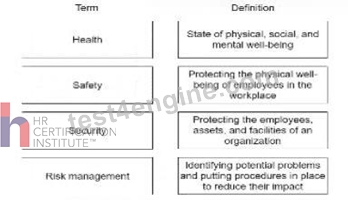
References:
ISO 31000, "Risk Management Guidelines" (2021).
World Health Organization (WHO), "Workplace Health and Well-Being" (2023).
Occupational Safety and Health Administration (OSHA), General Duty Clause (2022).
Society for Human Resource Management (SHRM), "Guide to Workplace Security Practices" (2022).
Chartered Institute of Personnel and Development (CIPD), "Workplace Health and Safety" (2022).
NEW QUESTION # 33
__________ is a data collection method where an HR professional watches and records employee behavior and interactions within the workplace.
- A. Surveys, which involve distributing structured questions to employees
- B. Employee suggestion boxes, where staff can submit ideas and concerns
- C. Focus groups, where small groups discuss specific topics guided by a moderator
- D. Observation, where HR professionals watch and document workplace interactions
Answer: D
Explanation:
Observation involves watching and documenting workplace interactions. This method allows HR to see firsthand how employees behave and interact, providing valuable insights into the work environment and team dynamics.
NEW QUESTION # 34
Which of the following parties is responsible for scheduling health and safety training in an organization?
- A. Regulatory body
- B. Safety consultant
- C. Employer
- D. Independent auditor
Answer: C
Explanation:
* Employer Responsibility in Health and Safety Training:Employers have a legal and ethical duty to ensure the health and safety of their employees. This includes scheduling, organizing, and funding health and safety training programs as part of their obligations under various workplace safety laws and regulations globally.
* Global Legal Frameworks and Obligations:
* Occupational Safety and Health Administration (OSHA) - United States:The employer is required to provide health and safety training under OSHA's General Duty Clause (Section 5(a) (1)). This mandates employers to furnish a workplace free from recognized hazards and to provide adequate training on safety procedures.
* Health and Safety at Work Act (1974) - United Kingdom:Employers must ensure that their employees receive training and supervision to perform their work safely (Section 2). This explicitly puts the responsibility for scheduling and managing training on employers.
* International Labour Organization (ILO) Standards:The ILO's Occupational Safety and Health Convention, 1981 (No. 155) emphasizes that employers are responsible for organizing ongoing training to ensure a safe working environment.
* Role of Other Parties:
* B. Regulatory Body:Regulatory bodies (e.g., OSHA, HSE) provide guidelines, compliance standards, and sometimes offer resources or inspections, but they do not schedule training for organizations. Their role is supervisory and advisory.
* C. Safety Consultant:Safety consultants may assist in designing or delivering training programs, but they act as external advisors. The responsibility for scheduling rests with the employer.
* D. Independent Auditor:Independent auditors evaluate compliance with safety standards and may recommend training. However, they are not involved in planning or scheduling training programs.
* Best Practices for Employers:Employers must:
* Conduct a needs analysis to identify specific training requirements based on industry risks.
* Develop a training calendar and ensure sessions are scheduled for all employees, including new hires and those requiring refresher training.
* Keep documentation of training provided to comply with legal requirements and audits.
* Occupational Safety and Health Administration (OSHA), United States: OSHA Training Requirements
* Health and Safety Executive (HSE), United Kingdom: HSE Legal Duties
* International Labour Organization (ILO): ILO C155 - Occupational Safety and Health Convention
* Canadian Centre for Occupational Health and Safety (CCOHS): Employer Responsibilities in Training References:==========
NEW QUESTION # 35
What is a crucial step in risk mitigation to maintain a safe working environment?
- A. Increasing productivity
- B. Implementing safety procedures
- C. Employee surveys
- D. Enhancing customer service
Answer: B
Explanation:
Implementing safety procedures is a crucial step in risk mitigation. Establishing clear and effective safety protocols helps prevent accidents and ensures that employees understand how to maintain a safe working environment.
NEW QUESTION # 36
Maria is responsible for processing HR forms in her company. What should she prioritize to ensure efficiency and compliance?
- A. Develop a systematic filing process
- B. Monitor employee productivity
- C. Schedule regular training sessions
- D. Establish clear communication
Answer: A
Explanation:
Developing a systematic filing process should be Maria's priority to ensure efficiency and compliance. A well-organized filing system allows for easy access to documents and helps maintain order and accuracy in HR records.
NEW QUESTION # 37
What is a key benefit of participating in job fairs as a recruitment method?
- A. Attract passive job seekers
- B. Conduct on-site interviews
- C. Reduce recruitment costs significantly
- D. Access to a large pool of candidates
Answer: D
Explanation:
A key benefit of participating in job fairs is access to a large pool of candidates. Job fairs attract many job seekers, providing recruiters with the opportunity to meet and assess numerous potential employees in one place.
NEW QUESTION # 38
Tom is working with an international team and wants to ensure clear communication. What should he prioritize to avoid misunderstandings?
- A. Intercultural awareness
- B. Body language nuances
- C. Formal language use
- D. Technical jargon use
Answer: A
Explanation:
Prioritizing intercultural awareness is essential when working with an international team to avoid misunderstandings. This involves being mindful of cultural nuances, communication styles, and potential language barriers, ensuring clearer and more effective interactions.
NEW QUESTION # 39
Which of the following is a valid source for salary information?
- A. Published compensation surveys
- B. Employee reported data
- C. Labor statistics pricing
Answer: A
Explanation:
Comprehensive and Detailed in Depth Explanation:
When determining salary information for compensation planning, HR professionals need reliable, objective, and market-based data. Published compensation surveys are a valid and widely accepted source because they provide aggregated, industry-specific data on salary ranges, often collected by reputable third-party organizations (e.g., Mercer, PayScale, or government labor bureaus). These surveys ensure accuracy and compliance with fair pay practices, a key focus in the aPHRi curriculum.
* Option A (Labor statistics pricing): This is not a standard term in HR. While labor statistics (e.g., from the U.S. Bureau of Labor Statistics) can provide salary data, "labor statistics pricing" is not a recognized source, making this option incorrect.
* Option B (Employee reported data): Employee-reported data, such as self-reported salaries on platforms like Glassdoor, can be unreliable due to bias, small sample sizes, or lack of verification, making it less valid for formal compensation planning.
Reference: aPHRi knowledge domain - Compensation and Benefits: Sources of salary data for market benchmarking, including compensation surveys.===========
NEW QUESTION # 40
An international corporation aims to enhance its training programs by incorporating more classroom sessions. Describe the steps an HR manager should take to determine the feasibility and impact of this change.
- A. Use feedback from past training sessions exclusively.
- B. Hire external trainers for specialized sessions.
- C. Invest in state-of-the-art training facilities.
- D. Conduct a needs analysis and feasibility study.
Answer: D
Explanation:
Conducting a needs analysis and feasibility study helps the HR manager determine whether incorporating more classroom sessions is practical and beneficial, considering factors such as costs, resources, and potential impact on learning outcomes.
NEW QUESTION # 41
The most common way to source passive job candidates is to use:
- A. Radio advertisement
- B. A jon fair
- C. An internal posting
- D. Professional associations.
Answer: D
Explanation:
Professional associations are one of the most common ways to source passive job candidates, as they often house directories, forums, and networking opportunities for experienced professionals who are not actively seeking jobs but are open to discussions.
* Why Professional Associations (A) is Correct:
* Professional associations are one of the most effective ways to source passive candidates, as they are typically composed of individuals who are already employed and engaged in their respective industries or professions. These associations provide networking opportunities, industry events, and specialized job boards where recruiters can identify and connect with high-caliber talent who may not be actively looking for new roles.
Reference: According to SHRM's "Guide to Passive Candidate Recruitment" (2022), professional associations are cited as a leading source for engaging passive talent.
Why Not Job Fair (B):
Job fairs primarily target active job seekers, such as recent graduates or individuals actively looking for new opportunities. Passive candidates typically do not attend job fairs.
Reference: CIPD, "Recruitment Strategies for Active vs Passive Talent" (2023).
Why Not Internal Posting (C):
Internal postings are aimed at existing employees within the organization, not passive candidates who are external to the company. While useful for internal mobility, they do not address external talent sourcing.
Reference: Harvard Business Review, "Internal vs External Recruitment" (2021).
Why Not Radio Advertisement (D):
Radio advertisements are generally broad and target a mass audience, making them less effective for reaching the skilled and selective passive job candidate pool.
Reference: SHRM, "Effectiveness of Recruitment Media Channels" (2022).
Final Justification:
Professional associations are a targeted and industry-specific method for sourcing passive candidates, making them the most effective option in this scenario.
References:
Society for Human Resource Management (SHRM), "Guide to Passive Candidate Recruitment" (2022).
Chartered Institute of Personnel and Development (CIPD), "Recruitment Strategies for Active vs Passive Talent" (2023).
Harvard Business Review, "Internal vs External Recruitment" (2021).
SHRM, "Effectiveness of Recruitment Media Channels" (2022).
WorldatWork, "Best Practices in Talent Sourcing" (2021).
NEW QUESTION # 42
Which of the following encourages employees to use their benefits?
- A. Offering a session with an insurance provider
- B. Scheduling a team-building session
- C. Ensuring payroll is processed on time
- D. Publishing profit-sharing information
Answer: A
Explanation:
Comprehensive and Detailed in Depth Explanation:
Encouraging employees to use their benefits involves educating them about available offerings and how to access them. Offering a session with an insurance provider directly informs employees about their benefits (e.
g., health insurance) and encourages utilization by clarifying coverage and processes.
* Option A (Scheduling a team-building session): This fosters collaboration but does not directly encourage benefit use.
* Option B (Publishing profit-sharing information): This relates to compensation, not benefits like insurance or leave.
* Option C (Ensuring payroll is processed on time): This ensures timely payment, not benefit utilization.
Reference: aPHRi knowledge domain - Compensation and Benefits: Promoting employee engagement with benefits programs.===========
NEW QUESTION # 43
A primary purpose of internet policies is to:
- A. Ensure the employees have secure access
- B. Protect information shared within and outside of the organization
- C. Reduce frequency of communication in the organization
- D. Create a structure for disciplinary procedures
Answer: B
Explanation:
Comprehensive and Detailed in Depth Explanation:
Internet policies outline acceptable use of the organization's internet resources, including email, browsing, and file sharing. A primary purpose is to protect information shared within and outside the organization by preventing data breaches, ensuring confidentiality, and mitigating risks like malware or unauthorized disclosures.
* Option A (Ensure the employees have secure access):While secure access is important, it is a technical aspect, not the primary purpose of the policy.
* Option B (Reduce frequency of communication in the organization):Internet policies do not aim to reduce communication; they regulate it.
* Option C (Create a structure for disciplinary procedures):This is a secondary outcome, not the primary purpose.
NEW QUESTION # 44
Match the job analysis method to the correct description.
Answer:
Explanation: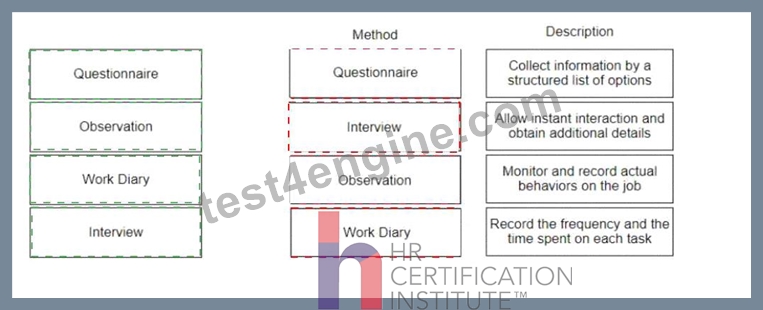
Explanation:
Here is the correct matching for each job analysis method with its corresponding description:
* Questionnaire # Collect information by a structured list of options
* Observation # Monitor and record actual behaviors on the job
* Work Diary # Record the frequency and the time spent on each task
* Interview # Allow instant interaction and obtain additional details
Step-by-Step Explanation
* Questionnaire: A questionnaire is a structured method where employees provide information by selecting from a list of predefined options. This method is efficient for gathering large amounts of data across multiple employees and job roles.
* Observation: Observation involves directly watching employees as they perform their duties to capture and record their actual behavior on the job. This method is useful for understanding real-time tasks and workflows.
* Work Diary: A work diary requires employees to record their activities, noting the time spent and frequency of each task. This method provides detailed insights into the distribution of work activities and how employees allocate their time.
* Interview: The interview method allows for direct interaction with employees, enabling the interviewer to ask follow-up questions and gather additional details. This method is ideal for gaining in-depth information and clarifying responses.
NEW QUESTION # 45
Medical records are usually kept separate from employee general data for:
- A. Ease of accessibility
- B. Privacy protection
- C. Background checks
- D. Emergency use
Answer: B
Explanation:
Comprehensive and Detailed in Depth Explanation:
Medical records are sensitive and contain personal health information that must be protected under privacy laws (e.g., HIPAA in the U.S., GDPR in the EU). Keeping them separate from general employee data ensures privacy protection, limiting access to authorized personnel only and reducing the risk of unauthorized disclosure.
* Option A (Emergency use):While medical records may be used in emergencies, this is not the primary reason for separation.
* Option B (Privacy protection):Correct, as it ensures compliance with privacy laws.
* Option C (Background checks):Medical records are not typically part of background checks.
NEW QUESTION # 46
Match the job analysis method to the correct description.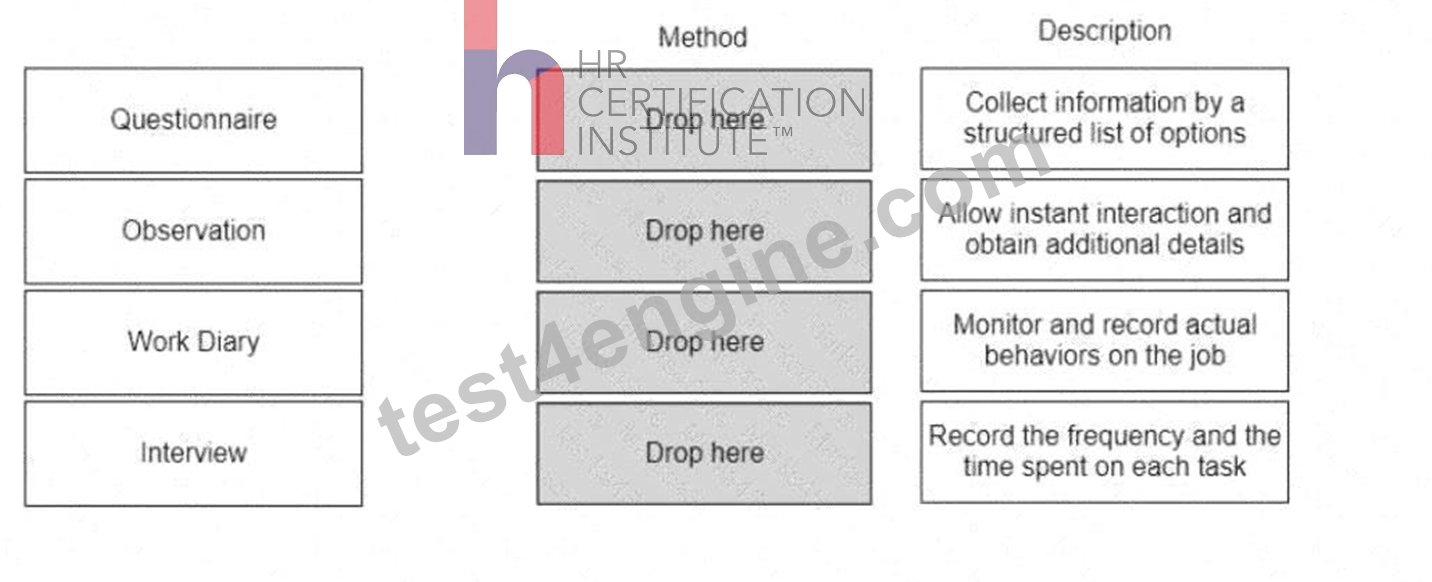
Answer:
Explanation:
Explanation:
Here is the correct matching for each job analysis method with its corresponding description:
* Questionnaire# Collect information by a structured list of options
* Observation# Monitor and record actual behaviors on the job
* Work Diary# Record the frequency and the time spent on each task
* Interview# Allow instant interaction and obtain additional details
Step-by-Step Explanation
* Questionnaire: A questionnaire is a structured method where employees provide information by selecting from a list of predefined options. This method is efficient for gathering large amounts of data across multiple employees and job roles.
* Observation: Observation involves directly watching employees as they perform their duties to capture and record their actual behavior on the job. This method is useful for understanding real-time tasks and workflows.
* Work Diary: A work diary requires employees to record their activities, noting the time spent and frequency of each task. This method provides detailed insights into the distribution of work activities and how employees allocate their time.
* Interview: The interview method allows for direct interaction with employees, enabling the interviewer to ask follow-up questions and gather additional details. This method is ideal for gaining in-depth information and clarifying responses.
NEW QUESTION # 47
Jessica needs to communicate a policy update to the entire company. Which method should she use to ensure everyone receives the information at the same time?
- A. Email communication
- B. Oral communication
- C. Written communication
- D. Visual communication
Answer: A
Explanation:
Email communication is the best method for communicating a policy update to the entire company to ensure everyone receives the information at the same time. It provides a written record and can be easily distributed to all employees simultaneously.
NEW QUESTION # 48
Consider a scenario where an organization is expanding into a new country with different labor laws. What should HR prioritize to ensure smooth integration and compliance?
- A. Creating a global HR handbook
- B. Understanding local labor laws
- C. Focusing on rapid growth strategies
- D. Expanding the workforce rapidly
Answer: B
Explanation:
Understanding local labor laws is crucial when expanding into a new country, as HR needs to ensure that the organization complies with all relevant employment regulations and integrates smoothly into the new legal environment.
NEW QUESTION # 49
Why is clear communication crucial when extending an employment offer?
- A. To expedite the hiring process
- B. To avoid misunderstandings and disputes
- C. To compete with other job offers
- D. To enhance the company's image
Answer: B
Explanation:
Clear communication when extending an employment offer is crucial to avoid misunderstandings and disputes, ensuring both parties are on the same page.
NEW QUESTION # 50
......
HRCI aPHRi (Associate Professional in Human Resources - International) Certification Exam is a globally recognized certification for individuals who are beginning their career in human resources. Associate Professional in Human Resources - International certification is designed to showcase an individual's knowledge of HR fundamentals and their ability to apply those concepts in a global context.
HRCI aPHRi Certification Exam covers a range of HR topics such as talent acquisition, employee relations, benefits, compensation, and employment law. aPHRi exam is computer-based and consists of 100 multiple-choice questions that must be completed within two hours. aPHRi exam is available in English and is offered at testing centers around the world.
aPHRi Free Certification Exam Material with 179 Q&As : https://www.test4engine.com/aPHRi_exam-latest-braindumps.html
New Version aPHRi Certificate & Helpful Exam Dumps is Online: https://drive.google.com/open?id=1lpEtjM6tOHWFOBZulbP6GaGxS8nKiGqL