


[Apr-2026] Get 100% Real Free CIPS Level 5 Advanced Diploma in Procurement and Supply L5M9 Sample Questions
Accurate L5M9 Questions with Free and Fast Updates
NEW QUESTION # 40
Below are details of 4 local manufacturing companies. For each company you must decide what the main objective is for the organisation and what layout their manufacturing plant has.
Company 1: This company creates large, delicate products which are hard to move. The main aim of the company is to stand out from competitors due to the superior level of materials used and by using the latest forms of technology to create the items.
Company 2: This company produces 72 different items and has designated zones within its premises for the creation of each item. The zones are organised based on the technology used and some products may be passed between different zones to be completed. The company creates many different items in response to changing customer demands, with many product lines only lasting a single season.
Company 3: Company 3 creates one product which flows along a single production line, with staff members adding to the product on four different occasions. The company must produce a high volume of this singular product in order to break even. Therefore, there is always a steady flow of items through the plant and it is important there is no stoppage in production.
Company 4: This company produces small batches of products, as and when they are ordered by customers. Due to uncertainty in demand, a high profit margin is added to the cost of each item. Teams in the factory are grouped into different areas depending on the technological process they are using.
Complete the table below by listing the objective criteria and plant layout for each company. Each response should only be used once: flexibility, speed, quality, cost, functional layout, cell layout, product layout, fixed-position layout
Which of the following will you put into box 6?
- A. functional layout
- B. cell layout
- C. fixed-position layout
- D. product layout
Answer: B
Explanation:
The correct answers are as follows:
NEW QUESTION # 41
When conducting a Failure Mode and Effective Analysis (FMEA) which system could be used to show risks to a business's operations? Select TWO
- A. RAG System
- B. ABC Analysis
- C. Scale 1-10
- D. Colour Code
Answer: A,C
Explanation:
an FMEA is very similar to a risk assessment- it looks at potential failures and the likelihood and severity that these have on an organisation. In order to figure out which failures would have the biggest impact on a business, you'd give the failure a score for likelihood and a score for severity. This would be on a scale 1-10. You can then go one step further and use a RAG system (Red Amber Green) to denote which of the failures are severe (Red e.g. scores over 8) and which are not severe (Green e.g. scores under 2). The textbook does mention scales but doesn't mention the RAG system. However RAG is mentioned in other modules and should be a concept you're familiar with. The other two answers are clearly wrong- ABC Analysis is about categorising inventory and colour coding is not a recognised system and would be different for each organisation. P.99
NEW QUESTION # 42
Below are details of 4 local manufacturing companies. For each company you must decide what the main objective is for the organisation and what layout their manufacturing plant has.
Company 1: This company creates large, delicate products which are hard to move. The main aim of the company is to stand out from competitors due to the superior level of materials used and by using the latest forms of technology to create the items.
Company 2: This company produces 72 different items and has designated zones within its premises for the creation of each item. The zones are organised based on the technology used and some products may be passed between different zones to be completed. The company creates many different items in response to changing customer demands, with many product lines only lasting a single season.
Company 3: Company 3 creates one product which flows along a single production line, with staff members adding to the product on four different occasions. The company must produce a high volume of this singular product in order to break even. Therefore, there is always a steady flow of items through the plant and it is important there is no stoppage in production.
Company 4: This company produces small batches of products, as and when they are ordered by customers. Due to uncertainty in demand, a high profit margin is added to the cost of each item. Teams in the factory are grouped into different areas depending on the technological process they are using.
Complete the table below by listing the objective criteria and plant layout for each company. Each response should only be used once: flexibility, speed, quality, cost, functional layout, cell layout, product layout, fixed-position layout
Which of the following will you put into box 2?
- A. quality
- B. cost
- C. speed
- D. flexibility
Answer: D
Explanation:
The correct answers are as follows:
NEW QUESTION # 43
One of the main differences between Business Process Re-Engineering and Kaizen is that Kaizen is more expensive, is this true?
- A. no- Business Process Re-engineering is a slow process that involves all members of the team
- B. no- Business Process Re-Engineering is usually more expensive as a Consultant is often hired
- C. yes- Kaizen involves changing an entire process
- D. yes- Kaizen uses a cross-functional team to implement
Answer: B
Explanation:
Firstly, the sentence is False- BPR is more expensive than Kaizen- so discount options 1 and 2. Between 3 and 4, 4 is incorrect as BPR is quick and doesn't involve everyone. Kaizen is slow and involves everyone. Differences between BPR and Kaizen are on p.90 of the study guide.
NEW QUESTION # 44
Where a company produces many different but similar products, what is this dimension known as?
- A. low variety
- B. high variety
- C. low variation
- D. high variation
Answer: B
Explanation:
This is high variety. Variation is about fluctuations in demand. See p.49
NEW QUESTION # 45
Below are details of 4 local manufacturing companies. For each company you must decide what the main objective is for the organisation and what layout their manufacturing plant has.
Company 1: This company creates large, delicate products which are hard to move. The main aim of the company is to stand out from competitors due to the superior level of materials used and by using the latest forms of technology to create the items.
Company 2: This company produces 72 different items and has designated zones within its premises for the creation of each item. The zones are organised based on the technology used and some products may be passed between different zones to be completed. The company creates many different items in response to changing customer demands, with many product lines only lasting a single season.
Company 3: Company 3 creates one product which flows along a single production line, with staff members adding to the product on four different occasions. The company must produce a high volume of this singular product in order to break even. Therefore, there is always a steady flow of items through the plant and it is important there is no stoppage in production.
Company 4: This company produces small batches of products, as and when they are ordered by customers. Due to uncertainty in demand, a high profit margin is added to the cost of each item. Teams in the factory are grouped into different areas depending on the technological process they are using.
Complete the table below by listing the objective criteria and plant layout for each company. Each response should only be used once: flexibility, speed, quality, cost, functional layout, cell layout, product layout, fixed-position layout
Which of the following will you put into box 7?
- A. product layout
- B. functional layout
- C. cell layout
- D. fixed-position layout
Answer: A
Explanation:
The correct answers are as follows:
NEW QUESTION # 46
Little Joy Ltd is a large company with several functional departments. Below are details of four departments. For each, you must decide which functional area of the business the department is, as well as the SERVQUAL Gap that each Department Lead is concerned with.
Department 1: This department is concerned with the creation of products. The products are created in line with BS EN 716-1 and undergo vigorous tests before they leave the factory. Many customers are unaware of the additional costs of testing to BS EN 716-1 and complain about the price of this product line.
Department 2: Other departments of the business are internal customers of this functional area and approach the Department Lead when they require something to be bought. Often the internal customers have unrealistic expectations of the timescales involved in the process and the Department Lead spends a lot of time explaining lead times and logistics.
Department 3: This functional area creates the budgets for the company and emails these to the Department Leads at the beginning of every quarter. Due to the complexity of the documents, other functional areas of the business often don't understand the information provided.
Department 4: This area of the business is concerned with revenue, which has recently slumped. The Department Lead is conducting market surveys to find out the reason for this.
Complete the table below by listing the Functional Area of the business, and the corresponding SERVQUAL Gap. Each response should only be used once: procurement, finance, sales, production, satisfaction gap, delivery gap, standards gap, communication gap.
Which of the following will you put into box 4?
- A. production
- B. procurement
- C. finance
- D. sales
Answer: D
Explanation:
The correct answers are as follows:
NEW QUESTION # 47
Below are details of five companies who operate a Total Quality Management System (TQM). For each company, select the system used and identify which area of the Balanced Scorecard this relates to.
Company 1: The focus of this company is to gather real-time data to assess the quality of products created during the manufacturing process. There are tight budgets and reworking any defects will affect the bottom line.
Company 2: This company is concerned about how their products are received. They have recently completed market research focused on their client's feelings. The objective is now to improve the product's look and performance to meet these expectations.
Company 3: The focus of this company is defining the customer requirements and translating this into a high-quality specification and effective operational process.
Company 4: Within this company there is a group of 6 employees who meet regularly with the objective of reducing issues that arise in the manufacturing of products.
Complete the table below by listing the TQM System used and the relevant Balanced Scorecard criteria for each company. Each response should only be used once: Quality Circle, Statistical Process Control, Kansei Engineering, Quality Function Deployment, Finance Criteria, Business Process Criteria, Learning and Growth Criteria, Customer Criteria.
Which of the following will you put into box 3?
- A. statistical process control
- B. quality function deployment
- C. kansei engineering
- D. quality circle
Answer: B
Explanation:
The correct answers are as follows: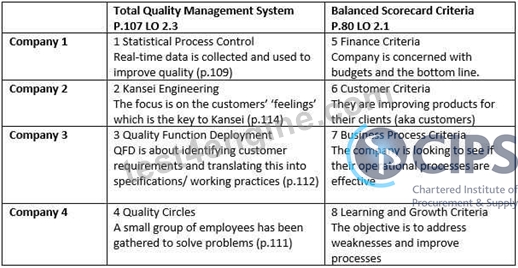
NEW QUESTION # 48
Below are details of five companies who operate a Total Quality Management System (TQM). For each company, select the system used and identify which area of the Balanced Scorecard this relates to.
Company 1: The focus of this company is to gather real-time data to assess the quality of products created during the manufacturing process. There are tight budgets and reworking any defects will affect the bottom line.
Company 2: This company is concerned about how their products are received. They have recently completed market research focused on their client's feelings. The objective is now to improve the product's look and performance to meet these expectations.
Company 3: The focus of this company is defining the customer requirements and translating this into a high-quality specification and effective operational process.
Company 4: Within this company there is a group of 6 employees who meet regularly with the objective of reducing issues that arise in the manufacturing of products.
Complete the table below by listing the TQM System used and the relevant Balanced Scorecard criteria for each company. Each response should only be used once: Quality Circle, Statistical Process Control, Kansei Engineering, Quality Function Deployment, Finance Criteria, Business Process Criteria, Learning and Growth Criteria, Customer Criteria.
Which of the following will you put into box 7?
- A. finance criteria
- B. learning and growth criteria
- C. business process criteria
- D. customer criteria
Answer: C
Explanation:
The correct answers are as follows:
NEW QUESTION # 49
Which of the following is a computer-based programme which determines the amounts of inputs required into a process?
- A. MRP
- B. Kaizen
- C. Work Scheduling
- D. Just in Time
Answer: A
Explanation:
This is MRP. You will likely remember this from Level 4- it comes up again here but there's nothing new that you won't have seen before. P.55
NEW QUESTION # 50
In which industry would scheduling, health and safety and quality control be key focuses of operations processes?
- A. construction
- B. retail
- C. finance
- D. agriculture
Answer: A
Explanation:
The correct response is Construction. Out of those listed, it is the one most concerned with Health and Safety. This is from p.64
NEW QUESTION # 51
Which of the following will increase 'order winning' objectives of a retail organisation?
- A. improved supplier relations
- B. streamlined operations procedures
- C. customer loyalty
- D. increased costs
Answer: C
Explanation:
4 is the correct answer. Here you're looking for the answer which will ensure a customer always picks this business over competitors. Of the four options given, loyalty is the only one that would make sense. Remember 'order winners' are the 'customers' justification for their purchase of a product or service'- this is a direct quote from P.43
NEW QUESTION # 52
Blue Slipper Ltd is a multi-national organisation that produces a variety of cosmetic products. A team has been put together to create a strategy for the Marketing Department in order to increase sales and thus profitability. What level of strategy is being created?
- A. business level strategy
- B. functional level strategy
- C. corporate level strategy
- D. operational level strategy
Answer: B
Explanation:
The correct answer is functional level strategy as Marketing is a function within the business. P.32 discusses the three levels of strategy: corporate (whole organisation), business level (divided by business unit such as lipsticks, mascara etc) and function (divided by department such as marketing, operations and HR). The last option is made up.
NEW QUESTION # 53
When processing low volumes of a product, specialisation is high and it is therefore possible to create products at a lower unit cost. Is this TRUE?
- A. yes- staff gain specialities when there is less products to create
- B. yes- when producing low volumes of a product, cost savings can be transferred to the customer
- C. no- creating products in low volumes often leads to a higher unit cost
- D. no- the volume of products created does not impact upon unit costs as these are fixed in advance
Answer: C
Explanation:
3 is the correct answer. Firstly we look at if the sentence is true or not. It is not- so we can discount options 1 and 2. The study guide states that low volume = less specialisation and higher unit costs. It gives the example of McDonaldsbecause of the high volume of meals they produce, they have Standard Operating Procedures and staff specialising in different areas of the kitchen to ensure efficiency (one person takes the order, another person fries the burger, another makes the drinks). The higher the volume of items produced, the lower the unit cost is. This means that Option 4 is therefore incorrect.
NEW QUESTION # 54
A bread factory is introducing a 'Poka yolk' methodology to reduce defects. What will be the focus of this?
- A. machinery- ensuring there is little to no downtime in machinery use
- B. inputs such as the quality of raw materials
- C. staff- the reduction of human error
- D. outputs- which will be measured against strict criteria
Answer: C
Explanation:
Poka Yolk is about reducing human / user errors. This is from p.134
NEW QUESTION # 55
Bilal is an Operations Manager at an apple pie manufacturer and is currently undertaking an Aggregate Capacity Analysis.
What is the purpose of this?
- A. It will tell Bilal if he has the correct number of apples he needs to produce the desired number of apple pies
- B. It will help Bilal decide if he needs to hire more workers in the short term to ensure the factory produces enough apple pies to meet demand
- C. It will help Bilal assess if he is working within the allocated budget
- D. It will give Bilal an overall evaluation of the company's ability to meet demand fluctuations
Answer: D
Explanation:
Aggregate Capacity Analysis looks as medium-term capacity to see whether supply can match demand. This is from p.23. Aggregate means 'from a group or cluster' and therefore requires quite a few bits of data. For this reason option 1 is incorrect as this describes a very short term look at capacity analysis.
NEW QUESTION # 56
An 'Order Qualifying' Objective contributes to the success of a business in that it is a criteria that will guarantee a customer will purchase an item. Is this sentence TRUE?
- A. yes- these objectives always guarantee a sale
- B. no- this means a customer will buy from the organisation, but not this particular product
- C. no- order qualifying is the process of accepting an order from a client, which may be rejected by the organisation
- D. yes- this means the product is superior to that of competitors
Answer: B
Explanation:
3 is correct- the sentence is false. 'Order Qualifying' is 'not a major factor in determining business success but plays a role in determining whether a customer will consider buying from the business or not'. This is a direct quote from p.43. 'Order Winners' is something that will guarantee a customer buys that product.
NEW QUESTION # 57
Doug's Doughnuts Ltd is a large manufacturer of doughnuts. They produce in excess of 100,000 doughnuts per day which are boxed and sent to supermarkets and other retail outlets for sale. Large pieces of machinery are used to make the doughnuts. Which form of maintenance would be the most appropriate to use at Doug's Doughnuts?
- A. condition based
- B. run to breakdown
- C. preventative
- D. reactive
Answer: C
Explanation:
Preventative maintenance should be used at Doug's Doughnuts. The machines should be serviced regularly to ensure they're working well. A break-down in machinery would stop production, and because Doug's Doughnuts produce so many items per day, this would cause a serious issue for the company. Run to breakdown means you don't repair anything until the item is completely broken. Condition-based maintenance is when maintenance is scheduled when it is required, usually to a schedule. Reactive is when maintenance is conducted when something breaks. See p.103.
NEW QUESTION # 58
......
L5M9 Study Guide Realistic Verified Dumps: https://www.test4engine.com/L5M9_exam-latest-braindumps.html