


Get New 2026 Valid Practice To your L5M9 Exam (Updated 124 Questions)
CIPS Level 5 Advanced Diploma in Procurement and Supply L5M9 Exam Practice Test Questions Dumps Bundle!
NEW QUESTION # 19
Below are details of 4 local manufacturing companies. For each company you must decide what the main objective is for the organisation and what layout their manufacturing plant has.
Company 1: This company creates large, delicate products which are hard to move. The main aim of the company is to stand out from competitors due to the superior level of materials used and by using the latest forms of technology to create the items.
Company 2: This company produces 72 different items and has designated zones within its premises for the creation of each item. The zones are organised based on the technology used and some products may be passed between different zones to be completed. The company creates many different items in response to changing customer demands, with many product lines only lasting a single season.
Company 3: Company 3 creates one product which flows along a single production line, with staff members adding to the product on four different occasions. The company must produce a high volume of this singular product in order to break even. Therefore, there is always a steady flow of items through the plant and it is important there is no stoppage in production.
Company 4: This company produces small batches of products, as and when they are ordered by customers. Due to uncertainty in demand, a high profit margin is added to the cost of each item. Teams in the factory are grouped into different areas depending on the technological process they are using.
Complete the table below by listing the objective criteria and plant layout for each company. Each response should only be used once: flexibility, speed, quality, cost, functional layout, cell layout, product layout, fixed-position layout
Which of the following will you put into box 5?
- A. cell layout
- B. product layout
- C. functional layout
- D. fixed-position layout
Answer: D
Explanation:
The correct answers are as follows:
NEW QUESTION # 20
There are four dimensions of operating processes; volume, variety, variation and visibility. What is meant by variation?
- A. the amount of different uses for the item being produced
- B. the number of different products made
- C. the fluctuation in demand for an item
- D. the number of different customers / markets for the product
Answer: C
Explanation:
The correct answer is 1- fluctuation in demand for an item. E.g. demand for woolly hats has a high variation depending on the time of year. Other products such as bread have a low variation as demand is more constant. Be careful not to confuse variation with variety. Variety is the number of different products made. This is from p.48-49
NEW QUESTION # 21
In the SERVQUAL model how many different types of gaps should be identified by a service provider?
- A. 0
- B. 1
- C. 2
- D. 3
Answer: C
Explanation:
There are 5 gaps in the SERVQUAL model: knowledge, standards, delivery, communication and satisfaction. The gaps measure the 'distance' between what the company provides and what customers expect. See p.56-57.
NEW QUESTION # 22
Below are details of five companies who operate a Total Quality Management System (TQM). For each company, select the system used and identify which area of the Balanced Scorecard this relates to.
Company 1: The focus of this company is to gather real-time data to assess the quality of products created during the manufacturing process. There are tight budgets and reworking any defects will affect the bottom line.
Company 2: This company is concerned about how their products are received. They have recently completed market research focused on their client's feelings. The objective is now to improve the product's look and performance to meet these expectations.
Company 3: The focus of this company is defining the customer requirements and translating this into a high-quality specification and effective operational process.
Company 4: Within this company there is a group of 6 employees who meet regularly with the objective of reducing issues that arise in the manufacturing of products.
Complete the table below by listing the TQM System used and the relevant Balanced Scorecard criteria for each company. Each response should only be used once: Quality Circle, Statistical Process Control, Kansei Engineering, Quality Function Deployment, Finance Criteria, Business Process Criteria, Learning and Growth Criteria, Customer Criteria.
Which of the following will you put into box 1?
- A. quality function deployment
- B. statistical process control
- C. kansei engineering
- D. quality circle
Answer: B
Explanation:
The correct answers are as follows: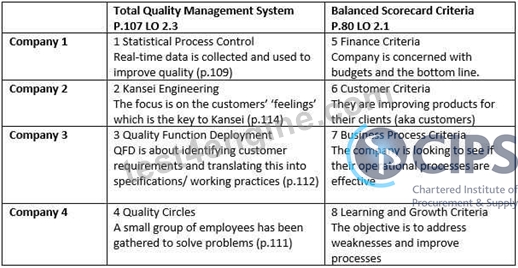
NEW QUESTION # 23
Below are details of 4 local manufacturing companies. For each company you must decide what the main objective is for the organisation and what layout their manufacturing plant has.
Company 1: This company creates large, delicate products which are hard to move. The main aim of the company is to stand out from competitors due to the superior level of materials used and by using the latest forms of technology to create the items.
Company 2: This company produces 72 different items and has designated zones within its premises for the creation of each item. The zones are organised based on the technology used and some products may be passed between different zones to be completed. The company creates many different items in response to changing customer demands, with many product lines only lasting a single season.
Company 3: Company 3 creates one product which flows along a single production line, with staff members adding to the product on four different occasions. The company must produce a high volume of this singular product in order to break even. Therefore, there is always a steady flow of items through the plant and it is important there is no stoppage in production.
Company 4: This company produces small batches of products, as and when they are ordered by customers. Due to uncertainty in demand, a high profit margin is added to the cost of each item. Teams in the factory are grouped into different areas depending on the technological process they are using.
Complete the table below by listing the objective criteria and plant layout for each company. Each response should only be used once: flexibility, speed, quality, cost, functional layout, cell layout, product layout, fixed-position layout
Which of the following will you put into box 2?
- A. flexibility
- B. quality
- C. cost
- D. speed
Answer: A
Explanation:
The correct answers are as follows:
NEW QUESTION # 24
Which of the following are basic performance objectives used for day-to-day operations and ensure staff are working towards tangible achievements? Select TWO
- A. cost
- B. customer satisfaction
- C. operations agility
- D. quality
Answer: A,D
Explanation:
The 5 BASIC performance objectives (according to CIPS) are cost, quality, flexibility, speed and dependability. Customer Satisfaction and Operations Agility are objectives at the strategic level. See p.75
NEW QUESTION # 25
Blue Slipper Ltd is a multi-national organisation that produces a variety of cosmetic products. A team has been put together to create a strategy for the Marketing Department in order to increase sales and thus profitability. What level of strategy is being created?
- A. operational level strategy
- B. corporate level strategy
- C. functional level strategy
- D. business level strategy
Answer: C
Explanation:
The correct answer is functional level strategy as Marketing is a function within the business. P.32 discusses the three levels of strategy: corporate (whole organisation), business level (divided by business unit such as lipsticks, mascara etc) and function (divided by department such as marketing, operations and HR). The last option is made up.
NEW QUESTION # 26
Little Joy Ltd is a large company with several functional departments. Below are details of four departments. For each, you must decide which functional area of the business the department is, as well as the SERVQUAL Gap that each Department Lead is concerned with.
Department 1: This department is concerned with the creation of products. The products are created in line with BS EN 716-1 and undergo vigorous tests before they leave the factory. Many customers are unaware of the additional costs of testing to BS EN 716-1 and complain about the price of this product line.
Department 2: Other departments of the business are internal customers of this functional area and approach the Department Lead when they require something to be bought. Often the internal customers have unrealistic expectations of the timescales involved in the process and the Department Lead spends a lot of time explaining lead times and logistics.
Department 3: This functional area creates the budgets for the company and emails these to the Department Leads at the beginning of every quarter. Due to the complexity of the documents, other functional areas of the business often don't understand the information provided.
Department 4: This area of the business is concerned with revenue, which has recently slumped. The Department Lead is conducting market surveys to find out the reason for this.
Complete the table below by listing the Functional Area of the business, and the corresponding SERVQUAL Gap. Each response should only be used once: procurement, finance, sales, production, satisfaction gap, delivery gap, standards gap, communication gap.
Which of the following will you put into box 8?
- A. delivery gap
- B. standards gap
- C. communication gap
- D. satisfaction gap
Answer: D
Explanation:
The correct answers are as follows:
NEW QUESTION # 27
Which of the following are considered 'transformed resources' and an input into the Operations Process (input- processoutput)?
Select THREE
- A. raw materials
- B. customers
- C. money
- D. employees
- E. information
Answer: A,B,E
Explanation:
Customers, Raw Materials and Information are inputs. This is from p.44-45. Raw materials is the obvious one- it's the input in manufacturing and is transformed into a finished good. Information is an input in the service industry- for example a lawyer or an accountant requires information in order to prepare their case. Customers is the other correct answer and is an input in things like hairdressing (you can't cut hair without a customer's head!). Employees are considered transforming inputs not transformed resources (p.45). Money is also not an input as it isn't converted into an output.
NEW QUESTION # 28
The operating process which ensures projects are completed according to customers' specifications is known as what?
- A. quality control
- B. procurement
- C. process selection
- D. project management
Answer: A
Explanation:
This is quality control. The definition is taken from p.64. It comes under the section on construction, but can be applied to other industries too, particularly manufacturing.
NEW QUESTION # 29
Which of the following items created by an organisation are intangible? Select TWO
- A. A cup of coffee from a restaurant
- B. Legal Advice provided by a solicitor
- C. A massage given at a Spa
- D. A shirt bought at a retail outlet
Answer: B,C
Explanation:
Legal Advice and a massage are intangible. This means you can't physically hold or see the item. There is a lot in this module on the differences between services and goods- it's important to remember that goods are tangible and services are intangible. P.56
NEW QUESTION # 30
When conducting a Failure Mode and Effective Analysis (FMEA) which system could be used to show risks to a business's operations? Select TWO
- A. Colour Code
- B. Scale 1-10
- C. ABC Analysis
- D. RAG System
Answer: B,D
Explanation:
an FMEA is very similar to a risk assessment- it looks at potential failures and the likelihood and severity that these have on an organisation. In order to figure out which failures would have the biggest impact on a business, you'd give the failure a score for likelihood and a score for severity. This would be on a scale 1-10. You can then go one step further and use a RAG system (Red Amber Green) to denote which of the failures are severe (Red e.g. scores over 8) and which are not severe (Green e.g. scores under 2). The textbook does mention scales but doesn't mention the RAG system. However RAG is mentioned in other modules and should be a concept you're familiar with. The other two answers are clearly wrong- ABC Analysis is about categorising inventory and colour coding is not a recognised system and would be different for each organisation. P.99
NEW QUESTION # 31
Sunshine Ltd is a global manufacturer of confectionary with sales of products in over 30 different countries bringing in a revenue of over £5m. Due to different cultures and tastes, they produce similar products for each country market, but tweak the recipe slightly for each customer base. Which type of manufacturing process is used at Sunshine Ltd?
- A. mass production
- B. mass customisation
- C. make to order
- D. customisation
Answer: B
Explanation:
This is mass customisation as the items are produced both in large quantities and are customised for different client bases. See p.53 for more information on different production methods
NEW QUESTION # 32
Managing the supply chain, inventory and the implementation of Lean processes fall under which category of activity of the Operational Process?
- A. directing
- B. delivery
- C. designing
- D. developing
Answer: B
Explanation:
This is delivery as these activity relate to ensuring the goods get to the final customer. See p.51
NEW QUESTION # 33
The methodology for defining customer requirements and creating products that meet those needs is commonly known as which of the following?
- A. business process re-engineering
- B. defining business needs
- C. quality function deployment
- D. value engineering
Answer: C
Explanation:
This is Quality Function Deployment. It's a framework for ensuring that products are designed in line with what customers want/ need. P.112
NEW QUESTION # 34
Which of the following are operations management activities? Select THREE
- A. capacity planning
- B. job design
- C. process selection
- D. development of new products
- E. materials management
Answer: A,C,E
Explanation:
1 2 and 4 are correct. Development of New Products would be the activity of the R&D department, and job design the activity of HR. There is a list of 10 Operations Management activities on p.12
NEW QUESTION # 35
Which of the following do you need to know in order to work out the gross profit margin of an item? Select TWO
- A. sales volume
- B. net profit
- C. costs of goods sold
- D. revenue
Answer: C,D
Explanation:
The formula for working out gross profit is (revenue - cost of goods sold) divided by revenue. Therefore 2 and 3 are correct. It's unlikely you will have to do any mathematical calculations in this exam, but if you do they'll be super easy and there is a calculator inbuilt into the system you can use. There's a couple of different cost formulas on p.78 but these will be familiar to you already from Level 4.
NEW QUESTION # 36
Inventory Management is an important focus of operations within the Construction Industry. Is this TRUE?
- A. no- the construction industry does not require the storage of inventory
- B. yes- this is the most important aspect of managing a construction project
- C. yes- its important that materials are ordered to the correct timescale to ensure the project remains on track
- D. no- inventory management is a key focus in the manufacturing industry only as raw materials are converted into outputs
Answer: C
Explanation:
Firstly the statement is true- inventory management is an important focus in Construction (p.64). Of options 1 and 2, 1 is correct. It is important materials (bricks, windows, electric cables etc) are delivered to site when they are needed and stored correctly to avoid damage. Option 2 is incorrect, although it is important, its not the MOST important aspect of construction.
NEW QUESTION # 37
In order to keep processing costs down, which of the following should a company opt for in terms of operating processes?
- A. high volume, low variety
- B. low volume, high variety
- C. low variation, high visibility
- D. high variation, low visibility
Answer: A
Explanation:
2 is the correct response. This is the only response where both characteristics given keeps costs down. High volume means a lower unit cost and higher profits. Low variety keeps costs down as you don't need to produce many different products. In the other three options high variety, high variation and high visibility all lead to increased costs. P. 50
NEW QUESTION # 38
There are 5 foundational aspects of Total Productive Maintenance. Which of the following do these include? Select THREE
- A. selling
- B. sustaining
- C. sorting
- D. selecting
- E. shining
Answer: B,C,E
Explanation:
The 5S Model is always to do with cleaning and organising. Therefore the correct answers are sorting, sustaining and shining. You may have seen this in other modules and the words might be slightly different, for example sweeping sometimes comes up instead of shining. The reason for the changes is that these are translations from Japanese, and depending on who translated it, the list is sometimes different. They always make the words begin with S though. See p.110
NEW QUESTION # 39
The goal of Operations Management is to create processes which ensure the three Es: Efficiency, Effectiveness and Efficacy. What is meant be Efficacy?
- A. the process meets the intended purpose
- B. the process produces as little waste as possible
- C. the process is optimised
- D. the process is cost-effective
Answer: A
Explanation:
1 is correct, Efficacy means the process meets its intended purpose (i.e. that it produces the intended result/ effect). This is from p.3 of the study guide.
NEW QUESTION # 40
......
Fully Updated Dumps PDF - Latest L5M9 Exam Questions and Answers: https://www.test4engine.com/L5M9_exam-latest-braindumps.html
Updated L5M9 PDF for the L5M9 Tests Free Updated Today: https://drive.google.com/open?id=1psVzOVSNGeA7Y-NuUsq9jbMJh-_K5WR4